Keto Side Effects: Symptoms, Risks, and When to Get Help
Get urgent medical help now
Call emergency services for chest pain, fainting, severe trouble breathing, a seizure, confusion, or difficulty waking. Repeated vomiting, inability to keep fluids down, or very little urine with marked dizziness also needs urgent assessment.
If you have diabetes, nausea, vomiting, abdominal pain, unusual tiredness, deep or labored breathing, or confusion may indicate diabetic ketoacidosis (DKA). This is especially urgent if you take an SGLT2 inhibitor such as empagliflozin, dapagliflozin, or canagliflozin. SGLT2-associated DKA can occur with glucose below 250 mg/dL, so a normal-looking home glucose result does not make those symptoms safe.23
If you use insulin, a sulfonylurea, or another medicine that can cause hypoglycemia, follow your prescribed low-glucose plan. Severe confusion, loss of consciousness, or a seizure is an emergency. Do not reduce or stop insulin to make a diet work.4
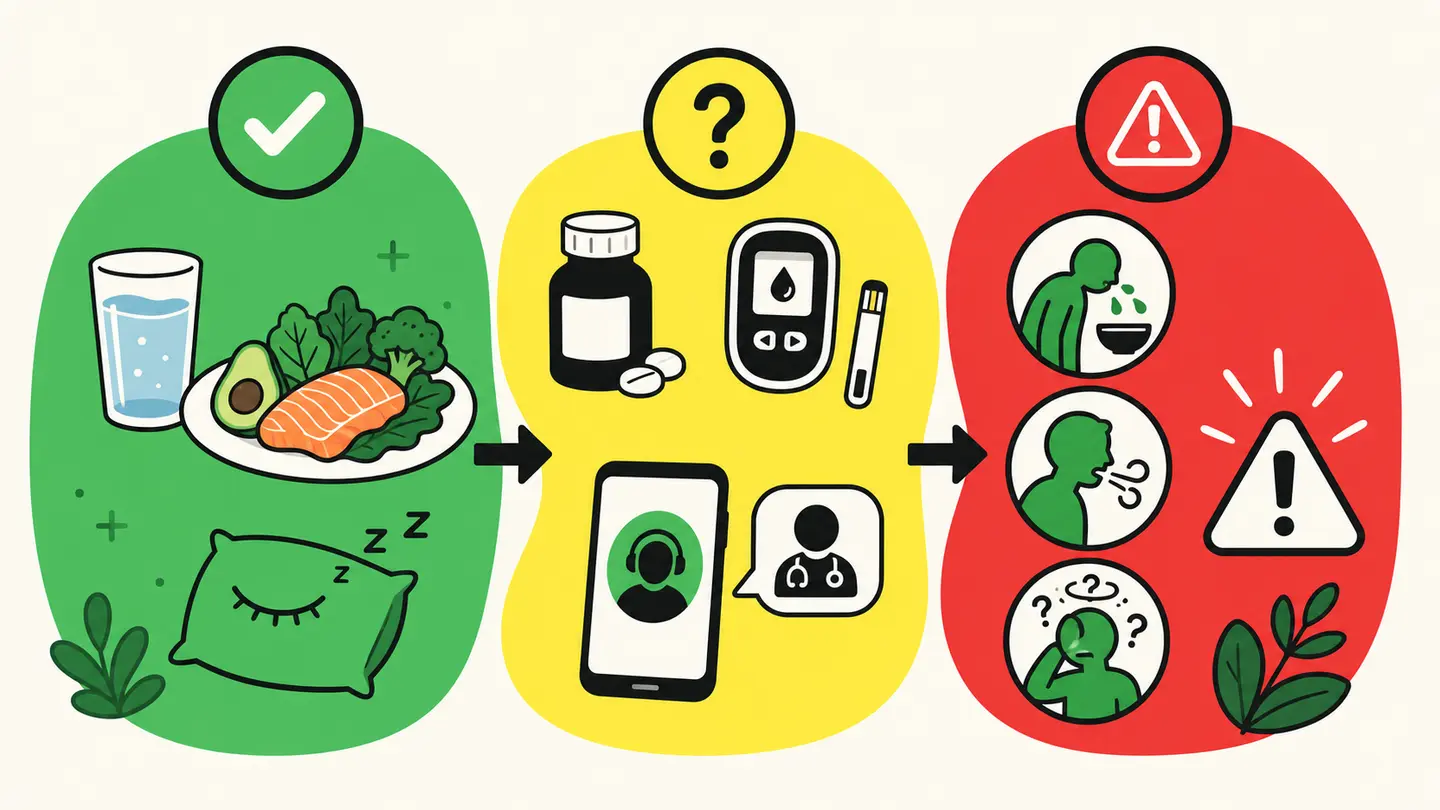
This guide draws on the cited research papers and current official guidance, read directly rather than through promotional summaries.
What people mean by “keto flu”
“Keto flu” is an informal label for symptoms reported after a substantial carbohydrate reduction. It is not a medical diagnosis, and no symptom pattern proves that a person is in ketosis.
In a 2025 scoping review, Oddbjørn Skartun, Callum Rhys Smith, Johnny Laupsa-Borge, and Simon Nitter Dankel found reports of headache, fatigue, dizziness, nausea, vomiting, reduced appetite, constipation, muscle cramps, sleep disturbance, and other symptoms during keto initiation. The studies used different diets, populations, definitions, and reporting methods. Few proposed mechanisms or remedies had been tested directly.1
That uncertainty changes how symptoms should be handled. A headache after cutting carbohydrates may be related to a change in food or fluid intake, but headache also has many unrelated causes. Fatigue cannot identify low sodium, potassium, or magnesium. Nausea can occur during diet transition, with a medicine, during an infection, or with DKA. Timing supplies context; it does not establish a diagnosis.
Use the Keto Flu Symptom Checker to organize timing and severity, then act on warning signs rather than using the result as a diagnosis.
How long do induction symptoms last?
Published reports often place transient symptoms near the start of a ketogenic diet, but the evidence does not establish one dependable onset or end date. The 2025 review found substantial variation and limited direct study of keto induction.1
Do not wait for an assumed adaptation period when symptoms are severe, worsening, or interfering with normal activity. Persistent symptoms deserve assessment for other causes. That is particularly important with diabetes, pregnancy, kidney or heart disease, an eating disorder, recent illness, or medicine that affects glucose, blood pressure, fluid balance, or minerals.
Lower-risk steps for mild, recent symptoms
For an otherwise healthy adult with mild symptoms and no warning signs:
- Pause further restriction. There is no benefit to forcing a sharper carbohydrate cut while feeling unwell. A slower transition may be easier to evaluate.
- Eat regular, adequate meals. An abrupt fall in total food intake can overlap with fatigue, nausea, and poor exercise tolerance.
- Use ordinary hydration. Drink to normal thirst unless a clinician has prescribed a fluid target. Do not force large volumes of water.
- Favor food over symptom-based supplements. Include varied whole foods that fit the eating pattern. A symptom list cannot tell you which electrolyte is low or what dose would be safe.
- Reduce strenuous activity temporarily. A large diet change can make training feel different, especially before food intake and recovery are stable.
- Reassess promptly. Stop self-management and seek care if symptoms intensify, persist, or new warning signs appear.
The induction review found a physiological rationale for several proposed remedies, including electrolyte supplementation, but little clinical evidence testing their effectiveness.1 That is not a basis for a universal salt, potassium, or magnesium protocol. Supplemental potassium can be dangerous with kidney disease and some medicines; fluid and sodium advice can also be unsafe in heart, kidney, or blood-pressure conditions.
Medication and diabetes risks come first
Carbohydrate reduction can change glucose quickly enough that diabetes treatment may need adjustment. The 2026 American Diabetes Association (ADA) Standards advise consistent medical oversight for very-low-carbohydrate plans because insulin and other medicines may need changes to prevent hypoglycemia. The ADA also advises avoiding very-low-carbohydrate eating patterns with SGLT2 inhibitors because of ketoacidosis risk.4
The international hyperglycemic-crisis consensus led by endocrinologist Guillermo Umpierrez explains that DKA requires biochemical assessment of ketones and acidosis. A home glucose or ketone reading cannot measure every diagnostic component or rule the condition out.2 Read ketosis versus ketoacidosis for the distinction, but seek care first if symptoms suggest an emergency.
The FDA tells people taking an SGLT2 inhibitor to stop the medicine and seek immediate medical attention if possible ketoacidosis symptoms occur. The agency lists nausea, vomiting, abdominal pain, unusual tiredness, and trouble breathing, and warns that glucose may be below the level usually expected in DKA.3 A prescriber should provide an individualized plan before a major carbohydrate reduction, illness, surgery, or fasting.
Digestive changes
Constipation, diarrhea, nausea, and vomiting appear in keto-induction reports, but their frequency and cause vary.1 A menu that removes fruit, legumes, whole grains, and many vegetables without replacing their fiber is more likely to be nutritionally narrow.
For mild constipation, review the whole plan before buying a supplement:
- include tolerable lower-carbohydrate vegetables, nuts, seeds, and avocado;
- increase fiber gradually rather than making a sudden large change;
- drink normally and move regularly if medically appropriate;
- check whether a medicine or supplement may be contributing.
Severe abdominal pain, persistent vomiting, a swollen abdomen, blood in the stool, black stool, fever, or inability to pass stool or gas needs medical assessment. Ongoing diarrhea can cause dehydration and should not be dismissed as adaptation.
Muscle cramps, dizziness, and palpitations
Cramps and dizziness can occur with changes in food intake, exercise, sleep, glucose, blood pressure, fluid balance, or medicine. They do not identify an electrolyte deficiency.
A new fast, pounding, or irregular heartbeat warrants same-day medical advice. Use emergency services when it occurs with chest pain, fainting, severe shortness of breath, confusion, or weakness. Do not delay assessment to test whether salt, water, potassium, or magnesium changes the symptom.
Lipids can improve in one direction and worsen in another
A ketogenic diet does not produce one uniform lipid response. Juanjuan Zhao and colleagues' 2026 meta-analysis of 53 randomized trials found lower triglycerides and higher HDL cholesterol on average, alongside higher LDL cholesterol and total cholesterol. Heterogeneity was substantial, and certainty for the LDL result was rated low.5
Individual increases can be much larger than the average. In a randomized crossover feeding trial led by Jonas Burén, a four-week ketogenic low-carbohydrate, high-fat diet increased LDL cholesterol in all 17 women who completed both phases. Apolipoprotein B, small dense LDL, and large buoyant LDL also increased.6 The short study involved healthy, young, normal-weight women and cannot predict every person's response, but it shows why a favorable triglyceride or ketone result does not cancel an LDL or apoB increase.
If you continue the diet, discuss the timing and interpretation of lipid testing with a qualified clinician, especially if you have high baseline LDL, familial hypercholesterolemia, cardiovascular disease, diabetes, or a strong family history. Food choices matter: replacing some butter, coconut fat, fatty processed meat, and cream with olive oil, nuts, seeds, avocado, and fish can reduce reliance on saturated fat.
Do therapeutic ketogenic-diet complications apply to lifestyle keto?
Some of the most detailed adverse-event records come from ketogenic diet therapy for drug-resistant epilepsy. Those protocols may use a prescribed ketogenic ratio, initial fasting, calorie or fluid rules, antiseizure medicines, supplements, laboratory monitoring, and a specialist team.
Hoon Chul Kang and colleagues reviewed 129 patients treated at an epilepsy center. Dehydration was especially common among patients who began with fasting; gastrointestinal effects and several laboratory abnormalities were also reported. Some later complications included kidney stones and bone or cardiac problems.7 In a separate Johns Hopkins cohort of 195 children receiving ketogenic therapy for intractable epilepsy, Amitha Sampath and colleagues reported kidney stones in 13 children.8
These observations matter for clinical protocols, but they are not prevalence estimates for every adult who informally eats low carbohydrate. The patients, diet formulations, medicines, ages, monitoring, and reasons for treatment differ. The correct conclusion is narrower: therapeutic ketogenic diets have known adverse events and require protocol-specific screening and follow-up. A lifestyle article should not copy a pediatric epilepsy complication rate and present it as a general keto risk.
Education is not diagnosis
- General education
- Personal self-check
- Clinician discussion
- Urgent care if needed
Who should not self-manage a ketogenic diet?
Get individualized guidance before a very-low-carbohydrate diet if you:
- have type 1 diabetes, a history of DKA, or pancreatic disease;
- take insulin, a sulfonylurea, an SGLT2 inhibitor, a diuretic, or medicine affected by a major diet change;
- are pregnant or breastfeeding;
- are a child or adolescent;
- have kidney disease or a prescribed fluid, sodium, potassium, or protein limit;
- have an eating disorder or a history that makes rigid restriction risky;
- are using ketogenic diet therapy for epilepsy or another medical condition.
The ADA does not recommend very-low-carbohydrate plans during pregnancy or lactation, for children, for people with kidney disease, or for people with or at risk for disordered eating.4 See Is Keto Right for You? for a fuller pre-start screen.
What to monitor
A ketone number is not a safety score. Monitoring should follow the goal and the person's risks.
- Note the timing, severity, and persistence of symptoms.
- Check whether the menu supplies enough food, fiber, protein, and micronutrient variety.
- If the goal involves diabetes, use the glucose and medication plan supplied by the treating clinician.
- Ask a clinician whether blood pressure, kidney function, liver tests, uric acid, glucose markers, a lipid panel, or apoB is relevant.
- Stop and reassess if the plan causes persistent illness, an unfavorable laboratory change, recurrent hypoglycemia, distressed or rigid eating, or an inability to meet nutritional needs.
The ketone level interpreter explains what home blood, breath, and urine measurements can and cannot show. It cannot diagnose or exclude DKA.
Works cited
Article history
- Legacy update; details were not recorded
- First published
Your learning guide