The Science of Ketosis: What Happens in the Body
In this article
- Ketosis is a continuum: the liver is making ketone bodies faster than tissues are using them, so their concentration rises.
- Carbohydrate restriction changes the mix of fuels in use. It does not turn glucose metabolism off.
- Blood, urine, and breath tests measure different compounds and are not interchangeable.
- A ketone result does not prove body-fat loss, cognitive improvement, or safety.
- Diabetic ketoacidosis includes metabolic acidosis and can occur without extremely high glucose, especially with an SGLT2 inhibitor.
Ketosis is a metabolic state in which circulating ketone bodies rise because liver production has increased relative to tissue use. The main circulating compounds are acetoacetate and beta-hydroxybutyrate (BHB). Acetone is produced from acetoacetate and is largely exhaled. BHB is conventionally called a ketone body even though, chemically, it is a hydroxy acid.1
The body does not operate a binary glucose-or-fat switch. In ketosis it continues to use glucose and fatty acids alongside ketones, with the proportions changing by tissue, activity, recent food intake, hormonal state, and time. This guide follows the cited papers and current clinical guidance directly; it does not infer health outcomes from biochemical findings alone.
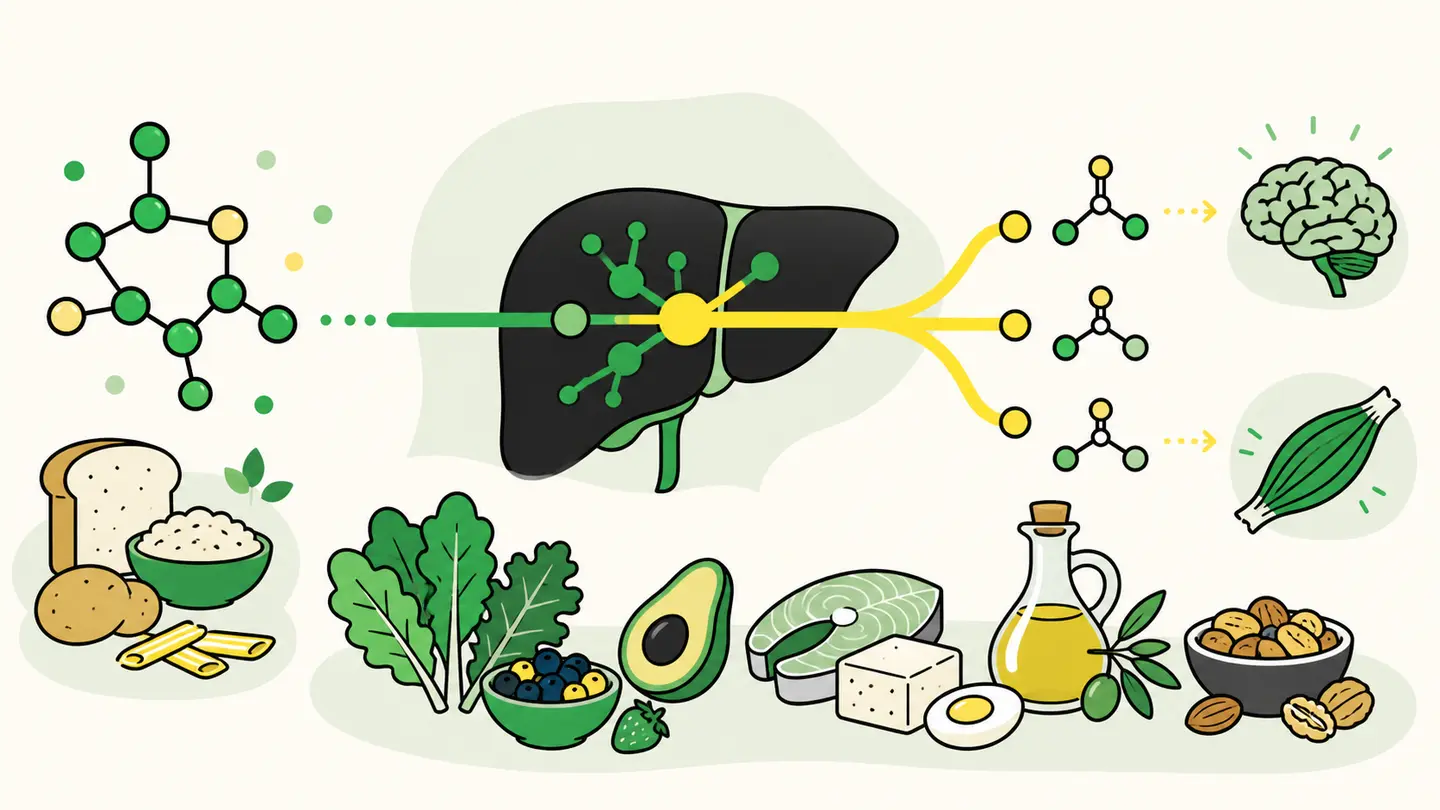
How does the liver make ketones?
The pathway can be understood in five steps.
- Carbohydrate availability and insulin signaling fall. During fasting or substantial carbohydrate restriction, less dietary glucose enters circulation. Insulin generally falls relative to counter-regulatory hormones, reducing insulin's suppression of fat release and liver ketone production.
- Fatty acids reach the liver. Adipose tissue releases fatty acids, and dietary fat can also contribute. Inside liver-cell mitochondria, beta-oxidation converts fatty acids into acetyl-CoA.
- Acetyl-CoA enters ketogenesis. Mitochondrial HMG-CoA synthase 2 (HMGCS2) commits acetyl-CoA to the ketogenesis pathway, which produces acetoacetate.1
- Acetoacetate has two main fates. Much of it is reduced to BHB; a smaller amount spontaneously loses carbon dioxide to form acetone.
- The liver exports acetoacetate and BHB. They circulate to tissues with mitochondria, where they can be converted back to acetyl-CoA and oxidized to make ATP.
The liver produces the bulk of circulating ketones but cannot perform their main terminal oxidation because it lacks the required SCOT enzyme. Red blood cells also cannot oxidize ketones because they have no mitochondria. Other tissues, including muscle, heart, kidney, and brain, can use them to varying degrees.1
Does the brain stop using glucose?
No. Ketones reduce the brain's glucose requirement during prolonged fasting, but they do not eliminate it. Glucose is still required by red blood cells and parts of the brain and kidney. The liver and kidney maintain glucose through gluconeogenesis using substrates such as lactate, glycerol, and amino acids.
A classic 1967 study by Oliver Owen, George Cahill, and colleagues measured cerebral fuel use in three people after five to six weeks of fasting. BHB and acetoacetate had become the brain's predominant measured fuels, while glucose use persisted.2 The study established an important human mechanism, but its extreme fasting context and sample of three should not be treated as a test of an everyday keto diet or cognitive performance.
What triggers ketosis, and how long does it take?
Ketone production can rise during fasting, prolonged exercise, carbohydrate restriction, energy restriction, or insulin deficiency. Exogenous ketone products can also raise measured BHB without requiring the liver to make that BHB. These routes are metabolically different, even if a meter displays a similar number.
There is no universal time-to-ketosis promise or single cutoff that divides everyone into “in” and “out.” Studies and clinics choose thresholds for a particular protocol. Liver glycogen, recent carbohydrate and energy intake, exercise, alcohol, medication, illness, pregnancy, and individual physiology can all change the time course.
The concentration is also dynamic. Production can rise while tissues simultaneously increase ketone uptake. A lower reading can reflect less production, more use, dilution, timing, or measurement error. One isolated value does not explain which process changed.
Why ketosis does not prove body-fat loss
Ketone bodies can be made from fatty acids released from body fat or from fat recently eaten. A meter cannot distinguish those sources. Exogenous BHB can raise a blood reading without either process. Weight and fat change therefore cannot be inferred from ketones alone.
Kevin Hall and colleagues demonstrated the distinction in a controlled metabolic-ward trial. Seventeen men received a high-carbohydrate baseline diet followed by an isocaloric ketogenic diet with protein held constant. Fat oxidation increased and respiratory quotient fell, showing a change in fuel use. The ketogenic phase did not accelerate body-fat loss; during the initial switch, body-fat loss slowed.3
That study was short, involved only men, and did not test an ad-libitum weight-loss program. It still answers a narrow mechanistic question: burning more fat at a given moment is not the same measurement as losing more stored body fat over time.
Do ketones do more than supply energy?
BHB and acetoacetate participate in signaling as well as energy metabolism. Patrycja Puchalska and Peter Crawford summarize work on receptors, protein modifications, redox state, inflammation, and gene regulation.1 Much of that evidence comes from cells, animals, infusion studies, or disease-specific settings.
A plausible pathway is a reason to run a clinical trial. It is not evidence that a ketogenic diet improves memory, treats cancer, prevents inflammation, or extends life in people. A diet changes many variables at once, including foods, energy intake, fatty-acid composition, fiber, body weight, and medication requirements. Human outcomes must be tested directly.
Ketogenic diet therapy for selected drug-resistant epilepsies is a genuine clinical use, but even there, seizure response is not explained by one simple BHB mechanism. International recommendations led by Mackenzie Cervenka and NICE guidance call for a specialist team, nutrition assessment, monitoring, and side-effect management.89
What do ketone tests measure?
| Method | Main compound measured | What the result can tell you | Important limitation |
|---|---|---|---|
| Blood meter | BHB in capillary blood | BHB concentration at that moment | Does not measure blood acidity or prove a benefit |
| Urine strip | Acetoacetate excreted in urine | Whether urine contains acetoacetate over the collection interval | Affected by hydration, timing, renal handling, and adaptation |
| Breath device | Acetone in exhaled air | Device-specific breath acetone estimate | No universal conversion to blood BHB; devices and sampling methods vary |
Blood BHB is the most direct of these home measurements for current circulating BHB. It is still one analyte from one moment. Urine can lag behind changes in blood: during DKA treatment, for example, BHB is converted back to acetoacetate, so urine ketones can appear to rise while the crisis is resolving.4
Urine strips also perform poorly as a yes-or-no screen for mild dietary ketosis. In a study of 50 women during and after a severely energy-restricted diet, urine dipsticks missed many blood-defined ketosis observations, especially at lower BHB thresholds.5 That result should not be generalized beyond the study's setting, but it shows why urine and blood results cannot be treated as equivalent.
Use the ketone level interpreter only to organize a reading with its units, device, symptoms, and risk factors. If you calculate a glucose ketone index, the output is arithmetic, not a diagnosis or a validated wellness grade.
Education is not diagnosis
- General education
- Personal self-check
- Clinician discussion
- Urgent care if needed
Ketosis and diabetic ketoacidosis are not separated by one number
The 2024 international consensus report led by Guillermo Umpierrez defines diabetic ketoacidosis (DKA) using three components together: diabetes or hyperglycemia, elevated ketones, and metabolic acidosis.6 A home meter does not measure all three.
| Question | Dietary or fasting ketosis | Diabetic ketoacidosis |
|---|---|---|
| What drives it? | Reduced carbohydrate or energy availability with enough insulin to regulate ketone production | Absolute or relative insulin deficiency, often with illness, missed insulin, or another precipitating factor |
| What happens to acid-base balance? | The body usually maintains acid-base balance in an otherwise healthy person | Metabolic acidosis develops |
| Must glucose be extremely high? | No | No; DKA can present with lower glucose, particularly with SGLT2 inhibitors |
| What should a person do? | Interpret the result in the context of the diet, goal, symptoms, and medical history | Seek urgent medical assessment |
FDA warnings state that SGLT2-associated ketoacidosis can occur with blood glucose below 250 mg/dL. Symptoms can include nausea, vomiting, abdominal pain, unusual tiredness, and trouble breathing.7 Pregnancy, prolonged fasting, acute illness, heavy alcohol intake, dehydration, and insulin reduction can also change risk.
Seek urgent medical care for possible DKA symptoms, especially if you have diabetes, take an SGLT2 inhibitor, are pregnant, or have elevated ketones. Deep or rapid breathing, confusion, repeated vomiting, abdominal pain, severe weakness, or dehydration are not “keto adaptation” symptoms to manage with salt or a supplement. Do not stop insulin. Do not rely on a normal-looking glucose value or a home ketone interpretation to exclude DKA.
For people with diabetes, the 2026 ADA Standards discourage ketogenic eating for people taking an SGLT2 inhibitor and advise medical oversight for very-low-carbohydrate plans. They do not recommend such plans during pregnancy or lactation, for children, for people with kidney disease, or for those with or at risk for disordered eating.10
What a ketone result can and cannot answer
A ketone test can answer a narrow question: how much of the measured ketone was present in this sample, using this device, at this time. With a defined clinical protocol, it may help assess adherence or identify a safety concern.
It cannot establish that a diet is nutritionally adequate, that body fat is falling, that the brain is working better, or that a disease is improving. Those questions require their own outcomes. Start with Keto Diet 101 for the evidence and practical safeguards, or read potential side effects before deciding whether to restrict carbohydrate.
Works cited
Article history
- Legacy update; details were not recorded
- First published
Your learning guide