Low-Carb Packed Lunches: From Fridge to Office Table
Whether your packed lunch survives the workday starts with what your office actually offers: a fridge to keep perishables cold on arrival, an insulated bag with two cold sources if there's no fridge but you can keep food at 40°F or below until lunch, or shelf-stable food when reliable cold holding isn't available. Figure out which one applies to you, and the rest of the plan falls into place.1
Start with the office equipment check, not the shopping list
Before you buy or make anything, look at what your workplace actually gives you: a refrigerator you can put food into, a microwave, a sink, maybe an ice machine, or none of the above. That inventory decides your options far more than any recipe would — a lunch that works great in an office with a fridge and microwave can be the wrong call at a job site or a shared table with no cold storage at all.
Pick a cold lunch or a reheated one — the rules are different
Two broad paths cover almost every packed lunch: something meant to be eaten cold (a salad, a wrap, sliced meat and cheese), or something meant to be reheated (last night's dinner, a stew, a stir-fry). Decide which one you're packing before you choose containers, because the cold-chain and reheating rules below apply differently to each.
Pack wet and crisp parts in their own containers
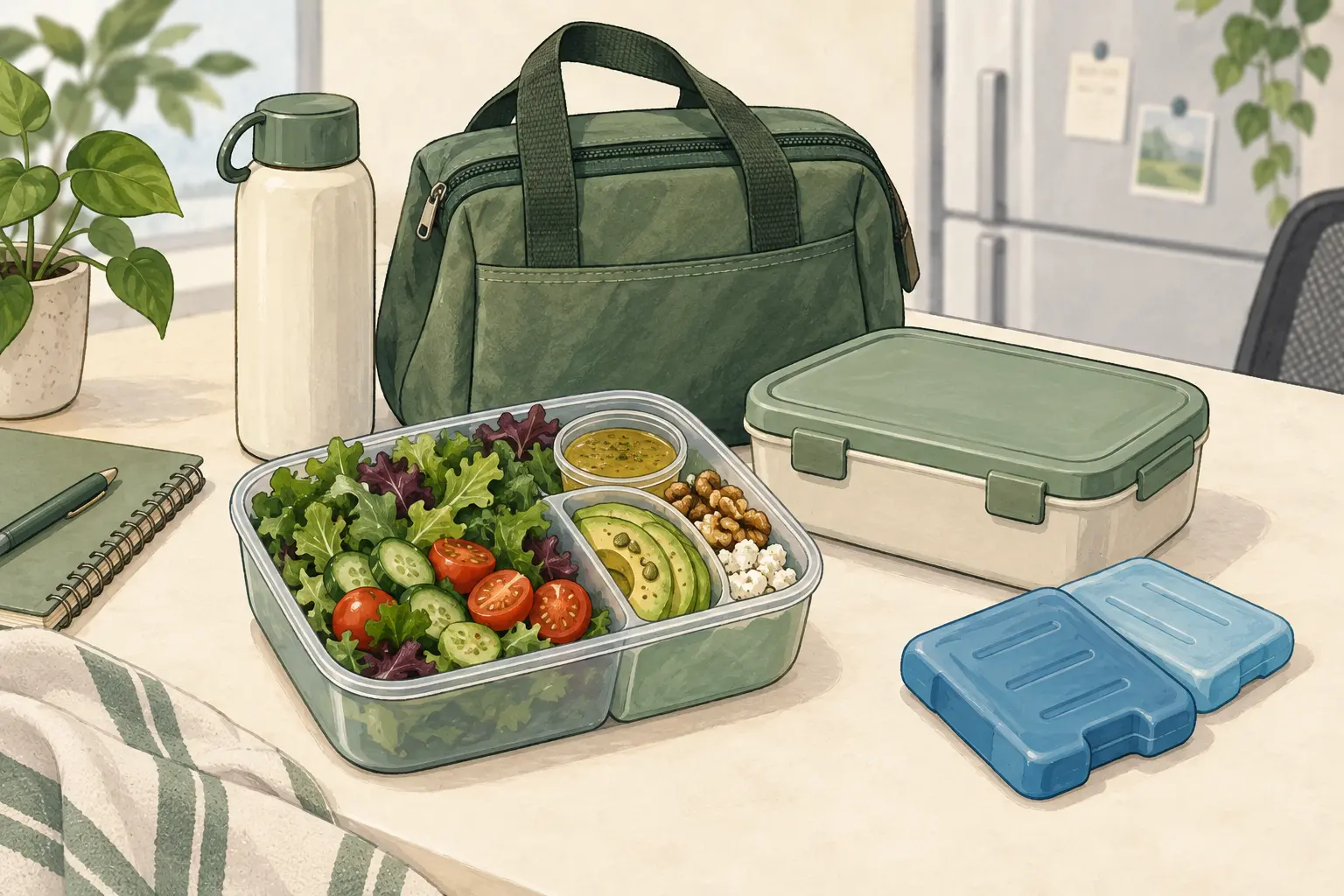
Dressing, sauce, and anything liquid travel best in a small separate container, added right before you eat. The same goes for anything meant to stay crisp — greens, cucumber, nuts — kept apart from anything warm, wet, or acidic until you're ready to combine them at your desk. This is mostly about texture, but it also keeps components physically separate in transit.
The cold chain: fridge → packed travel → office fridge → lunch
Refrigerated ingredients — cooked meat, poultry, eggs, cut vegetables, dairy — need to stay cold for the entire trip, not just when they leave your kitchen. Pack them in an insulated bag with at least two cold sources, and move them into a work refrigerator as soon as you arrive, if one is available 1. An ice pack that still feels cool at lunchtime doesn't tell you the food actually stayed at a safe temperature all morning — it's a reasonable precaution, not proof.
Reheating leftovers without guessing
If today's lunch is last night's dinner, the safety clock started when you cooked it. You don't need to let it cool on the counter first — hot food can go straight into the refrigerator, divided into shallow containers so it chills evenly 2. From there, get it refrigerated within two hours (one hour if the surrounding temperature is above 90°F), keep it at 40°F or below until reheating, and use it within three to four days 3. When you reheat, bring the food to 165°F all the way through. Microwaves heat unevenly, so check more than one spot with a food thermometer — a container that looks steaming on top can still have a cold center 3. None of this applies if you're eating something cold on purpose; the 165°F mark only matters for food you're actively reheating.
Two lunches, worked out from fridge to fork
A cold lunch: components, not a bowl already tossed together
Picture packing a protein you already cooked — shredded chicken, hard-boiled eggs, whatever you have on hand — in its own container, a crisp vegetable mix in another, and a small dressing container on the side. Everything goes into the insulated bag together, then into the office fridge on arrival. At lunchtime, combine them at your desk. This is one way to organize a cold lunch, not a fixed recipe, a nutrition calculation, or a claim about how it fits any particular way of eating.
For a fixed ingredient list, the chicken Cobb salad is an untested editorial formula. Its chicken, eggs, dressing, and cut produce still need the same verified cold handling; the recipe has no travel-tested holding result.
A leftover lunch: last night’s dinner, handled on purpose
Say dinner was a pan of roasted vegetables and a cooked protein. As soon as it's done cooking, portion it into a shallow container or two — hot food can go straight into the refrigerator, no need to let it sit out first 2 — and get it refrigerated within that two-hour window (one hour if the surrounding temperature is above 90°F) 3. In the morning, it goes into the insulated bag with at least two cold sources, then into the work fridge on arrival 1. At lunch, reheat it in the microwave, checking a couple of spots with a thermometer before you eat 3. Again, this is an example of the handling sequence, not a tested dish and not a stand-in for checking your own leftovers.
Reading labels before you share
If you bring extra food to share, or you use communal equipment, check the label on anything packaged before offering it around — the ingredient list matters more than how something looks 4. If a coworker manages a food allergy and has asked you to follow specific precautions, use your own utensils and container rather than shared ones, since food-contact surfaces can carry allergens even after a routine wipe-down 5. Beyond following what someone with an allergy actually asks for, there's no generic packed-lunch habit that manages another person's allergy for them.
When there’s no fridge and no microwave
Some days the honest answer is you have no fridge to land in when you arrive. That doesn't automatically rule out a cold lunch — if your insulated bag with two cold sources is actually keeping things at 40°F or below by the time you eat, a perishable lunch can still work 1. The catch is that you have to know that, not assume it: if you can't check, or you're not confident the bag held up, treat it as unreliable rather than take the risk.
When safe cold holding is unavailable or uncertain, the fallback is food that's genuinely shelf-stable until opened — sealed, unopened, and following its own label's storage directions, not your best guess 6. A cooked egg, leftover chicken, a cut salad, or an opened can of fish or meat is never shelf-stable no matter how it's packed — check the package itself, since some canned goods say "keep refrigerated" even before opening, and once you open something, it needs to follow its own storage directions from there 6. Not everything behaves like those examples: an opened jar of nut butter, for instance, isn't automatically perishable the way a cut salad is — read its label rather than assuming either way 6.
Packing checklist before you walk out the door
- Insulated bag with at least two cold sources for anything perishable 1
- Wet and crisp components in separate containers
- A plan for keeping perishables at 40°F or below — a work fridge, or a verified insulated bag — with a genuinely shelf-stable backup if you can't confirm that 16
- Your own utensils and container if a coworker's allergy plan calls for it 4
- A food thermometer nearby if today's lunch needs reheating to 165°F 3
Sources
Article history
- First published
Your learning guide