Keto Grocery Shopping List: A Practical, Label-Literate Guide
Buy for meals, not for a slogan. Choose the protein, vegetables, and mostly unsaturated fats needed for the meals you will actually prepare. Use the regulated nutrition panel for packaged food.
No premium label is required. Organic produce, grass-fed meat, pasture-raised eggs, and wild-caught fish can be personal preferences. They are not requirements for ketosis, food safety, or a useful grocery list.
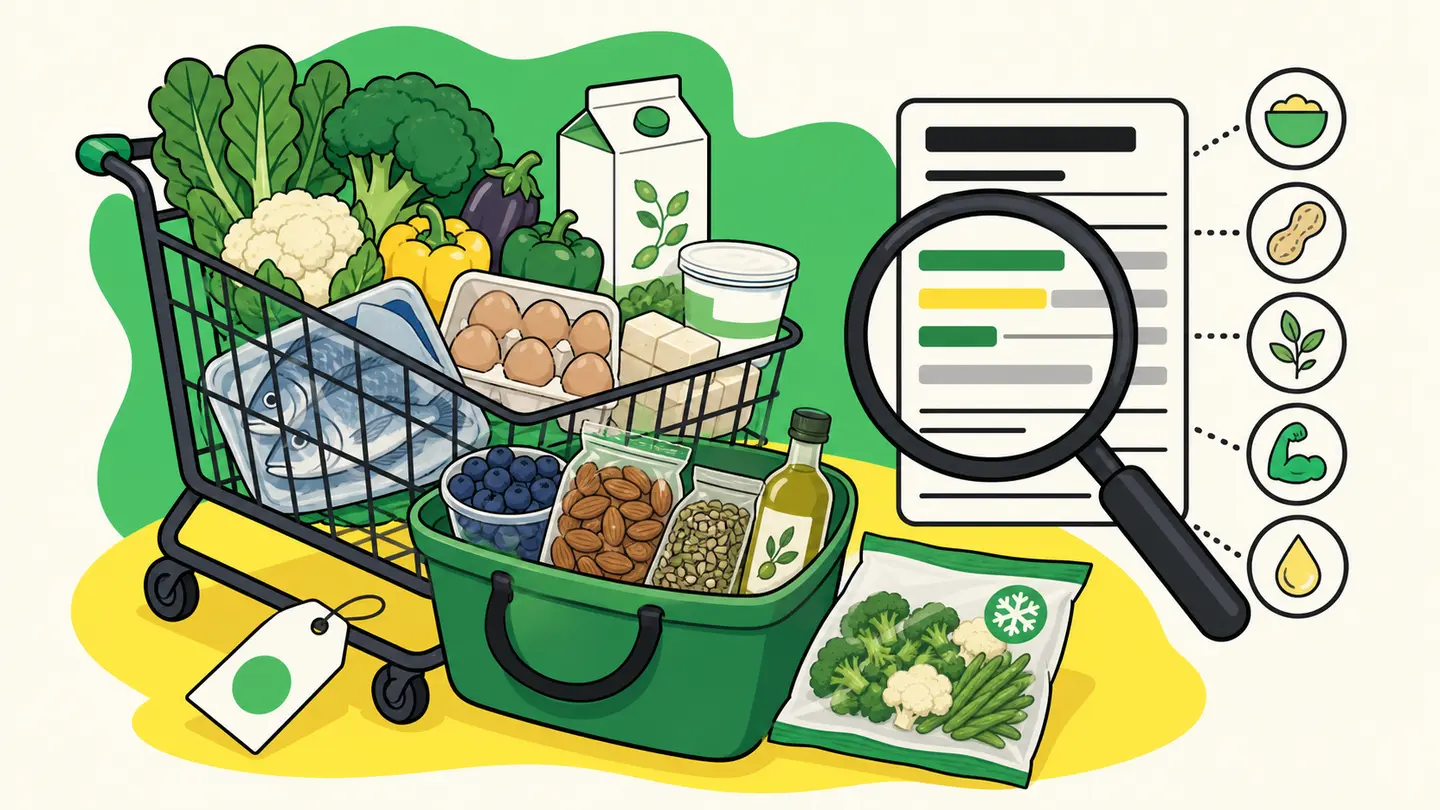
This shopping guide is based on current government food-composition and labeling sources, original regulations, and scientific nutrition guidance. It does not prescribe a carbohydrate target. A clinician-directed ketogenic therapy, diabetes care plan, pregnancy, kidney disease, food allergy, or eating-disorder history requires a different level of assessment. Start with the keto suitability guide if any of those situations apply.
Free printable
45-Item Keto Starter Shopping List
A reusable inventory with quantity blanks; cross out anything that does not fit your meals, budget, allergies, culture, or care plan.
PDF · 2 pages · Letter portrait
The printable is a starting inventory. Any production descriptor in it, such as pasture-raised or wild-caught, is optional. Its foods and the preloaded items in the interactive shopping-list tool are prompts, not endorsements or current nutrition data. The exact package and serving still control.
Compare label systems carefully
- US label
- Declared total carbohydrate
- EU / UK label
- Use the package in hand
Plan meals before aisles
A long list can produce an expensive refrigerator full of ingredients that do not make a meal. Use this sequence instead:
- Mark the meals that will be eaten at home. Include packed lunches, restaurant meals, leftovers, and days with little cooking time.
- Choose familiar meal structures. Record the protein, non-starchy vegetables, cooking fat or sauce, and any measured carbohydrate-containing side for each meal. The meal-planning guide provides a reusable method.
- Check what is already available. Review the refrigerator, freezer, and pantry before adding duplicates.
- Write quantities from recipes and household use. A universal number of eggs, avocados, or liters of water will either waste food or leave a household short.
- Add one realistic backup meal. Frozen vegetables with eggs or tofu, canned fish with salad vegetables, or another locally familiar combination may prevent an unplanned order. Choose a backup that fits the household rather than buying a branded “keto meal.”
If a sample menu is useful, adapt the 7-day keto meal plan instead of copying its portions without checking your needs.
A reusable cart framework
You do not need every item in every row. Choose enough to complete the meals on the plan and to replace what the household has used.
| Cart section | Foods that may fit | Decision to make before buying |
|---|---|---|
| Fresh, frozen, or canned vegetables | Leafy greens, cabbage, broccoli, cauliflower, peppers, mushrooms, courgette or zucchini, aubergine or eggplant, okra, green beans, cucumber, tomatoes | Which meals use each item? Is sauce, syrup, breading, or starch added? Will fresh produce be used before it spoils? |
| Animal protein, if used | Fish and shellfish, eggs, poultry, and meat, plain yogurt, cottage cheese | Is it breaded, sweetened, heavily processed, or high in saturated fat or sodium? Is there freezer space for what will not be cooked soon? |
| Vegetarian protein | Tofu, tempeh, unsweetened soy foods, eggs and dairy if included, nuts, seeds, seitan if gluten is suitable | How much protein and carbohydrate does the planned serving provide? Does it contain soy, wheat, milk, egg, nut, or sesame allergens? |
| Mostly unsaturated fats | Olive, canola, soybean, sunflower, safflower, peanut, or avocado oil; nuts, seeds, olives, avocado, and fish | Which current saturated-fat source will this replace? Does the household already have an open container? |
| Dairy or alternatives, if used | Plain yogurt, cottage cheese, cheese, and unsweetened fortified plant alternatives | Check lactose or total carbohydrate, added sugar, saturated fat, calcium and vitamin D, and allergens. Full-fat is optional. |
| Pantry and flavor | Herbs, spices, vinegar, mustard, stocks, canned fish, nut or seed butter, tomato products, unsweetened cocoa | Check serving size, starch, added sugar, sodium, and allergens. Do not assume a sauce is low in carbohydrate because it tastes savory. |
| Fruit or carbohydrate allocation | Avocado, olives, berries, or measured portions of another fruit, legume, or culturally important staple | Record the form and portion. Dried, juiced, canned-in-syrup, and whole versions are different products. |
| Drinks | Tap or bottled water as needed, plain sparkling water, and unsweetened coffee or tea if tolerated | Buy for thirst, access, weather, exercise, and clinical advice. Keto does not create a fixed water requirement. |
| Convenience backup | Frozen plain vegetables, a protein that stores safely, or a packaged meal assembled from foods above | Can the label be verified? Is the portion filling enough for its protein and fiber? Is it affordable enough to use as planned? |
USDA FoodData Central is the primary US reference for nutrient composition of plain foods. It contains multiple data types, including analytically sampled Foundation Foods and manufacturer-provided branded records, and it identifies how recently those collections are updated.1 The Food Database is a practical starting point for matching a plain-food entry to its form and listed portion. Raw spinach, cooked spinach, a drained canned vegetable, and a creamed frozen vegetable are not interchangeable entries. For a packaged product, the current package remains authoritative.
Read a packaged-food label in this order
Front-panel terms such as “keto,” “low carb,” “zero sugar,” “natural,” or “paleo” do not replace the Nutrition Facts panel and ingredient list.
- Serving size and servings per container. FDA explains that serving size describes an amount people typically consume; it is not a recommendation. Multiply every nutrient when the amount eaten is more than one serving.2
- Total carbohydrate and fiber. Identify the label jurisdiction before doing subtraction.
- Total and added sugars. “Zero added sugar” does not mean zero carbohydrate, and naturally occurring sugar still appears in Total Sugars on a US panel.
- Protein. Compare the planned serving, especially for snack products and vegetarian substitutes. A “protein” claim on the front may refer to a small absolute amount.
- Saturated fat, sodium, and fiber % Daily Value. On US labels, 5% DV or less is considered low and 20% DV or more is high. Use those markers to compare products with the same serving size.2
- Ingredients and allergens. Ingredients appear by weight. Read the whole list and any “Contains” statement, even for a familiar product.
The keto food list explains how each category fits into a meal. The net-carb calculator can perform arithmetic, but it cannot identify a missing ingredient amount or decide whether a marketing claim is reliable.
US, EU, and UK carbohydrate labels are different
| Where the product is labeled | Fiber treatment | Polyol and allulose caution |
|---|---|---|
| United States | Total Carbohydrate includes Dietary Fiber. A basic planning estimate may subtract the listed fiber once.3 | Total Carbohydrate also captures sugar alcohols and allulose. FDA states that it intends to exercise enforcement discretion when allulose is omitted from Total and Added Sugars, but allulose remains in Total Carbohydrate. Do not infer an allulose amount that is absent from the package.4 |
| European Union and UK-style labels | “Carbohydrate” excludes fiber because it is defined as carbohydrate metabolized by humans; fiber is a separate line. Do not subtract fiber again. The UK continues to use the Regulation 1169/2011 framework.5 | Polyols are included in carbohydrate and may be declared separately. Use the exact declared amount, type, jurisdiction, and the method in your care plan. |
A rule that subtracts half of all sugar alcohols is unreliable. Different polyols have different properties, and the package may not disclose the grams by type. If the needed amount is missing, leave the optional deduction out of the calculation. Large servings of polyol-sweetened products can also cause gastrointestinal symptoms.
Keep fiber and protein visible
Carbohydrate tracking can crowd out the nutrients a restrictive menu most needs. The National Academies based the adult Adequate Intake for total fiber on 14 grams per 1,000 kilocalories; the resulting daily amount varies by age, sex, and energy intake.6 Put fiber-containing foods on the list before filling it with cheese, meat, butter, and specialty snacks.
Practical sources include varied non-starchy vegetables, avocado, nuts, seeds, and measured portions of legumes where they fit. A product with isolated added fiber can have a favorable net-carb display while contributing little food variety. Check the ingredient list and how the food affects gastrointestinal symptoms.
Protein needs also vary. Choose the target from an appropriate clinical or planning method, then make sure the week's foods can supply it. The macro guide explains the limits of calculator estimates. Do not add fat to a meal merely to force a fixed percentage if protein, vegetables, and energy needs are already met.
Vegetarian and culturally flexible carts
A vegetarian list may use plain tofu, tempeh, unsweetened soy foods, seitan where gluten is safe, eggs or dairy if included, and measured nuts, seeds, or legumes. The vegetarian keto framework covers protein and micronutrient structure; the separate vegan keto guide covers vitamin B12 and the tighter fully plant-based constraint. Packaged plant-based meats often need a closer look for starch, sodium, saturated fat, and allergens.
Keep the foods and seasonings that already make meals recognizable. Tofu with greens, eggs with peppers, paneer with aubergine, fish with okra, chicken with cabbage, or tempeh with herbs and an unsweetened sauce can all be adapted. The actual recipe determines the nutrient total. Keto does not require replacing a cuisine with bacon, cream, almond flour, or packaged substitutes.
Buy mostly unsaturated fats
A high-fat target can produce a cart dominated by butter, coconut oil, ghee, fatty processed meat, cream, and cheese. Low carbohydrate content does not remove their saturated fat.
The American Heart Association's 2026 scientific statement, authored by Alice Lichtenstein, Amit Khera, Cheryl Anderson, Lawrence Appel, Christopher Gardner, Frank Hu, and colleagues, recommends unsaturated fats in place of saturated fats. It describes heart-healthy patterns as unlikely to exceed 10% of energy from saturated fat; current AHA consumer guidance recommends less than 6%.7 Compare Saturated Fat on labels and make most added fats nontropical liquid oils. Nuts, seeds, avocado, tofu, and fish can also shift the balance.
Canola, corn, soybean, sunflower, safflower, sesame, and related seed oils are valid unsaturated options. There is no evidence-based reason to reject the category as toxic. Butter and coconut oil can be used as foods, but they should not be presented as health foods or required keto staples.
Allergy checks belong on the list
The nine major allergens regulated in the United States are milk, egg, fish, crustacean shellfish, tree nuts, peanuts, wheat, soy, and sesame.8 Keto substitutes often concentrate these ingredients: almond-flour baking, whey-based snacks, soy protein, wheat-gluten bread, and seed-heavy crackers are common examples.
For a diagnosed allergy:
- read the ingredients and “Contains” statement on every purchase;
- check for recipe and facility changes;
- use the individual's cross-contact plan;
- do not treat “gluten free,” “plant based,” or “keto” as an all-allergen claim;
- contact the manufacturer when the package does not resolve the question.
The allergen rules differ across countries, and restaurant food may not use a packaged-food label. Follow local requirements and the person's emergency plan.
Reduce cost without reducing usefulness
Specialty keto products are usually the easiest line to remove from a tight budget. MCT oil, ketone products, bars, sweeteners, branded baking mixes, and substitute breads are optional.
For a repeatable cost method, including unit price, usable yield, waste, and safe leftovers, use keto on a budget. If prepared food is being considered instead of groceries, apply the label, cold-chain, and subscription checks in the meal-delivery evaluation guide.
Use the price and storage options available locally:
- compare unit prices and the price of the edible amount;
- choose frozen or canned vegetables without sweet syrup, breading, or sugary sauce when fresh produce is expensive or likely to spoil;
- consider eggs, tofu, canned fish, less expensive cuts, and store-brand plain dairy or alternatives according to the household's diet;
- buy nuts and seeds in amounts that can be stored before their oils turn rancid;
- use seasonal produce and familiar local proteins;
- pay extra for organic, grass-fed, pasture-raised, or wild-caught production only when that preference fits the budget.
A lower sticker price is not a saving if half the food spoils. Plan the first meals around the most perishable items and freeze appropriate portions early.
Store the food safely
Pick up refrigerated and frozen items near the end of the trip, keep raw animal foods separated from ready-to-eat food, and follow the package's handling instructions. USDA advises keeping a refrigerator at 40°F (4°C) or below and using refrigerated cooked leftovers within three to four days, or freezing them for longer storage.9
Label frozen portions with the food and date. Place raw meat, poultry, and seafood in leak-resistant packaging so juices cannot contaminate produce or cooked food. Discard perishable food that has remained in unsafe conditions; smell and appearance cannot reliably prove that it is safe.
Before checkout
A useful cart can answer these questions:
- Which planned meal uses each perishable item?
- Does each meal have a realistic protein source and vegetables?
- Are there several fiber-containing foods rather than only added-fiber snacks?
- Do unsaturated-fat sources outnumber foods bought mainly for saturated fat?
- Were serving size, total carbohydrate, and jurisdiction checked on packaged food?
- Were ingredients and allergens checked for every person eating the food?
- Is there enough refrigerator and freezer space to store the purchase safely?
- Can the list be repeated within the household's budget and cooking time?
If the shop reveals that the plan is too expensive, too restrictive, or difficult to adapt to allergies and culture, revise the plan before buying more substitute products. Ongoing dizziness, vomiting, fainting, confusion, rapid breathing, or symptoms of low blood glucose require the safety guidance in potential keto side effects, not a different grocery item.
Sources
Article history
- Replaced an inaccessible USDA storage link with stable federal shopping and storage guidance
- First published
Your learning guide