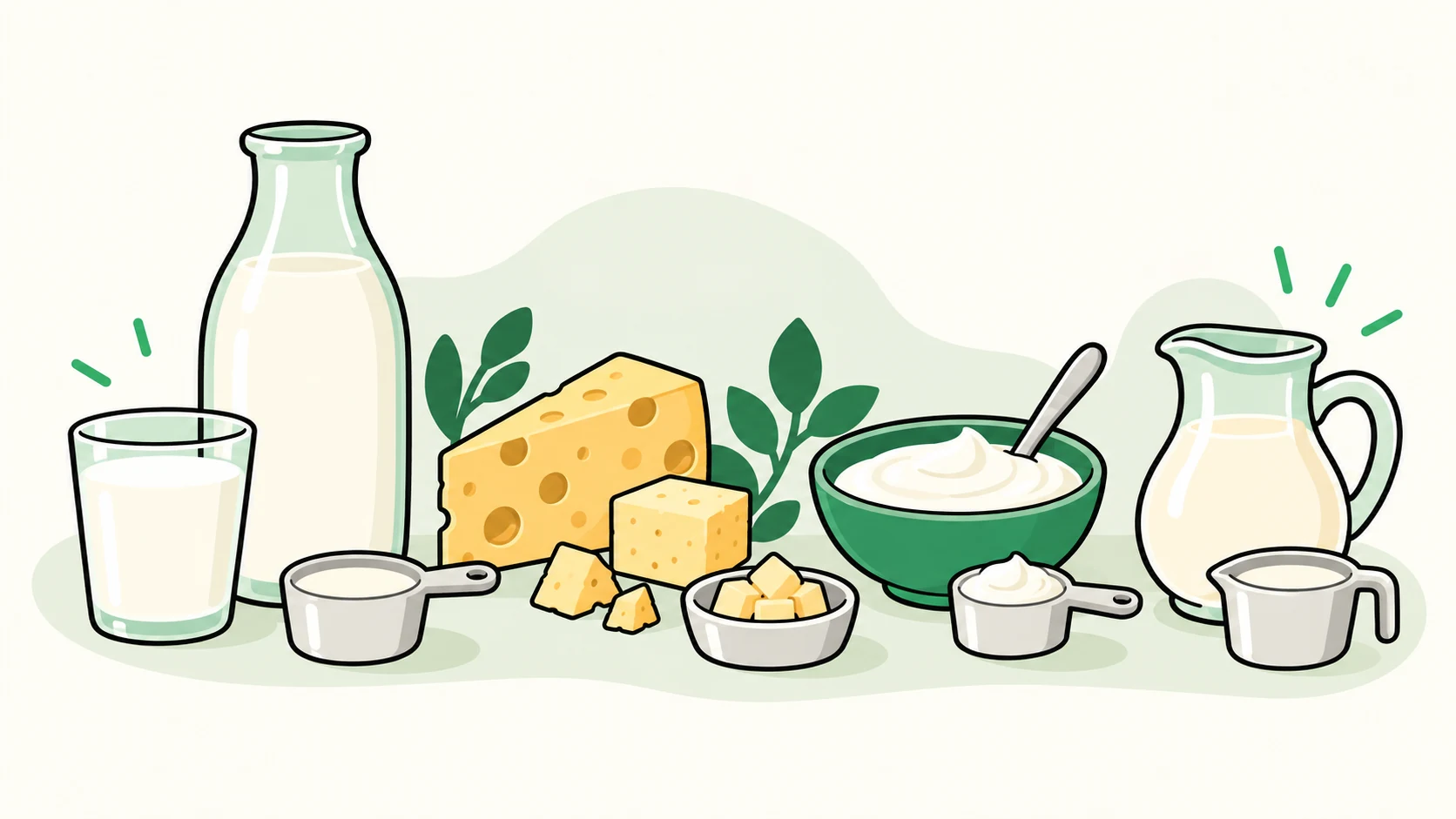
Dairy on Keto: Which Cheeses, Milks & Yogurts Fit Your Macros
Dairy is largely keto-friendly, but only in its full-fat, unsweetened, or well-aged forms. Cheese, butter, heavy cream, and plain full-fat yogurt fit comfortably inside a 20 to 50 g net-carb day. Milk, flavored yogurt, and most milk alternatives don't, because they carry more lactose or added sugar per serving than a keto budget can absorb.
Cheese counters and coffee creamer are two of the easiest places to accidentally blow a carb budget, because "dairy" isn't one food — it's a spectrum from almost-zero-carb (butter, hard cheese) to surprisingly high-carb (milk, sweetened yogurt). This guide breaks every major dairy category down by net carbs per serving, explains why aged cheese behaves so differently from a glass of milk, and gives you dairy-free swaps for anything that doesn't fit. For the full list of keto foods beyond dairy, see our complete keto food list.
Is dairy keto-friendly?
Yes, most dairy is keto-friendly in its full-fat, unflavored form. Hard cheeses, butter, ghee, heavy cream, sour cream, and plain full-fat yogurt are naturally high in fat and low in carbs, which fits the keto macro pattern directly. Two things disqualify a dairy product: lactose (the natural milk sugar in fluid milk) and added sugar (in flavored or "lite" products). Harvard's Nutrition Source similarly notes that butter and hard cheeses tend to fit a keto pattern because of their lower lactose content, while higher-lactose dairy like cream, ice cream, and full-fat milk are usually restricted.6
Here's the fast version for skim-readers:
| Category | Examples | Verdict |
|---|---|---|
| Eat freely | Butter, ghee, hard/aged cheese, heavy cream, sour cream | Naturally low-carb, high-fat |
| Eat in moderation | Cottage cheese, ricotta, plain Greek yogurt | Higher lactose; portion it |
| Limit or swap | Whole/2%/skim milk, half-and-half | ~12 g net carbs per cup |
| Avoid | Flavored yogurt, sweetened condensed milk, oat milk | Added sugar or starch |
Because dairy has essentially no fiber, its carbs are almost entirely lactose (or added sugar), so net carbs and total carbs on a dairy label are usually the same number — the exceptions are processed products with added fiber or sugar alcohols, which you should check on the ingredient list.1
How do you read dairy net carbs?
Lactose is milk sugar, and unlike fiber, it counts fully toward your net-carb total. The reason some dairy is nearly carb-free while other dairy isn't comes down to how much lactose survives processing: fresh milk keeps almost all of it, while hard, aged cheeses lose most of it during fermentation and pressing.
When cheese is made, most of the lactose-rich liquid (whey) is drained off, and the lactic acid bacteria used to culture the cheese consume much of what's left as the cheese ages. Research on cultured and aged cheeses shows lactic acid bacteria break down the bulk of residual lactose during fermentation and ripening, which is why a wedge of aged cheddar or parmesan carries only a fraction of a gram of carbs per ounce, while a cup of milk carries roughly 12 g.2
A few label-reading watch-outs:
- "Reduced-fat" and "lite" dairy is not automatically lower-carb — removing fat sometimes means more milk solids (and lactose) are added back for texture, so check the carb line, not just the fat line.
- Flavored anything (yogurt, cottage cheese, cream cheese spreads) usually means added sugar. A plain product and its "vanilla" or "honey" counterpart can differ by 10 g of carbs or more per serving.
- Small servings can hide trace carbs. A tablespoon of heavy cream rounds to "0 g" on a label, but three tablespoons in your coffee is closer to 1 to 1.5 g — not much, but it adds up if you're tracking tightly.
Run any product through the net-carb calculator if the label math looks confusing, and see our guide to calculating your keto macros for how dairy fits into a full day's targets.
Which cheeses are best for keto?
Hard and aged cheeses are the lowest-carb dairy category, running from about 0.1 to 1 g net carbs per 1 oz serving. Fresh, high-moisture cheeses (cottage cheese, ricotta) run higher because they retain more whey and lactose. Processed cheese products and cheese sauces are the ones to actually watch.
| Cheese (per 1 oz / 28 g) | Net carbs | Notes |
|---|---|---|
| Brie | ~0.1 g | Soft-ripened, very low carb |
| Cheddar | ~0.4 g | Sharp or mild, both low |
| Swiss | ~0.6 g | |
| Gouda | ~0.6 g | |
| Parmesan | ~0.9 g | Great for finishing, low volume |
| Mozzarella (part-skim) | ~1 g | Fresh mozzarella runs slightly higher |
| Cream cheese (1 oz) | ~1.5 g | Check for added stabilizer sugars |
| Cottage cheese (1/2 cup) | ~3.5 g | Higher due to residual whey |
| Ricotta (1/2 cup) | ~6 g | The highest-carb common cheese |
Best everyday picks: cheddar, gouda, swiss, parmesan, and brie for snacking or cooking; mozzarella for melting; cream cheese for sauces and fat bombs. Portion cottage cheese and ricotta more carefully since they carry several times the carbs of a hard cheese by volume.
Cheeses and spreads to skip or scrutinize: pre-shredded bagged cheese (often coated in starch to prevent clumping, adding roughly 1 to 2 g of extra carbs per serving), jarred cheese sauces, and sweetened cheese spreads or dessert cheeses — read the ingredient list on anything that isn't just "cheese, salt, cultures, enzymes."1
What milk and milk alternatives work on keto?
Regular cow's milk carries about 12 g of net carbs per cup, almost all lactose, which is too much to drink freely on a 20 to 50 g daily budget. Whole, 2%, and skim milk all land near that number because removing fat doesn't remove lactose. Unsweetened plant milks are the better everyday pour.
| Milk (per 1 cup / 240 ml) | Net carbs | Notes |
|---|---|---|
| Unsweetened almond milk | ~1 g | Best all-around keto swap |
| Unsweetened coconut milk (carton) | ~1–2 g | Higher fat, creamier |
| Unsweetened soy milk | ~1–2 g | Highest protein of the swaps |
| Heavy cream | ~6–7 g | Very high fat; use in small pours |
| Whole milk | ~12 g | Too high for regular use |
| Unsweetened oat milk | ~15 g+ | Starch-based; not keto despite "unsweetened" label |
Two traps worth flagging specifically. First, oat milk is not a keto swap even when labeled unsweetened, because its carbs come from the oat starch itself, not added sugar — a cup can carry 15 g of carbs or more.1 Second, heavy cream and half-and-half are high-fat, not zero-carb — they're excellent for coffee or cooking in tablespoon amounts, but drinking them by the cup adds up fast.
When shopping for a keto milk alternative, look for "unsweetened" on the front of the carton and confirm it on the nutrition label, and check the ingredient list for added starches or gums if you're sensitive to them. Build your dairy picks into a full trip with our keto grocery shopping list.
Is yogurt keto-friendly?
Plain, full-fat yogurt fits keto; flavored and low-fat "diet" yogurts usually don't. A 170 g (6 oz) serving of plain whole-milk Greek yogurt carries roughly 5 to 7 g of net carbs, while the same size container of fruit-on-the-bottom or vanilla yogurt can carry 20 g or more from added sugar alone.
Best picks: plain full-fat Greek yogurt or skyr, both strained to remove extra whey (which also removes some lactose). Coconut-milk yogurt is a solid dairy-free option, though carb counts vary by brand (roughly 2 to 6 g net carbs per serving) — check the label since some brands add starches or sugar for texture. Dress plain yogurt up keto-style with a few berries, chopped nuts, unsweetened cocoa, or a keto-friendly sweetener rather than buying the flavored version.
Are butter, ghee, and cream basically zero-carb?
Yes — butter, ghee, and heavy cream contain so little lactose per serving that they round to 0 g net carbs on a standard label. Ghee (clarified butter) has the milk solids removed entirely, and butter is almost pure fat, so what little lactose remains is a trace amount per tablespoon.1
Sour cream and crème fraîche are nearly as easy: about 1 g net carbs per 2 tbsp serving, making them an easy way to add richness to a bowl of taco toppings or a keto soup without meaningfully touching your carb budget. The one thing to watch is "butter blends" and spreadable tubs, which sometimes mix in vegetable oil, buttermilk solids, or flavorings that add a gram or two of carbs you wouldn't expect from something labeled "butter."
Can dairy stall your keto progress?
For some people, yes — dairy has a higher insulin response than its carb count alone would predict, which may matter for weight loss even though the evidence is mixed. A systematic review of randomized trials found dairy's effect on insulin resistance varied by study, with some trials showing improvement and others showing no change or a slight negative effect, particularly in people who are overweight.3 If you're tracking macros correctly but still stalling, dairy is one of a handful of variables worth testing — not an automatic culprit.
Beyond insulin, three other dairy-related issues come up often on keto:
- Lactose intolerance and digestive symptoms. Reduced lactase production is common in adults, and consuming more lactose than your body can break down can cause bloating, gas, or diarrhea — symptoms that are sometimes mistaken for "keto flu" or blamed on carbs when dairy is the actual trigger.4
- Dairy and acne. Several meta-analyses have found an association between milk consumption (especially skim and low-fat milk) and acne risk, though the studies are observational and can't prove milk causes acne — the mechanism proposed involves insulin and growth-factor signaling, and full-fat dairy and cheese show a weaker or absent link in the same research.5
- General inflammation. Evidence linking dairy to broader inflammation is inconsistent and often contradictory between studies; treat any personal flare-up as a reason to test your own response, not as settled science.
If you suspect dairy is stalling your progress or causing symptoms, run a simple 2 to 3 week elimination: cut all dairy, track how you feel and how the scale or your ketones move, then reintroduce one category (say, cheese) at a time and watch for changes. This tells you your personal response far better than a general study can.
How do you go dairy-free on keto?
Every dairy staple has a workable keto swap: coconut cream or cashew cream for heavy cream, unsweetened almond or coconut milk for regular milk, coconut oil or avocado oil for butter in most cooking, and nutritional yeast or dairy-free cheese for a cheesy flavor note. None of these swaps are identical, but they hold up in most keto recipes.
A few practical notes for going dairy-free without losing ground on macros:
- Fat and calories: replace dairy fat gram-for-gram with olive oil, coconut oil, or avocado, since dairy is often a meaningful chunk of daily fat intake on keto.
- Calcium: without dairy, lean on canned fish with bones (sardines, salmon), leafy greens, or a fortified plant milk to keep calcium intake up.
- Read vegan "cheese" labels closely. Many dairy-free cheese alternatives are starch- or tapioca-based rather than nut- or coconut-based, which means they can carry significantly more carbs per serving than the real cheese they're replacing — check the nutrition label, not just the "vegan" claim.
How does dairy fit into a full day of keto?
A realistic day of keto dairy — coffee cream, cheese with lunch, and a yogurt snack — runs about 8 to 10 g net carbs, leaving most of a 25 g daily budget for vegetables and other foods. Here's a sample breakdown:
| Dairy eaten | Net carbs |
|---|---|
| 2 tbsp heavy cream in coffee | ~0.8 g |
| 1.5 oz cheddar cheese at lunch | ~0.6 g |
| 6 oz plain full-fat Greek yogurt as a snack | ~6 g |
| 1 tbsp butter for cooking | ~0 g |
| Total | ~7.4 g |
That leaves roughly 17 g of an 25 g budget for non-starchy vegetables and everything else in the day. The main portion-control tip: cheese is calorie- and carb-dense enough that a "handful" habit can quietly crowd out the vegetables that should be filling most of your plate. Weigh or measure cheese servings for the first couple of weeks until eyeballing an ounce becomes second nature, and use the macro calculator to plan dairy into your personal targets rather than guessing.
Frequently Asked Questions
Is cheese OK on keto every day?
What is the best milk for keto coffee?
Can I eat cottage cheese on keto?
Is heavy cream or half-and-half better for keto?
Does dairy kick you out of ketosis?
Is Greek yogurt keto-friendly?
Works cited
Article history
- Updated
- First published
Your learning guide