Fruit on a Keto Diet: Compare Portions, Not Labels
“Is fruit keto?” is the wrong question, because fruit is not one carbohydrate category. The workable question is narrower: how many grams of carbohydrate are in the exact portion in front of you, and how does that compare with the definition and target in your plan? This page sets fifteen fruit portions side by side, adds nine higher-carbohydrate portions for contrast, and shows the arithmetic for each stated serving.
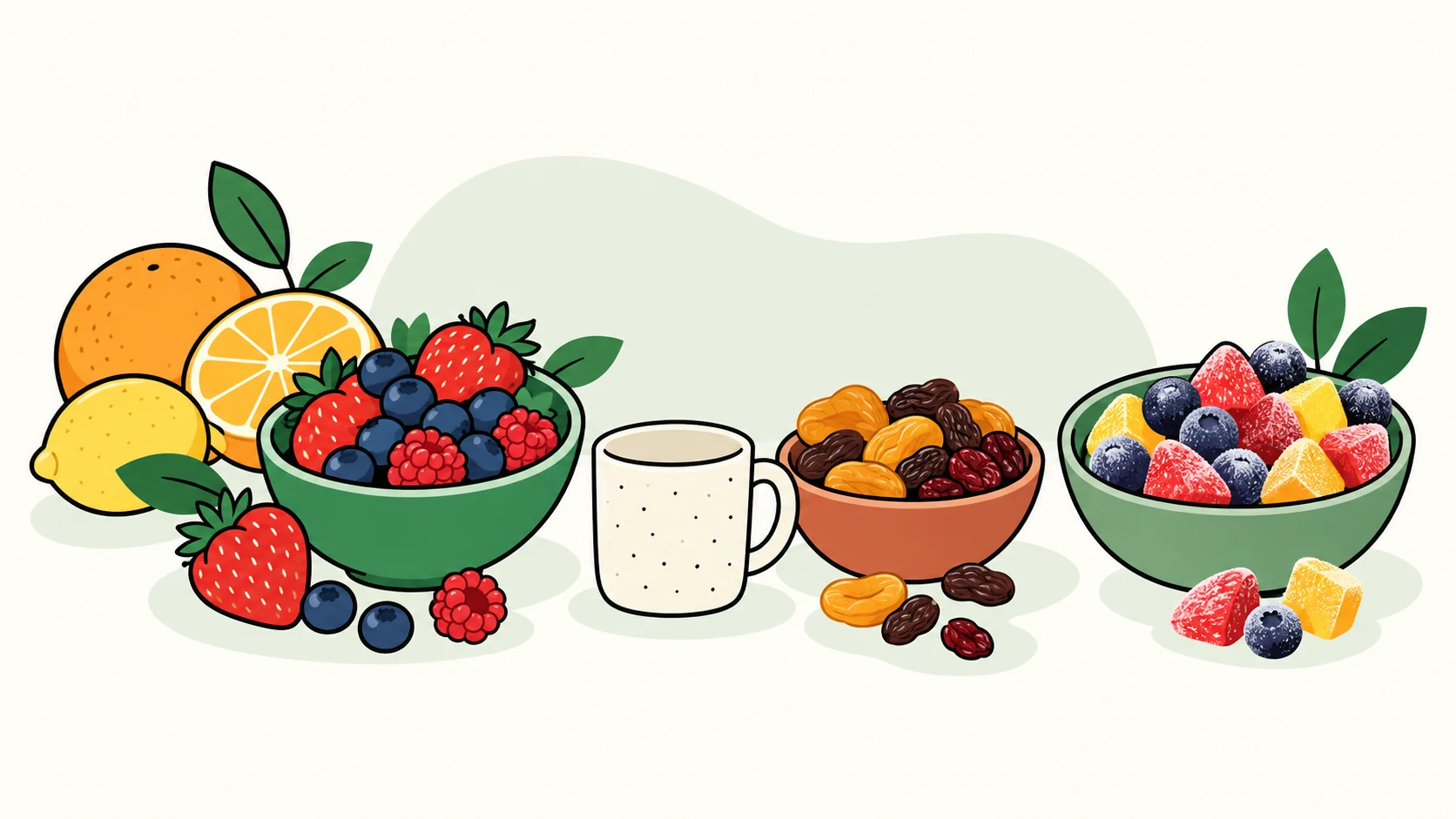
Can fruit fit a carbohydrate-restricted plan?
There is no single answer, because fruit is not one carbohydrate category. Species, variety, ripeness, processing, preparation, form, and serving size can all change a fruit’s composition, so a category label cannot settle the question. What settles it is a measured portion compared with the carbohydrate definition and target in a specific plan.
One boundary runs through this page: a food name, a fruit category, or a band in a table cannot determine whether an individual enters, remains in, or leaves ketosis. Calling a fruit “keto” or “not keto” skips the portion and the plan — the two things that actually get compared.
The values here are sourced from USDA FoodData Central and use the stated food form and serving.1 The displayed net-carbohydrate estimate is Total Carbohydrate minus Dietary Fiber for the stated serving. “Net carbs” is informal arithmetic, not an FDA-defined nutrient, and the calculation does not predict a person’s glucose response, ketosis, tolerance, benefit, or safety.2
For context, published very-low-carbohydrate patterns may use 20–50 g of nonfiber carbohydrate per day as a study or eating-pattern description. That range is not a personal threshold, not a per-food verdict, and not a guarantee of ketosis.3 The longer discussion sits in how many carbs on keto and net carbs explained.
How to read the serving table
Each row lists the fruit, a stated serving, total carbohydrate, dietary fiber, and the net-carbohydrate estimate from subtracting fiber from total. The values apply to that exact form and serving — 10 cherries, 1/2 cup of blackberries, 5 medium strawberries — not to the food in general.
Read the ranking with the right meaning. A lower stated value generally uses less of a defined carbohydrate target, while the complete intake and context still matter. A higher stated value is not a signal that a food must be avoided; it is a number attached to a stated portion.
If your plan defines carbohydrates differently, redo the arithmetic under that definition. The net carb calculator does the subtraction once you have the total and fiber figures for your measured serving.
Fifteen fruit portions compared
| # | Fruit | Serving | Total carbs | Fiber | Net-carb estimate |
|---|---|---|---|---|---|
| 1 | Olives | 10 olives (1 oz) | 1.8 g | 0.9 g | 0.9 g |
| 2 | Avocado | 1/2 medium (100 g) | 8.5 g | 6.7 g | 1.8 g |
| 3 | Lemon or lime | Juice & zest of 1 (2 Tbsp) | 2 g | 0 g | 2 g |
| 4 | Fresh coconut meat | 1/2 cup shredded | 6.1 g | 3.6 g | 2.5 g |
| 5 | Blackberries | 1/2 cup | 6.9 g | 3.8 g | 3.1 g |
| 6 | Strawberries | 5 medium | 4.4 g | 1.1 g | 3.3 g |
| 7 | Tomatoes | 1 medium | 4.8 g | 1.5 g | 3.3 g |
| 8 | Raspberries | 1/2 cup | 7.4 g | 4.0 g | 3.4 g |
| 9 | Star fruit (carambola) | 1 medium | 6.1 g | 2.5 g | 3.6 g |
| 10 | Fresh cranberries, unsweetened | 1/2 cup | 6.1 g | 2.3 g | 3.8 g |
| 11 | Watermelon | 1/2 cup diced | 5.7 g | 0.3 g | 5.4 g |
| 12 | Cantaloupe | 1/2 cup cubed | 6.5 g | 0.7 g | 5.8 g |
| 13 | Peaches | 1 small | 9.5 g | 1.5 g | 8.0 g |
| 14 | Blueberries | 1/2 cup | 10.5 g | 1.8 g | 8.7 g |
| 15 | Cherries | 10 cherries | 12.8 g | 1.7 g | 11.1 g |
The list opens with 10 olives (1 oz) at an estimated 0.9 g and 1/2 medium avocado (100 g) at 1.8 g, where most of the avocado’s 8.5 g of total carbohydrate is dietary fiber. The berries sit in the middle: 1/2 cup of blackberries at 3.1 g, 5 medium strawberries at 3.3 g, 1/2 cup of raspberries at 3.4 g, and 1/2 cup of blueberries at 8.7 g. Ten cherries, at 11.1 g, is the highest estimate in this table.
The servings are not uniform — 1 small peach, 1 medium tomato, the juice and zest of one lemon or lime, 1/2 cup diced watermelon — so every comparison is between stated portions, not between fruits in the abstract. Change the serving and the number changes with it.
Higher-carbohydrate fruit portions compared
| Fruit | Serving | Net-carb estimate |
|---|---|---|
| Pineapple | 1 cup chunks | 19 g |
| Pear | 1 medium | 21.5 g |
| Apple | 1 medium | 21 g |
| Grapes | 1 cup | 26 g |
| Mango | 1 cup pieces | 22 g |
| Banana | 1 medium | 24 g |
| Medjool date | 1 date | 16 g |
| Raisins | 1/4 cup | 29 g |
| Sweetened dried cranberries | 1/4 cup | 31 g |
These are single stated portions: 1 medium apple at 21 g, 1 medium banana at 24 g, 1 cup of grapes at 26 g, 1/4 cup of raisins at 29 g. The Medjool date row is worth a pause — one date is listed at 16 g, while one medium apple is 21 g, and the two servings are not the same measure. That is the case for comparing portions instead of labels.
No row here is an instruction to avoid a food or to choose one. Each row is arithmetic attached to a stated serving, ready to be set against your plan’s target alongside the rest of a day’s intake.
How form and portion change the comparison
Whole fruit, juice, smoothies, canned fruit, and dried fruit are different forms with different ingredient, water, fiber, added-sugar, and serving contexts. Verify the exact item rather than assuming one product represents its whole category.
Drying removes water, and that can make a stated portion more carbohydrate-dense by weight or volume. Some dried or canned products contain added sugar; others do not. The two cranberry entries on this page show why the distinction matters: fresh unsweetened cranberries are listed at an estimated 3.8 g for a 1/2-cup serving, while sweetened dried cranberries are listed at 31 g for 1/4 cup. Different form, different ingredients, different serving.
The same fruit can therefore carry very different numbers depending on which row you read. Match the row to what is actually in the bowl.
A practical way to use the numbers
- Start with the plan. If you follow a clinician-set plan, use that plan’s carbohydrate definition and target.
- Identify the exact item. Use the exact FoodData Central entry or the package label, the exact form, and a measured serving. If your portion differs from the stated one, the numbers move with it.
- Do the arithmetic your plan uses. On this page, the estimate is Total Carbohydrate minus Dietary Fiber.
- Read the result in context. A lower stated value generally uses less of the defined target; the rest of the day’s intake and the surrounding context still matter.
For the planning around these numbers, see calculating your macros, the keto food list, and the keto grocery shopping list.
FAQ
Five short answers before you measure.
Frequently Asked Questions
Can I eat fruit on a keto diet?
What does “net carbs” mean on this page?
Is the 20–50 g range a daily rule?
Do dried and canned fruits have more carbs than fresh?
How do I compare a fruit that is not listed?
Works cited
Your learning guide