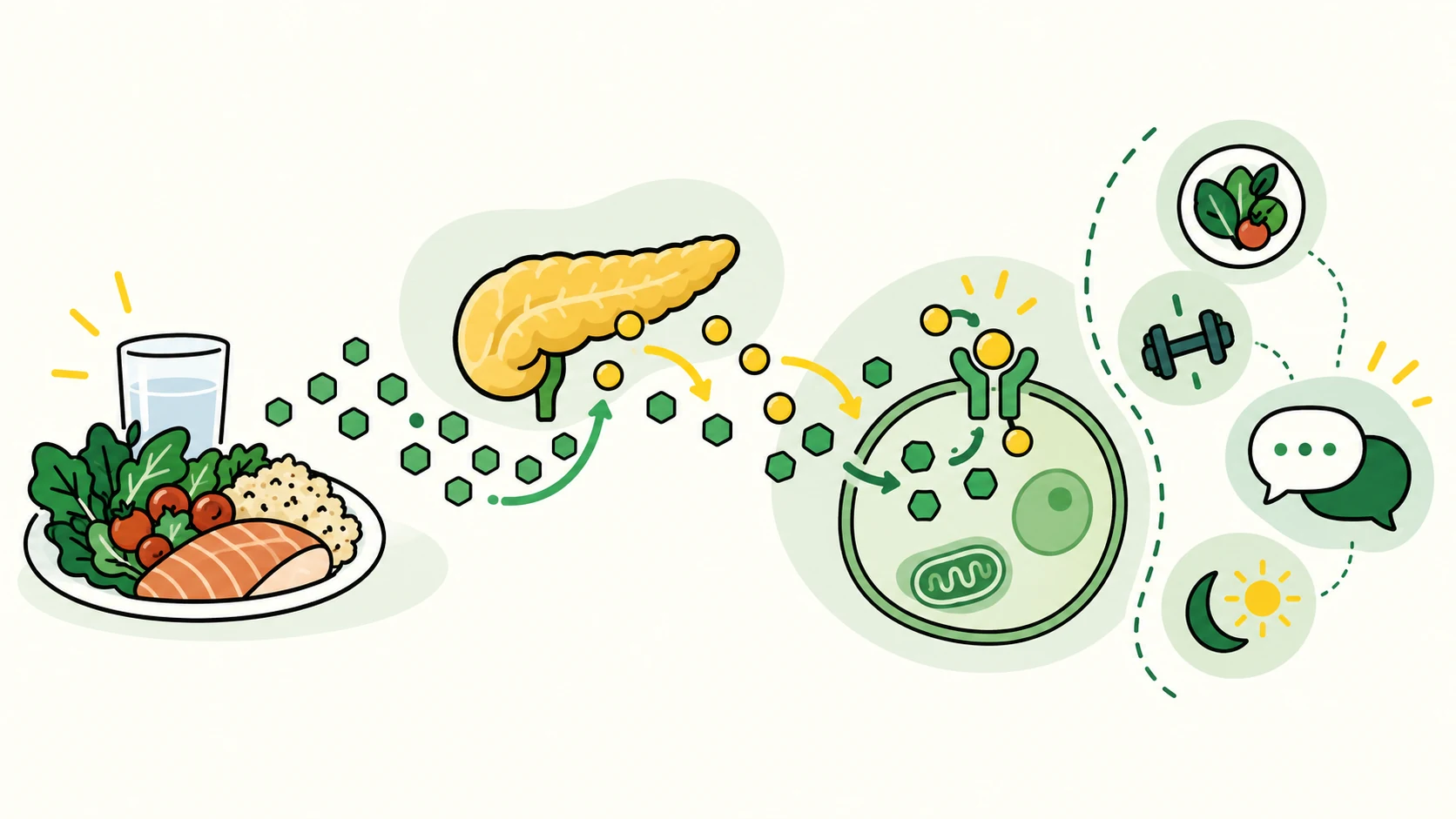
Insulin Resistance & Low-Carb Diets

Insulin resistance is a condition in which your muscle, fat, and liver cells respond poorly to insulin, so your pancreas produces more of it to keep blood sugar normal. It underlies prediabetes and type 2 diabetes. Low-carb and ketogenic diets may improve insulin sensitivity markers for some people, but aren't a cure — discuss testing and treatment with your doctor.

Insulin resistance doesn't cause symptoms on its own in its early stages, which is part of why it's so common and so often missed until blood work flags it. This page explains the mechanism in plain terms, what's known about low-carb and ketogenic diets as a dietary strategy for it, and how markers like HOMA-IR are actually used — always as a conversation to have with your doctor, never as a do-it-yourself diagnosis.

What is insulin resistance?

Insulin resistance means your cells — mainly in muscle, fat, and the liver — no longer respond normally to insulin, the hormone that moves glucose out of your blood and into cells for energy. To compensate, the pancreas secretes extra insulin (hyperinsulinemia) to keep blood glucose in a normal range, often for years before glucose levels themselves rise.1

That compensation is why insulin resistance can go unnoticed for a long time: standard fasting glucose can look normal while insulin is already running high in the background. Left unaddressed, the pancreas can eventually lose the ability to keep up, and blood sugar starts climbing — the transition point that gets labeled prediabetes, then type 2 diabetes.2

How does insulin resistance develop?

Insulin resistance develops from a mix of genetics, excess body fat (particularly visceral fat around the organs), physical inactivity, chronic inflammation, and diet patterns — no single cause explains every case. It's also associated with conditions like polycystic ovary syndrome (PCOS), non-alcoholic fatty liver disease, and metabolic syndrome, though the relationships run in both directions.1

Some risk factors are modifiable — weight, activity level, sleep, and dietary pattern — and others aren't, like family history and age. That's precisely why it's a topic to bring to your doctor rather than to self-manage from general information: your personal mix of risk factors determines what's actually worth changing first.

How might low-carb or keto diets affect insulin sensitivity?

Because carbohydrate intake is the main driver of insulin release after a meal, cutting carbs sharply — as on a ketogenic or low-carb diet — reduces the day-to-day demand on insulin. Several clinical studies have found improvements in fasting insulin and HOMA-IR scores on low-carbohydrate diets, particularly in people with overweight, prediabetes, or type 2 diabetes, though results vary by study and individual.3

Weight loss itself — independent of macronutrient split — reliably improves insulin sensitivity, and much of the improvement seen in low-carb studies likely reflects both the reduced carb load and the fat loss that tends to come with it.3 Ketosis and improved insulin sensitivity are related but distinct: you can read the underlying mechanism in our guide to the science of ketosis, and the wider set of documented outcomes in the benefits of the keto diet. None of this makes low-carb eating a treatment for diagnosed insulin resistance — any dietary change for a medical condition should be planned with your doctor, especially if you take insulin or other glucose-lowering medication, since carb reduction can require a dose adjustment.

Carbohydrate quality, not just quantity, also matters here — a food's glycemic index and how quickly it raises blood sugar is a related but separate concept, covered in our guide to glycemic index vs. net carbs.

What are HOMA-IR and fasting insulin, and what do they mean?

HOMA-IR (Homeostatic Model Assessment of Insulin Resistance) is a formula that estimates insulin resistance from a fasting blood glucose and fasting insulin reading, and fasting insulin alone is sometimes used the same way. Reference ranges differ by lab and population, so a result only means something in the context your doctor gives it — this is information to bring to a clinical visit, not a self-diagnosis tool.2

Your doctor may also use a standard fasting glucose test, hemoglobin A1C, or an oral glucose tolerance test alongside or instead of HOMA-IR, since each measures a slightly different piece of the picture. If you're curious about your own metabolic markers, the right first step is asking your healthcare provider which test fits your history and what your specific numbers mean — not comparing a lab result against a number found online.

Insulin resistance vs. prediabetes vs. type 2 diabetes

These three terms describe points along the same continuum, not three separate conditions — which is exactly why they're commonly confused.

TermWhat it meansTypically identified by
Insulin resistanceCells respond poorly to insulin; pancreas compensates with more insulinFasting insulin, HOMA-IR (interpreted by a clinician)
PrediabetesBlood glucose is above normal but below the diabetes thresholdFasting glucose, A1C, oral glucose tolerance test
Type 2 diabetesBlood glucose is consistently elevated; insulin production or response can no longer compensateFasting glucose, A1C, or glucose tolerance test meeting diagnostic thresholds

Insulin resistance can be present for years before either diagnosis, which is one reason it's discussed as an early, modifiable stage rather than a diagnosis in its own right. It also clusters with other markers — elevated blood pressure, higher triglycerides, low HDL cholesterol, and extra abdominal fat — that together are sometimes grouped under the label "metabolic syndrome." None of these labels are self-diagnoses; they're starting points for a conversation with your doctor about which tests, if any, make sense for you.

Why does this matter for a keto or low-carb reader?

If insulin resistance runs in your family, or you already carry a prediabetes or type 2 diabetes diagnosis, a lower-carbohydrate eating pattern is one of several dietary approaches your doctor may discuss with you — alongside activity, sleep, and, where appropriate, medication. It is not a substitute for medical care, and people on insulin or sulfonylureas in particular should not change carbohydrate intake without medical supervision, since the medication dose that was safe on a higher-carb diet can become too strong once carbs drop.

Bring your specific numbers, medications, and goals to your doctor or a registered dietitian rather than adjusting treatment based on general information — including this page. That conversation is what turns "insulin resistance" from an abstract label into an actual plan.

For the wider entity map this page belongs to — ketosis, ketone bodies, net carbs, and related terms — see the keto glossary, and browse more evidence-based answers on the keto questions hub.

Frequently Asked Questions

Is insulin resistance the same as diabetes?
No. Insulin resistance is an earlier stage where cells respond poorly to insulin but the pancreas is still compensating. Type 2 diabetes is diagnosed once blood glucose stays elevated because that compensation is no longer enough.
Can insulin resistance be reversed?
For many people, insulin sensitivity can improve significantly with weight loss, increased physical activity, and dietary changes, though 'reversed' should be discussed with your doctor since the degree of improvement varies by individual and underlying cause.
Does keto cure insulin resistance?
No single diet cures insulin resistance. Some studies show low-carb and ketogenic diets improve insulin sensitivity markers for some people, but it's a management strategy to discuss with your doctor, not a guaranteed fix.
What is a normal HOMA-IR score?
Reference ranges vary by lab and population, so there's no single universal cutoff. Ask your doctor to interpret your specific result against the range your lab uses.
What are the symptoms of insulin resistance?
Early insulin resistance often causes no noticeable symptoms, which is why it's typically found through blood work rather than how someone feels. Some people eventually notice fatigue, increased hunger, or skin changes like darkened skin patches (acanthosis nigricans).
Can you test insulin resistance at home?
There isn't a reliable at-home test for insulin resistance. Fasting insulin, glucose, and HOMA-IR calculations require a blood draw and lab interpretation, so testing should go through your doctor.

Works cited

  1. Insulin Resistance — StatPearls, NCBI BookshelfAugust 18, 2026 https://www.ncbi.nlm.nih.gov/books/NBK507839/
  2. Insulin Resistance & Prediabetes — National Institute of Diabetes and Digestive and Kidney Diseases (NIDDK)August 18, 2026 https://www.niddk.nih.gov/health-information/diabetes/overview/what-is-diabetes/prediabetes-insulin-resistance
  3. Diet Review: Ketogenic Diet for Weight Loss — Harvard T.H. Chan School of Public Health, Nutrition SourceAugust 18, 2026 https://nutritionsource.hsph.harvard.edu/healthy-weight/diet-reviews/ketogenic-diet/

Article history

  1. Updated
  2. First published

Your learning guide

Loading reading status…