Glycemic Index, Glycemic Load, and Net Carbs: Different Questions
Glycemic index, glycemic load, and "net carbs" each answer a different question, and none of them alone can answer "will this keep me in ketosis?" Glycemic index compares post-meal glucose responses; glycemic load folds portion size into that estimate; net carbs is an informal label calculation with no FDA definition. Here's what each measure can and can't tell you.
What glycemic index measures
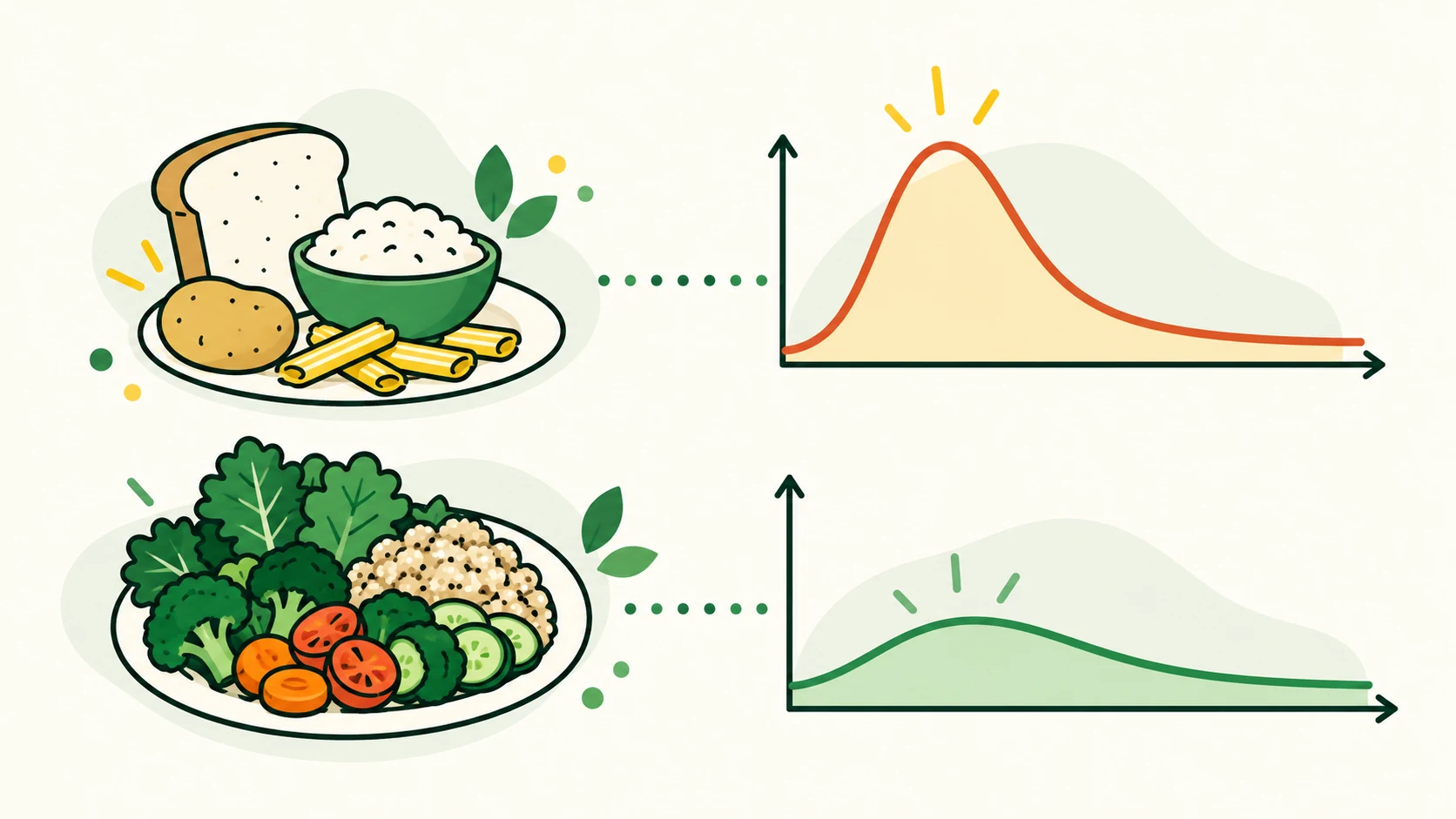
Glycemic index (GI) compares the incremental blood-glucose response after a food providing a fixed amount of available carbohydrate with the response to a reference food.1 It's a relative post-meal glucose-response measure — not a digestion-speed score and not a personal prediction.
Standard protocols commonly use 50 g of available carbohydrate, with 25 g sometimes used for foods with low carbohydrate density, and results are usually reported against glucose as the reference value of 100.1 Published GI values are group averages: food variety, ripeness, processing, preparation, lab method, and within-person and between-person variation can all affect results. A GI value doesn't reveal the response to an ordinary mixed meal or guarantee any individual's glucose response.
Common descriptive categories are low GI at 55 or less, medium at 56-69, and high at 70 or more when glucose is the 100 reference. Those bands describe the measured value; they don't translate into guaranteed slow, moderate, or sharp personal rises.
What glycemic load adds
Glycemic load (GL) combines GI with the available-carbohydrate amount in a stated serving: GI multiplied by the grams of available carbohydrate in the serving, divided by 100. That incorporation of portion size is the whole addition, and it's the reason GL and GI can tell different stories about the same food. GL remains an estimate and doesn't precisely predict an individual's response.
What "net carbs" can and cannot tell you
"Net carbs" is an informal label calculation, not an FDA-defined nutrient. A common U.S. label calculation starts with Total Carbohydrate and subtracts Dietary Fiber; some marketers also subtract some or all sugar alcohols or allulose. Because methods and physiological effects differ, a generic automatic subtraction isn't justified. We go deeper in net carbs explained and offer a net carb calculator.
FDA nutrition labels list Total Carbohydrate and can separately list Dietary Fiber, Total Sugars, Added Sugars, and Sugar Alcohol. FDA guidance exercises enforcement discretion for excluding allulose from the Total Sugars and Added Sugars declarations and for using 0.4 kcal/g for allulose — which still doesn't create a universal net-carbs formula.2
Which measure matters for keto?
| Measure | The question it asks | What it can't tell you |
|---|---|---|
| Glycemic index | How does this food's post-meal glucose response compare with a reference food's at a fixed available-carbohydrate amount? | Your individual glucose response, or the response to a mixed meal |
| Glycemic load | How does GI combine with the available carbohydrate in a stated serving? | A precise prediction of your response |
| Total carbohydrate | How much carbohydrate does the label report? | Whether any specific amount means ketosis for you |
| Net carbs (informal) | What does a label's or marketer's subtraction produce? | An FDA-defined value, or agreement between calculation methods |
GI, GL, total carbohydrate, nonfiber carbohydrate, and an informal net-carb calculation answer different questions, and none alone predicts ketosis. The ADA's 2019 consensus report notes that very-low-carbohydrate patterns often target 20-50 g of nonfiber carbohydrate, but that describes study and eating-pattern definitions, not a personal ketosis threshold.3 No food-level GI, GL, or net-carb value can answer "will this keep me in ketosis?" — individual response depends on the full dietary and clinical context and, when relevant, an appropriate measurement protocol. More terms in our keto glossary and carb-counting guidance.
Reading evidence in context
- Observed outcome
- Certainty
- Duration
- What remains unknown
Limits for diabetes decisions
For people managing diabetes, GI and GL can serve as contextual information, but they must not replace an individualized eating plan, a glucose monitoring plan, or medication guidance. Significant carbohydrate changes can alter medication needs, and this page won't advise dose changes — that conversation belongs with a clinician.
FAQ
Frequently Asked Questions
Is a low-GI food automatically keto-friendly?
How do I calculate net carbs?
What's the difference between GI and GL?
Does a low-GI value mean a gentle glucose rise for me?
Can any of these numbers tell me if a food fits my ketogenic pattern?
I manage diabetes — can GI or GL replace my meal plan?
Works cited
Your learning guide