Low-Carb Road-Trip Meals: Pack, Stop, and Keep a Backup
A road trip goes sideways the moment your cooler warms up or the place you counted on is closed. Sort out what actually needs to stay cold, pack a shelf-stable backup and keep it out of the heat, and know how to order flexibly wherever you land.
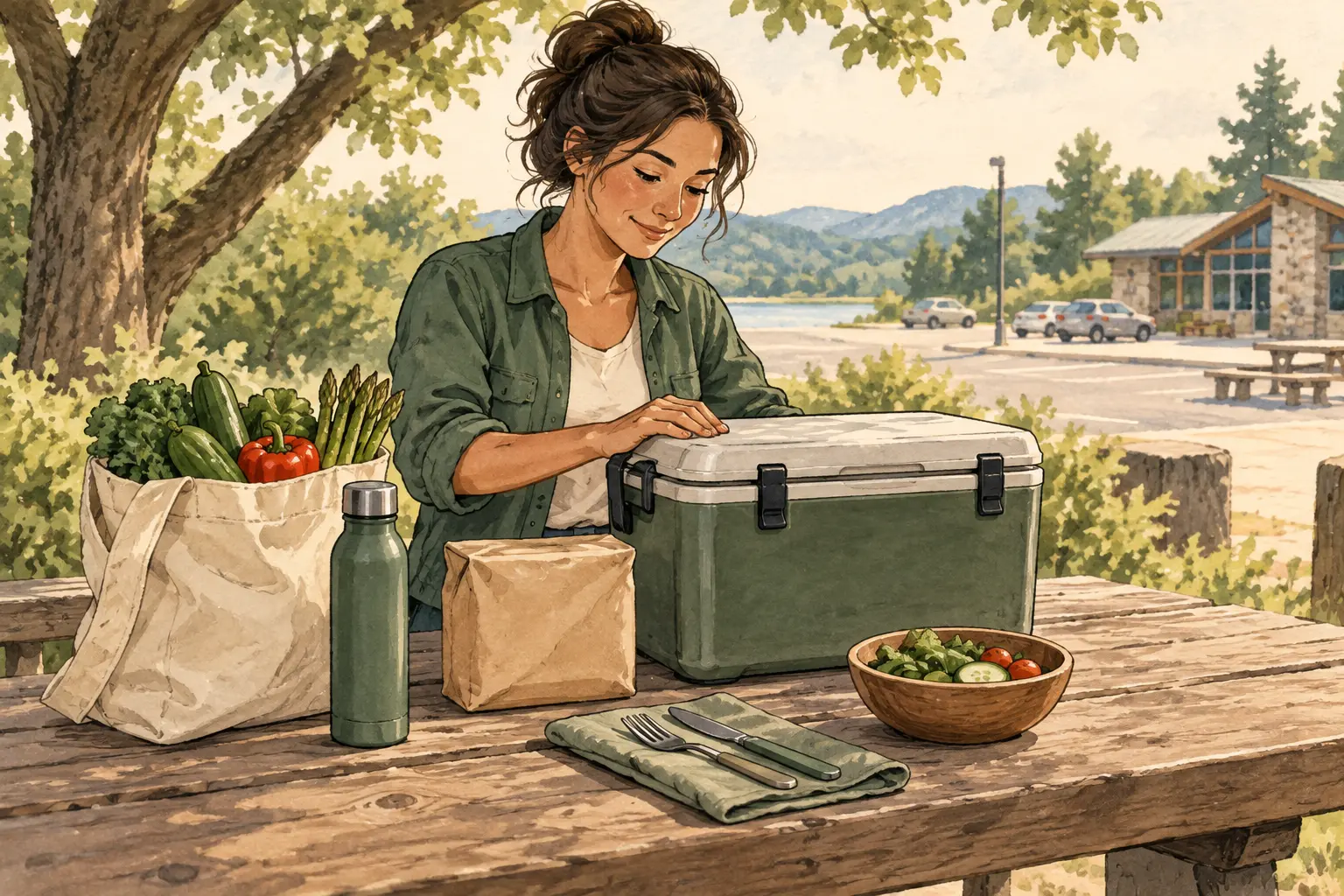
Start with the shape of the drive
Before you fill anything with ice, sketch out the day: how many hours, how many stops, and whether there's a working refrigerator waiting at the other end — a hotel room, a relative's kitchen, or nothing at all. That shape is what decides how hard you lean on a cooler versus food that doesn't care about temperature. A three-hour hop with one planned stop needs a lot less cold-chain effort than two days of unpredictable diner hours and a car that sits in a hot parking lot.
What actually needs to stay cold
Meat, poultry, eggs, and dairy-based sides are the items that create real risk if they warm up in transit. If you're packing an insulated lunch bag, USDA guidance for bag lunches calls for at least two cold sources 1. A larger cooler doesn't have that same fixed count to hit — what matters is that it stays at 40°F or below for the whole trip, and the only way to know that is an appliance thermometer, not how much ice is left in the bottom 23. Keep the cooler closed as much as possible, out of direct sun, and get perishable food back into a real fridge as soon as you reach one. If produce you plan to eat raw is riding in the same cooler, keep it away from raw meat or poultry, even once everything is cold 4.
| Food in the car | How to treat it |
|---|---|
| Raw or cooked meat, poultry, eggs, dairy sides | In an insulated lunch bag, pack at least two cold sources; in a larger cooler, pack enough ice or cold sources to hold 40°F or below and verify with a thermometer 123 |
| Leftovers you cooked before leaving | Refrigerate promptly in shallow containers — within two hours, or within one hour if the surrounding temperature is above 90°F (not just the outdoor weather) — keeping them at 40°F or below, and use within three to four days 5 |
| Unopened shelf-stable backup (cans, pouches, jerky, nut packets) | Follow the package's own storage line — some canned items say "Keep Refrigerated" even before opening — and keep it cool and dry, out of direct sun or a hot trunk 6 |
| Opened shelf-stable backup | Opened canned meat or fish needs refrigeration like any other leftover; opened nuts or nut butter may carry different package directions, so check the label rather than assuming 65 |
| A cooler or backup with an unknown temperature history | Leftover ice or a cool feel to the touch don't confirm the food stayed at 40°F or below — if you can't confirm the history, don't eat the perishable food inside 23 |
Build a shelf-stable backup — and still keep it cool
A good road-trip backup starts with unopened canned proteins or vegetables, shelf-stable nut butter packets, jerky, and seed and nut mixes. "Shelf-stable" describes how the food is packaged, not a promise that it comes through a hot trunk or glovebox unaffected — the package label is still the authority, and some canned items say "Keep Refrigerated" even before opening, so it's worth reading the fine print rather than assuming 6. Keep the backup itself out of direct sun and away from the hottest parts of the car, the same way you would any food you're not ready to gamble on.
Once you open something, the rules can change, but not the same way for everything. An opened can of tuna or chicken needs to go in the cooler and get treated like any other leftover 56. Opened nuts or nut butter aren't necessarily on the same clock — check the package for its own directions instead of assuming every opened shelf-stable item needs cold-leftover treatment 6.
If someone riding along isn't eating low-carb, that's completely fine — pack their preferred shelf-stable items next to yours, checking labels the same way.
Choosing a stop: grocery store or restaurant
A grocery stop hands you the most control — you can read the label and follow whatever storage instructions the package actually gives you, then make sure anything marked 'keep refrigerated' goes straight back into a cold cooler at 40°F or below rather than riding along in a warm car, and buy only what you're confident you can keep cold or that's genuinely shelf-stable for the rest of the drive 6.
A restaurant stop means working with what's visible and asking questions instead of assuming a number. Look at the plate you'd actually get, and ask about sauces, add-ins, portion size, and what can be swapped or left off — the restaurant guide walks through how to read a menu this way without treating any answer as a guaranteed carb count. If anyone in the car is managing a food allergy, remember that a side salad or a bunless order doesn't cancel out a shared grill, fryer, or cutting board — ask how the kitchen handles cross-contact, not just what's listed on the plate 78.
A hypothetical travel day, mapped out
Here's one way an eight-hour drive split into three legs might come together — an illustrative example, not a tested plan or a nutrition claim.
Before leaving, the cooler goes in with two frozen gel packs, hard-boiled eggs, sliced deli meat, and a hard cheese, plus an unopened can of tuna and a nut packet as backup, tucked somewhere out of direct sun rather than left in a sunbaked glovebox. Around the midpoint, instead of the fast-food exit, a grocery stop yields a rotisserie chicken and a bag of pre-washed salad. Buy the rotisserie chicken and eat it in full at the stop rather than portioning it into the cooler for later — its temperature at that point isn't known, so it shouldn't be assumed to still be safely hot, and it shouldn't be packed into the cooler beside food that's already cold 2. The salad goes back into the cooler with fresh ice bought at the same store. Late in the day, the diner that was supposed to be the dinner stop is closed for a private event, so the next sit-down place becomes the fallback: a protein and a vegetable side ordered plain, with the sauce asked about and left on the side. Through the drive, not just at the last stop, the cooler gets checked with an appliance thermometer — one reading at the end can't tell you whether it stayed at 40°F or below the whole way there 3. If a check comes back too warm, or there's any stretch where nobody's sure how warm things got, that perishable food gets left behind rather than eaten, and the fresh restaurant meal or the unopened backup fills in instead.
When the plan falls apart
A cooler that ran out of ice, a hotel room with a fridge that never quite feels cold, a stop that's closed when you arrive — none of these are emergencies if you built in a backup. A hotel mini-fridge doesn't get a free pass just because it's built into the room: if it can't hold 40°F or below, it isn't an appropriate place for perishable food, so treat it the same way you'd treat a warm cooler — don't put perishable food in 9. If you don't know how long something sat at an unsafe temperature, the safer move is to leave that perishable food out of the meal and reach for the unopened backup or something fresh, not to guess.
And if the reason you're adjusting food on the road is a medication or a health condition rather than personal preference, that's a different question than packing logistics — the guide to whether keto fits your situation is the place to work through it.
Sources
Article history
- First published
Your learning guide