Keto Drinks: Carbs, Labels & What to Compare
Start with the exact drink and serving: plain water has no carbohydrate, while prepared coffee, tea, soda, electrolyte products, shakes, and juice vary by recipe and label. The table below compares cited examples; a category name or low number does not guarantee ketosis, glucose response, hydration, or safety.
Drinks contribute to the same daily food-and-beverage intake as solid food. This hub compares label values and links to narrower guides without claiming that one drink determines a personal ketone result. For food, see the full keto food list; to check any label yourself, use the net-carb calculator.
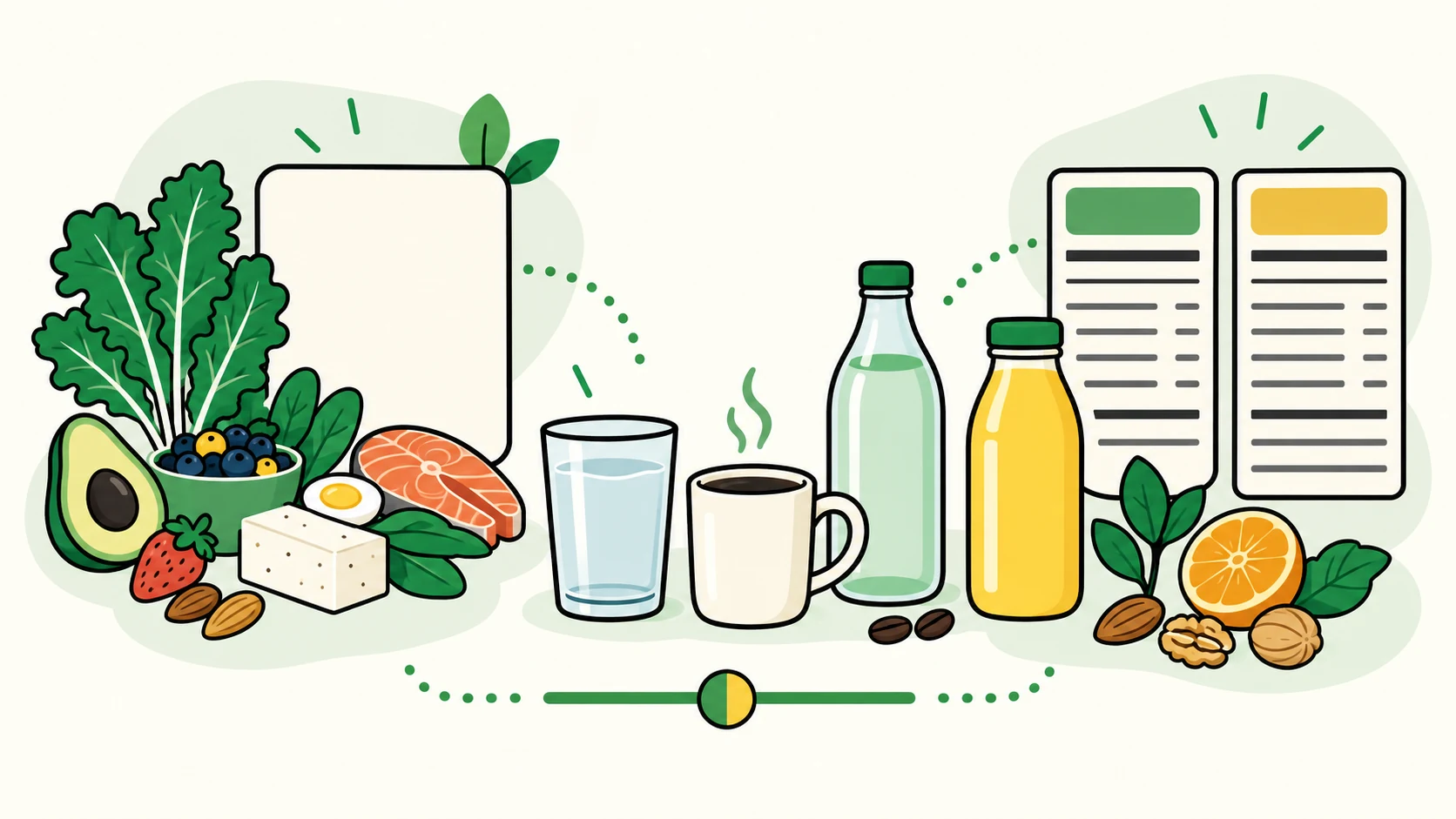
Compare label systems carefully
- US label
- Declared total carbohydrate
- EU / UK label
- Use the package in hand
What makes a drink keto-friendly?
A drink can be compared with a defined eating pattern only after the serving, Total Carbohydrate, ingredients, and label system are clear. “Net carbs” is informal arithmetic, and no universal subtraction rule or 20-to-50 g threshold predicts an individual ketone or glucose response. Guidance limits sugar-sweetened beverages for broader health reasons.1
Three things to check before trusting any drink's "keto" or "low-carb" label claim:
| What to check | Why it matters |
|---|---|
| Total carbs vs. a net-carb estimate | Start with the regulated value, then state the label system and each selected fiber, polyol, or allulose adjustment |
| Ingredient context | Juice concentrate, agave, cane sugar, starch-derived ingredients, and other additions can change the complete carbohydrate profile |
| Serving size on the label | Compare the declared serving with the amount consumed; a container can hold one or more servings |
Ingredient order does not supply a gram amount for maltodextrin or any other individual ingredient. Use the current Total Carbohydrate value and serving size instead of converting an ingredient name or glycemic-index value into an automatic deduction or personal glucose prediction.2
How do the cited drink examples compare by carbohydrate?
The cited examples range from 0 g carbohydrate to several dozen grams per serving, but brand, recipe, size, and date matter. Use the table to identify what to verify, not as a personal ketosis ranking.
| Drink | Example carbohydrate estimate | Verification note |
|---|---|---|
| Water / plain sparkling water | 0 g | Confirm flavored versions |
| Black coffee | 0 g in the cited generic record | Preparation can vary |
| Unsweetened tea (black, green, herbal) | 0 g in cited generic records | Prepared products can vary |
| Bone broth | 0 to 1 g in cited examples | Recipe and serving vary |
| Diet soda (aspartame/sucralose-sweetened) | 0 g | Verify the current product; no personal outcome follows |
| Zero-sugar electrolyte drinks/powders | 0 to 1 g | Verify serving and ingredients; minerals do not establish a personal need |
| Unsweetened almond or coconut milk | 1 to 2 g per cup | Verify that the exact product is unsweetened |
| Keto meal-replacement shakes | roughly 3 to 5 g per serving | Verify label, preparation, and nutritional context |
| Prebiotic sodas (fiber-forward brands) | 0 to 8 g, varies by brand/flavor | Check the label |
| Kombucha | 2 to 14 g, varies by brand | Check the label |
| Coconut water | roughly 8 to 9 g per cup | Compare the stated portion |
| Sports drinks (Gatorade-type) | 21 to 36 g per serving | Higher-carbohydrate cited examples |
| Fruit juice | 25 to 30 g per cup | Higher-carbohydrate cited examples |
| Sweetened coffeehouse drinks (flavored lattes) | 30 to 50+ g | Higher-carbohydrate cited examples |
| Regular soda | roughly 39 g per 12 oz can | Higher-carbohydrate cited example |
Ranges reflect variation between the cited examples. Confirm the current nutrition label rather than assuming a category has one composition or safety profile, especially for prebiotic sodas and kombucha.
Examples listed at or near 0 g carbohydrate
Plain water has no carbohydrate. Generic records for plain brewed coffee and unsweetened tea may also list 0 g, while flavored preparations and bone broth vary. A low carbohydrate value is not a general safety claim, and sodium needs cannot be inferred from diet symptoms.
Examples that require a current label and context
Diet soda, electrolyte drinks, plant-based drinks, meal-replacement shakes, and prebiotic sodas vary. Check the current product, label system, and serving rather than assuming that a category fits a universal daily threshold. A fiber value can change an informal net-carbohydrate calculation, but it does not predict an individual glucose or ketone response.3
Higher-carbohydrate cited examples
Some cited fruit juices, regular sodas, sports drinks, coffeehouse drinks, and kombuchas carry 25 g or more carbohydrate per serving. Compare the exact product with the defined eating pattern; do not turn that example into a universal allowance.
What can you drink on keto, by category?
Each card below links to a focused guide with cited examples, label details, limits, and an FAQ.
- Soda and Prebiotic Soda Comparison — diet sodas, zero-sugar brands, and prebiotic sodas compared by label values, sweetener type, and fiber content.
- Electrolyte Drinks for Keto — compare declared sodium, potassium, magnesium, carbohydrate, and serving information alongside the page's safety limits.
- Smoothie ideas — individual smoothie formulas are temporarily unlisted while their kitchen-test and nutrition records are rebuilt.
- Keto Chow Review — examine the product's declared macros, ingredients, evidence limits, and nutritional context.
- Keto Coffee Guide — how serving size and add-ins change a coffee, and what the numbers cannot predict.
- Alcohol on Keto — carbohydrate comparisons, current alcohol guidance, and why low carbohydrate does not establish safety.
- Keto Food List — a broader food reference for comparing forms, servings, and carbohydrate values beyond drinks.
- Net-Carb Calculator — apply an explicit label method to entered values and see the estimate’s assumptions.
Does a drink actually break ketosis?
No single drink label can show whether an individual will enter, remain in, or leave ketosis. Its carbohydrate belongs in the full intake record, but response also depends on the protocol, the rest of the diet, physiology, medicines, activity, and measurement timing. A 40 g carbohydrate value describes intake, not a guaranteed ketone outcome.
Sources that most often catch people off guard:
- Flavored coffee syrups and pre-made lattes — recipe, pump count, cup size, and toppings can change the carbohydrate total.
- Sweeteners on an ingredient label — agave nectar, honey, cane sugar, and other additions belong in the complete label or recipe total.
- Juice concentrate — its amount cannot be inferred from ingredient order alone; use the current Total Carbohydrate value.
- Alcohol mixers — distilled spirits, tonic water, soda, juice, and prepared cocktails need their own serving-level check; see the full alcohol on keto guide.
- Recovery and sports drinks — compare carbohydrate and electrolyte amounts separately; one does not cancel the other.
Frequently asked questions
Frequently Asked Questions
How should you assess diet soda on a ketogenic plan?
Does sparkling water determine ketosis?
What drink information should you compare?
How should you assess prebiotic sodas such as Olipop or Poppi?
Do electrolyte drinks have carbs?
Does a ‘keto’ meal-replacement label guarantee ketosis?
Works cited
Your learning guide