Net Carbs vs Total Carbs: How to Read US, EU and UK Labels
Net carbs is an informal estimate made from nutrition-label values. It is not a standardized nutrient, and it does not measure how much carbohydrate a particular person will absorb or how their blood glucose or ketones will respond. The correct arithmetic depends first on whether the package uses a US Nutrition Facts label or an EU or UK nutrition declaration.14
Use these two starting formulas:
- US label estimate: Total Carbohydrate minus the dietary-fiber, polyol and allulose adjustments you explicitly select.
- EU or UK label estimate: Carbohydrate minus a selected polyol adjustment. Do not subtract Fibre.
The net-carb calculator follows those rules and leaves optional deductions off until you choose them. For a plain food rather than a packaged label, use the Food Database to match the food's form and listed portion before applying the same arithmetic. For the separate question of daily intake, see how many carbs you can eat on keto.
Reading evidence in context
- Observed outcome
- Certainty
- Duration
- What remains unknown
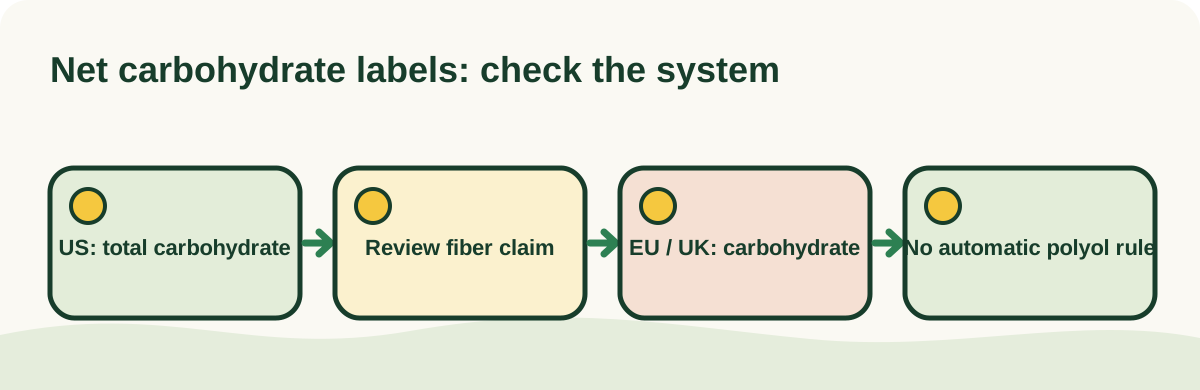
Why the label system changes the arithmetic
| Label system | Starting value | Fibre treatment | Polyols | Allulose |
|---|---|---|---|---|
| US Nutrition Facts | Total Carbohydrate | Included in the starting value; subtract only if that is the convention you selected | Included; no universal deduction percentage | Included in Total Carbohydrate; use a separate selected adjustment only when the amount is identified |
| EU or UK declaration | Carbohydrate | Already excluded by definition, even when no Fibre row appears | Included in Carbohydrate; use only an explicitly chosen adjustment | Do not import the US label treatment into this mode |
The words look similar, but the regulated definitions differ. On a US label, Dietary Fiber is a component of Total Carbohydrate. Under EU and UK rules, Fibre is separate from Carbohydrate. Fibre and polyol rows can be voluntary on an EU or UK declaration, but their absence does not change the definition of Carbohydrate.145
What US Total Carbohydrate contains
FDA's Nutrition Facts rules retain a total-carbohydrate-by-difference approach. Total Carbohydrate includes starches, sugars, dietary fiber and sugar alcohols. Dietary Fiber is shown as a subcomponent, not a separate amount added on top.1
FDA also defines which nondigestible carbohydrates qualify for declaration as Dietary Fiber. The category includes intrinsic and intact fiber and qualifying isolated or synthetic nondigestible carbohydrates with a demonstrated beneficial physiological effect.2 That regulatory definition does not mean every fiber supplies zero energy, undergoes no fermentation or produces the same response in every person.
A common informal US net-carb convention subtracts all declared Dietary Fiber. It is reasonable to describe that as label arithmetic. It is not accurate to describe it as a direct assay of glucose exposure or ketosis.
Why Fibre is never subtracted from EU or UK Carbohydrate
Regulation (EU) No 1169/2011 defines carbohydrate as carbohydrate metabolized by humans and defines fibre separately. The mandatory nutrition declaration includes Carbohydrate and Sugars; Fibre and Polyols may be added voluntarily. Great Britain retained the same arithmetic, while Northern Ireland follows the EU framework.45
This means an EU or UK package can omit the optional Fibre row and still report a Carbohydrate value that excludes fibre. Do not use the presence or absence of a Fibre line to decide whether to subtract it.
For example, if an EU declaration shows 9 g Carbohydrate and 14 g Fibre per 100 g, the starting carbohydrate value remains 9 g. Subtracting 14 g would mix two separate regulatory categories and create a meaningless negative result.
Why there is no universal sugar-alcohol deduction
Sugar alcohols, also called polyols, differ in absorption, fermentation, energy contribution and acute glycemic effect. A package can also group several polyols under one line. The FDA, EU and UK label rules cited here do not prescribe a half-deduction. The human studies below do not validate one fixed fraction across maltitol, sorbitol, xylitol, isomalt and glycerin.
Geoffrey Livesey's review reported widely differing glycemic-index values among individual polyols. Glycemic index is not an absorption percentage and cannot be converted into a gram-for-gram deduction rule.8 In a small six-person digestion study, Beaugerie and colleagues found substantial, differing absorption or digestion for sorbitol and maltitol, directly arguing against one fixed fraction for both.9
A randomized crossover study led by Fabienne Teysseire found that a 50 g dose of erythritol did not raise glucose or insulin relative to water or sucralose in 20 healthy volunteers. That acute, compound-specific result does not validate a universal deduction formula or establish long-term safety for every use.10
A 2025 randomized study led by Thomas Wolever found that label-derived net-carbohydrate values did not precisely predict glycemic impact across seven low-carbohydrate products. Two of the three authors were General Mills employees, so the study is best read as evidence of prediction limits, not as independent validation of a replacement formula.11
The practical rule is simple: enter a polyol adjustment only when the counting method you follow defines one and the package gives enough information to apply it. Otherwise leave the adjustment at zero and use the label carbohydrate value.
How allulose is treated
Allulose is a rare monosaccharide, not a sugar alcohol. FDA guidance keeps it within Total Carbohydrate while allowing manufacturers to exclude it from Total Sugars and Added Sugars and to use 0.4 kcal per gram in calorie calculations.3 The guidance is an enforcement-discretion policy, not a new standardized net-carb formula.
A 2026 review led by Lauryn Osborn included 20 trials: 12 tested allulose and eight tested tagatose, with 1,033 participants across both subsets. In the allulose subset, pooled post-meal glucose and insulin fell, while HbA1c, fasting glucose and insulin, lipids, uric acid and body composition did not change significantly; certainty ranged from very low to moderate.12 Those findings support cautious, outcome-specific language rather than treating allulose as biologically identical to zero carbohydrate.
The EU Union list of authorized novel foods reviewed on August 23, 2026 did not list allulose, and Great Britain's RP-1130 application remained in progress. Do not assume that a US allulose declaration or adjustment transfers to an EU or UK product.1314
Worked examples that match the calculator
US Nutrition Facts example
Suppose one serving lists:
| Entry | Amount |
|---|---|
| Total Carbohydrate | 20 g |
| Dietary Fiber | 6 g |
| Sugar alcohols | 8 g |
| Allulose identified by the manufacturer | 2 g |
With no selected adjustments, the calculator returns the 20 g label value. If you select the common full-fiber convention, the estimate becomes 14 g.
If a separately defined counting method tells you to enter a 3 g polyol adjustment and a 1 g allulose adjustment, the calculation is:
20 g minus 6 g minus 3 g minus 1 g = 10 g estimated net carbohydrate.
The 3 g and 1 g entries are examples of explicit user choices, not recommended universal deductions.
EU or UK example
Suppose one column shows 9 g Carbohydrate, 14 g Fibre and 2 g Polyols. Fibre is not deducted. With no selected polyol adjustment, the estimate remains 9 g. If a defined method specifies a 1 g polyol adjustment, the result is 8 g.
Use values from the same serving or the same 100 g column. The calculator does not resize portions, infer missing components or choose an adjustment for you.
Compare label systems carefully
- US label
- Declared total carbohydrate
- EU / UK label
- Use the package in hand
What label claims and rounding can change
FDA does not define or require net carbs as a Nutrition Facts nutrient or calculation. A voluntary front-of-package claim must still be truthful and not misleading under US food-label law.6 In the EU, Northern Ireland and Great Britain, commercial nutrition claims are limited by authorized-claim rules. “Low carbohydrate” is not an authorized GB nutrition claim, and the EU authorized list does not provide a general low-carbohydrate condition.57
US rounding can also make components look inconsistent. Total Carbohydrate below 0.5 g per serving may be declared as 0 g; an amount from 0.5 g to less than 1 g may be declared as “less than 1 g.” Several rounded components therefore may not reconstruct the displayed total exactly.15
Do not force an impossible calculation to zero. Recheck that every value uses the same serving basis and label system. The calculator reports an error when selected deductions exceed the starting carbohydrate amount.
When total carbohydrate is the safer number
The American Diabetes Association says “net carbs” has no legal definition and advises people managing diabetes to use Total Carbohydrate rather than relying on a front-label net-carb claim.16 Insulin dosing and medication decisions require the method supplied by the person's clinical team.
The same caution applies whenever a precise physiological prediction matters. A calculated label estimate does not establish a glucose response, a ketone response, weight loss, digestive tolerance or medication need.
Frequently Asked Questions
What is the correct net-carb formula?
Do you subtract fibre from an EU or UK label?
Should maltitol, sorbitol or xylitol always be counted at half?
Is allulose a sugar alcohol?
Can a net-carb result be negative?
Should people with diabetes use net carbs?
Works cited
Article history
- Updated label-arithmetic context and added Food Database guidance for matching plain-food form and portion
- First published
Your learning guide