GLP-1 Medicines vs Keto: Evidence Compared
A prescription medicine and a dietary pattern are not interchangeable treatments. Semaglutide has randomized trials for defined indications, tirzepatide is a dual GIP/GLP-1 medicine with its own trials, and ketogenic diets vary in carbohydrate level, calorie intake, food quality, support, and adherence. Separate studies cannot answer which option is “better” for one person.
No randomized head-to-head trial was identified that assigns comparable participants to a modern anti-obesity incretin medicine or a well-defined ketogenic diet under otherwise equivalent care. Claims that one produces more weight loss than the other usually compare different populations, study durations, support programs, and outcome methods.
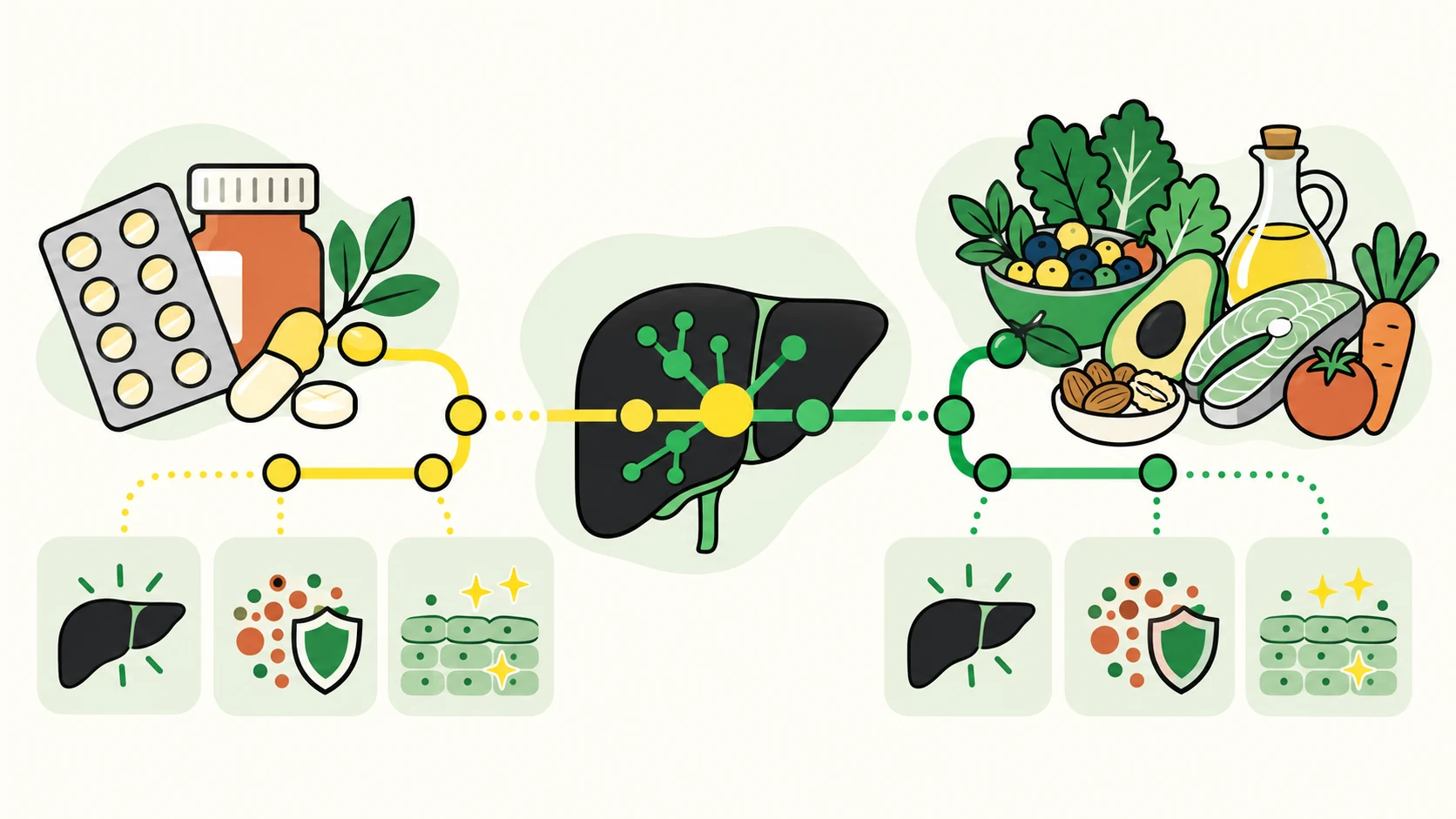
Reading evidence in context
- Observed outcome
- Certainty
- Duration
- What remains unknown
Education is not diagnosis
- General education
- Personal self-check
- Clinician discussion
- Urgent care if needed
What medication trials actually tested
In STEP 1, 1,961 adults with overweight or obesity and without diabetes were randomized to once-weekly semaglutide 2.4 mg or placebo, both alongside a lifestyle intervention. Mean weight change at 68 weeks was -14.9% with semaglutide and -2.4% with placebo.1 Gastrointestinal adverse effects were common, and discontinuation because of gastrointestinal events was more frequent with semaglutide.
In SURMOUNT-1, 2,539 adults with obesity, or overweight with a complication, and without diabetes were randomized to tirzepatide or placebo alongside lifestyle intervention. At 72 weeks, mean weight changes were -15.0%, -19.5%, and -20.9% across the three tirzepatide doses and -3.1% with placebo.2 Tirzepatide is not pharmacologically identical to a GLP-1-only agonist.
Those figures belong to those protocols. They are not guaranteed outcomes, and the approved indication, contraindications, warnings, access, tolerability, and other medicines matter. The current Wegovy label includes warnings about pancreatitis, gallbladder disease, severe gastrointestinal reactions, acute kidney injury from volume depletion, and hypoglycemia with insulin or an insulin secretagogue.3
What low-carbohydrate trials can show
“Low carb” in a research paper may mean less than 130 grams per day, less than a percentage of energy, or a much stricter ketogenic intake. Interventions also differ in calorie targets, counseling, fat quality, protein, and medication adjustment. A 2022 Cochrane review found little to no difference in weight loss between low-carbohydrate and balanced-carbohydrate weight-reducing diets for up to two years, with limited certainty for several outcomes.4 That review does not prove that every ketogenic program performs identically; it shows why a universal diet effect should not be inferred.
For type 2 diabetes, lowering carbohydrate can change glucose quickly and may require medication adjustment. Very-low-carbohydrate intake, fasting, and dehydration are ketoacidosis risk factors with SGLT2 inhibitors, while insulin and insulin secretagogues can cause hypoglycemia.5 A ketogenic diet also needs attention to fiber, micronutrients, saturated fat, food variety, and long-term feasibility.
Side-by-side questions that matter
| Question | Prescription incretin medicine | Ketogenic diet |
|---|---|---|
| What is it? | A regulated medicine for labeled indications | A carbohydrate-restricted eating pattern |
| Evidence unit | A specific drug, dose, population, and trial | A defined diet protocol and support program |
| Main practical constraint | Eligibility, adverse effects, monitoring, access | Food restriction, planning, tolerance, adherence |
| Medication interaction | May require adjustment of other glucose-lowering drugs | Can rapidly change glucose and medication needs |
| What happens if stopped? | Appetite and weight can rebound; continuation decisions are clinical | Effects depend on the next eating pattern and energy intake |
| Can it set protein needs? | No | No |
The keto calculator is an input-only macro arithmetic worksheet. It calculates results from values you enter; it does not choose a personalized protein or macro target.
Can they be combined?
They can be used together under clinical supervision, but that is not proof of extra benefit. The 2025 four-society advisory supports nutritional assessment and high-quality food during GLP-1 therapy, while noting gaps in evidence and the risk of nutritional inadequacy.6 It does not establish a ketogenic combination as superior.
When appetite is already small, adding a restrictive diet can reduce food variety and total intake. Review keto while taking a GLP-1, what to eat on a GLP-1, and the lean-mass evidence before making that change.
A better decision framework
Discuss these points with the clinician who knows the diagnosis and medication list:
- What outcome is being treated: obesity, diabetes, cardiovascular risk, sleep apnea, another labeled indication, or dietary preference?
- Does the expected benefit outweigh the medicine's risks for this person?
- Is a restrictive diet compatible with nutrition needs, pregnancy status, kidney or liver health, and eating-disorder history?
- Which medicines would require glucose monitoring or adjustment?
- What plan is sustainable if symptoms occur or treatment changes?
Keto is not “natural Ozempic,” and an incretin medicine does not remove the need for adequate nutrition. The valid comparison is between complete, individualized care options rather than headline percentages.
Frequently Asked Questions
Is keto as effective as semaglutide or tirzepatide?
Is tirzepatide a GLP-1 receptor agonist?
Can keto replace a prescribed GLP-1 medicine?
Does combining keto with a GLP-1 work better?
Can the keto calculator choose between them?
Works cited
Article history
- Rebuilt the comparison around separate trial designs, medication safety, diet evidence, and combination uncertainty
- First published
Your learning guide