Fresh, Frozen or Canned Vegetables: Pick the Form You'll Use
Start with the kitchen you actually have: where the food will be stored, how you will heat it, and what dish it is going into. Fresh, frozen, and canned vegetables each fit some setups better than others, and none of them is the universal winner for health, price, taste, or carbohydrate count. This guide helps you pick the form you will really use, then compares nine USDA records side by side.
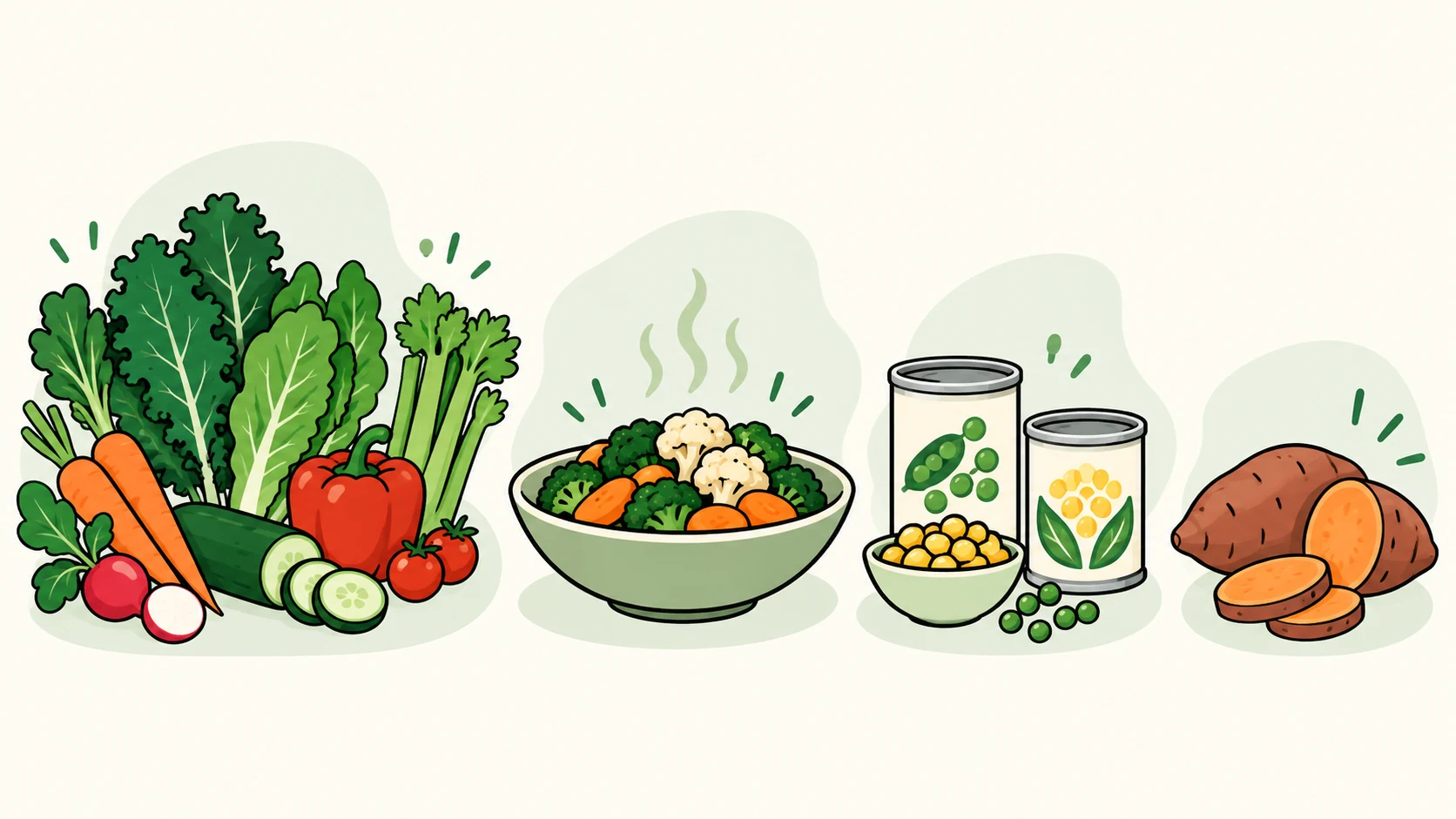
Match the form to your equipment and the dish
Use this matrix to narrow the choice. It is a planning aid, not a ranking. Each row pairs an action with a check you can do at the counter or on the package.
Small-screen view: this comparison table scrolls sideways. Swipe or drag it horizontally to see every column.
| Situation | Forms to consider | Action | Check |
|---|---|---|---|
| Cooked side dish at home | Fresh, plain frozen, or canned, whichever suits your stove or microwave | Prepare it by the package directions, or by a reliable method if it is unpackaged fresh produce | Ingredient list for sauce, added fat, and salt; the amount you actually eat after preparation |
| Pantry shelf, no freezer | A canned or other shelf-stable package | Keep it unopened until you need it, stored as the label directs | Label storage directions; can condition (see the storage section) 2 |
| Packed meal | Fresh, plain frozen, or canned, whichever your reheating setup can handle | Prepare it, measure what you will eat, and pack it cold | Refrigeration at every stage; see the packed lunches guide for the whole workflow |
If price is your main question, the keto on a budget guide is the better place to start. To browse other vegetables, use the vegetable directory.
What to check on your own product
Whatever form you choose, check these four things on the food you are actually buying:
- Ingredients: look for sauce, added fat, and added salt, and read the sodium value on the label.
- Edible or drained amount: work out what you will actually eat after draining, cooking, or discarding liquid, not the weight on the front of the package.
- Preparation: follow the package directions. Commercially frozen foods should be cooked according to their package directions 2. Fresh, unpackaged produce has no package directions, so use a reliable preparation method suited to that vegetable.
- Storage: read the storage directions on the label, before and after opening 2.
How to read the records
The tables below use nine USDA FoodData Central FNDDS records. Each is a cooked, no-added-fat record, and each shows its FDC ID so you can look it up 1.
- Not a supermarket label. These are not raw-product labels, and they are not no-salt records. No added fat does not mean unsalted, drained, or low in sodium, and it does not mean every record used the same cooking method 1.
- Your food has to match. The drained weight and cooking method of the food you eat should match what the record defines. Do not assume that from the record's wording.
- Different units. Sodium is in milligrams (mg); carbohydrate and fiber are in grams (g).
Per 100 g: the same-weight comparison
Per-100 g values put every record on the same weight, so start here when comparing forms 1.
Small-screen view: this comparison table scrolls sideways. Swipe or drag it horizontally to see every column.
| Record (FDC ID) | Total carbohydrate (g) | Fiber (g) | Calculated net (g) | Sodium (mg) |
|---|---|---|---|---|
| Asparagus, fresh (2709834) | 4.2 | 2.3 | 1.9 | 127 |
| Asparagus, frozen (2709835) | 1.9 | 1.6 | 0.3 | 119 |
| Asparagus, canned (2709836) | 2.5 | 1.6 | 0.9 | 287 |
| Green beans, fresh (2709852) | 7.7 | 3.1 | 4.6 | 121 |
| Green beans, frozen (2709853) | 6.4 | 3.0 | 3.4 | 117 |
| Green beans, canned (2709854) | 4.1 | 1.9 | 2.2 | 282 |
| Spinach, fresh (2709615) | 3.1 | 1.9 | 1.2 | 262 |
| Spinach, frozen (2709616) | 4.8 | 3.7 | 1.1 | 212 |
| Spinach, canned (2709617) | 3.4 | 2.4 | 1.0 | 322 |
What these rows show is limited to these records 1:
- Net carbohydrate: the order changes with the vegetable. The frozen asparagus record has the lowest net value of the three asparagus records, the fresh green beans record has the highest of the three green bean records, and the three spinach records sit close together at 1.0 to 1.2 g.
- Sodium: the canned record shows the highest recorded sodium per 100 g for each vegetable (287 mg for asparagus, 282 mg for green beans, 322 mg for spinach). That describes these records only. Your product's label is the value that applies to your food.
Per source cup: portion weights differ
A cup is not the same weight across records, so cup rows are not a like-for-like comparison. The canned asparagus record's cup is 240 g, while the other two asparagus records use 180 g. The fresh spinach cup is 180 g, while the frozen and canned spinach cups are 215 g 1. These listed source portions are not prescribed servings.
Small-screen view: this comparison table scrolls sideways. Swipe or drag it horizontally to see every column.
| Record (FDC ID) | Cup weight (g) | Total carbohydrate (g) | Fiber (g) | Calculated net (g) | Sodium (mg) |
|---|---|---|---|---|---|
| Asparagus, fresh (2709834) | 180 | 7.5 | 4.1 | 3.3 | 228.6 |
| Asparagus, frozen (2709835) | 180 | 3.4 | 2.9 | 0.6 | 214.2 |
| Asparagus, canned (2709836) | 240 | 5.9 | 3.8 | 2.1 | 688.8 |
| Green beans, fresh (2709852) | 140 | 10.8 | 4.3 | 6.4 | 169.4 |
| Green beans, frozen (2709853) | 140 | 9.0 | 4.2 | 4.8 | 163.8 |
| Green beans, canned (2709854) | 140 | 5.8 | 2.7 | 3.1 | 394.8 |
| Spinach, fresh (2709615) | 180 | 5.6 | 3.4 | 2.2 | 471.6 |
| Spinach, frozen (2709616) | 215 | 10.3 | 8.0 | 2.3 | 455.8 |
| Spinach, canned (2709617) | 215 | 7.3 | 5.2 | 2.2 | 692.3 |
Source and method notes
The records come from the USDA FNDDS release dated October 31, 2024, in a source snapshot accessed September 10, 2026. FNDDS records give nutrient values and source portion weights 1.
Net carbohydrate is total carbohydrate minus fiber, with a floor of zero. It was calculated from each record's unrounded per-100 g inputs, and only the final displayed value was rounded to one decimal, half up 1. Because of that, subtracting a displayed fiber value from a displayed total can differ from the displayed net by 0.1 g. Do not recompute from the rounded table values.
Our food database pages show rounded values, so to work out the amount you actually eat, use the unrounded per-100 g source inputs on the exact USDA record linked from that food's page, or the current product label for an exact packaged food. The net carb calculator and net carbs explained cover the method.
Storage and safety limits
Let the storage decision follow these FDA limits 2:
- Keep the refrigerator at or below 40°F (4°C) and the freezer at 0°F (-18°C).
- Do not leave perishable food out more than 2 hours, or 1 hour when it is above 90°F.
- Follow package cooking directions for commercially frozen foods, and check the storage directions on labels.
- Swelling, leaks, punctures, deep rust, and severe crushing or denting are warning signs on canned goods. Avoid damaged cans.
Checking the package each time you use it matters, but a check is not a guarantee, and appearance or smell is not proof that food is safe.
Two hypothetical kitchens
These are planning examples, not tested recipes, and they do not add up complete macros.
Hotel room with a microwave, a thermometer-confirmed adequate fridge, and no freezer. No freezer means you cannot plan to store frozen food, but a frozen product that you prepare promptly, following its label, is still possible. Canned or fresh products are other planning choices, not the only ones. Decide how much you will eat in one sitting and pick a product whose directions fit a microwave. Buy or open only that quantity if you can. Keep any leftovers within the temperature and time limits above, and skip planning for them if you cannot keep them cold 2. A mini-fridge should not be assumed cold enough without a thermometer reading 2. The low-carb hotel meals guide covers the wider setup.
Home freezer and microwave, preparing a lunch. Compare plain frozen forms by their package directions, including ingredients, sauce, and added fat. Prepare the vegetable as directed, then measure the amount you will actually eat after preparation and use that weight, not the package weight, in any calculation. Keep the packed lunch refrigerated through transport. The packed lunches guide walks through the complete workflow.
If you do not have reliable refrigeration
Without a dependable way to keep food cold, lean on an unopened shelf-stable product, used as its package indicates, and do not plan on leftovers. Do not assume every canned food is ready to eat without heating; the label says how that product is meant to be used.
Where to go next
To turn a choice into a shopping plan, see the keto grocery shopping list. For individual record pages, use the links in the per-100 g table.
Works cited
Article history
- First published
Your learning guide