Signs of Ketosis: What Symptoms and Tests Can Tell You
There is no validated symptom checklist for nutritional ketosis. Breath acetone can change, but appetite, weight, energy, concentration, thirst, digestive symptoms, sleep, and exercise performance cannot confirm a blood beta-hydroxybutyrate (BHB) level and may have unrelated causes.
Testing can measure one ketone compound at one point in time. It does not prove body-fat loss, diet quality, treatment success, or a safe medical state. If you need help interpreting a result, use the ketone level interpreter and apply the safety guidance on this page.
Education is not diagnosis
- General education
- Personal self-check
- Clinician discussion
- Urgent care if needed
Why symptoms cannot confirm ketosis
Ketosis changes how the liver supplies energy, but glucose production and glucose use continue. The liver makes acetoacetate and BHB from fatty-acid-derived acetyl-CoA, while tissues use a mixture of fuels. Symptoms do not reveal which fuel a particular tissue is using. The science of ketosis guide explains that physiology in more detail.
Several experiences are often marketed as “signs,” but the evidence does not support a diagnostic checklist:
- Breath odor: acetone is volatile and can create a fruity or solvent-like odor. Breath odor alone neither measures blood BHB nor distinguishes nutritional ketosis from DKA.
- Appetite: a ketone-ester study led by Esben Thyssen Vestergaard found lower hunger measures in ten healthy men, while a study led by Catia Martins found hormone associations after a very-low-energy diet but no association between ketosis and subjective appetite. These studies do not validate appetite as a ketosis test.12
- Focus, energy, and sleep: a small randomized crossover study led by Stella Iacovides confirmed ketosis but found no meaningful difference in cognition, mood, or sleep between diets. Personal experiences can vary, yet these sensations cannot confirm ketosis.3
- Early scale change: glycogen and fluid shifts can change body mass after carbohydrate restriction. A scale cannot separate water, food mass, lean tissue, and fat without further measurement.
- Fatigue, headache, nausea, thirst, or digestive changes: these are nonspecific. They may accompany a diet change, inadequate food or fluid intake, an infection, a medication effect, hypoglycemia, hyperglycemia, or another condition. See the evidence review of the informal term keto flu.
- Exercise performance: training status, glycogen availability, energy intake, sleep, hydration, and the type of exercise all matter. A stronger or weaker workout cannot establish a ketone concentration.
Symptoms can be useful reasons to pause and assess how you feel. They are poor measurement tools.
What each ketone test measures
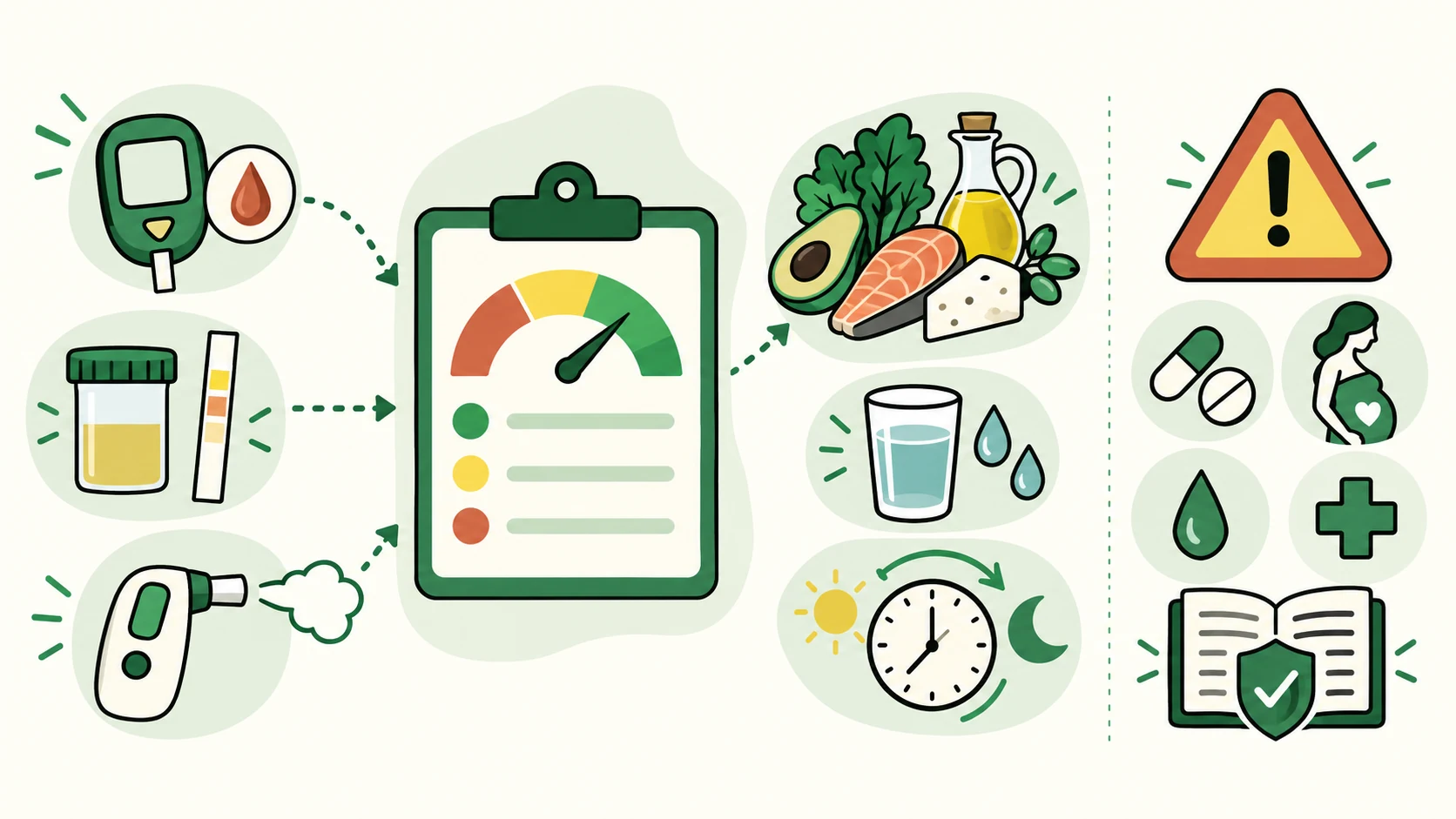
Blood, urine, and breath tests measure different compounds. Their numbers are not interchangeable.
| Method | What it measures | What the result can tell you | Important limitation |
|---|---|---|---|
| Blood meter | BHB in capillary blood | A quantitative BHB concentration at that moment | It does not measure acidosis or “total ketones.” |
| Urine strip | Excreted acetoacetate, semi-quantitatively | Whether acetoacetate was present in that urine sample | Hydration, renal function, timing, and time since voiding affect the result; it misses BHB. |
| Breath device | Acetone in exhaled breath | A device-specific acetone reading or trend | Scales differ by device and cannot be converted reliably to blood BHB. |
Blood BHB is the preferred direct ketone measurement when clinicians assess suspected DKA. Urine nitroprusside tests do not measure BHB and can underestimate early DKA or appear to worsen during recovery as BHB converts to acetoacetate.4 Read the dedicated guides to blood ketone meters and urine ketone strips before comparing results.
Breath acetone can be useful for a personal trend when a device is used consistently. It cannot exclude DKA and should not be translated into a blood BHB value unless a validated device-specific method supports that conversion.
What does a BHB result mean?
Research often uses blood BHB of at least 0.5 mmol/L as an operational definition of nutritional ketosis.4 That convention is not a validated weight-loss target, wellness range, or personal carbohydrate ceiling. No universally beneficial BHB range exists for general health.
A result is a snapshot of ketone production, tissue use, distribution, and clearance. A higher number does not show that more body fat is being lost, and a lower post-meal number cannot identify a specific cause such as protein conversion to glucose.
Therapeutic ketogenic diets use condition-specific protocols. Adult epilepsy programs may consider diet composition, symptoms, medication, seizures, weight, nutritional status, and laboratory results together; a generic internet target cannot replace that team’s protocol.5
A ketone meter cannot diagnose or rule out DKA
The 2024 international consensus led by Guillermo Umpierrez requires all three components for adult DKA:6
- diabetes or glucose of at least 200 mg/dL;
- BHB of at least 3.0 mmol/L or urine ketones of at least 2+; and
- metabolic acidosis, shown by pH below 7.3 and/or bicarbonate below 18 mmol/L.
BHB of 3.0 mmol/L meets only the ketone component. A home meter cannot measure pH or bicarbonate, so it cannot diagnose or exclude DKA by itself. About 10% of DKA presentations in the consensus evidence had glucose below 200 mg/dL. This euglycemic form is associated with contexts including pregnancy, reduced food intake, and SGLT2-inhibitor use.
Seek urgent medical assessment for repeated vomiting or inability to retain fluids, severe abdominal pain, confusion, fainting, difficulty waking, or rapid, deep, or difficult breathing. Do this regardless of a home glucose reading. The CDC lists vomiting, abdominal pain, fruity breath, and breathing difficulty among DKA warning signs.7
If you have diabetes or take an SGLT2 inhibitor and develop nausea, vomiting, abdominal pain, malaise, breathlessness, or elevated ketones, follow your prescribed sick-day plan and seek prompt assessment. Do not stop basal insulin or alter medication based on this page. The 2026 American Diabetes Association Standards discourage ketogenic eating patterns in people at risk for DKA who use an SGLT2 inhibitor.8
Very-low-carbohydrate eating patterns are not recommended during pregnancy or lactation in the 2026 ADA nutrition guidance. Pregnancy lowers the threshold for professional advice about symptoms or ketones.9
The DKA glossary guide and ketosis-versus-ketoacidosis guide provide more detail.
When is home testing useful?
Testing has a clear role when a clinician has given you a disease-specific monitoring plan. Follow the device instructions and the thresholds in that plan.
For general dietary curiosity, first decide what action the result would change. Repeated testing may add cost without answering whether the diet is nutritionally adequate, sustainable, or producing the outcome you care about. Track the outcome directly when possible and discuss medical goals with a qualified clinician.
Frequently Asked Questions
Can you be in ketosis without keto breath?
Are urine strips accurate for long-term keto?
What is a good ketone level for weight loss?
Does feeling no symptoms mean ketosis is absent?
Does BHB above 3.0 mmol/L mean DKA?
Works cited
Article history
- Evidence and safety review: removed the unsupported ten-sign framework and optimal ketone zones, clarified test limitations, and added current DKA, SGLT2-inhibitor, medication, and pregnancy guidance
- First published
Your learning guide