How to Freeze and Store Keto Meals Safely
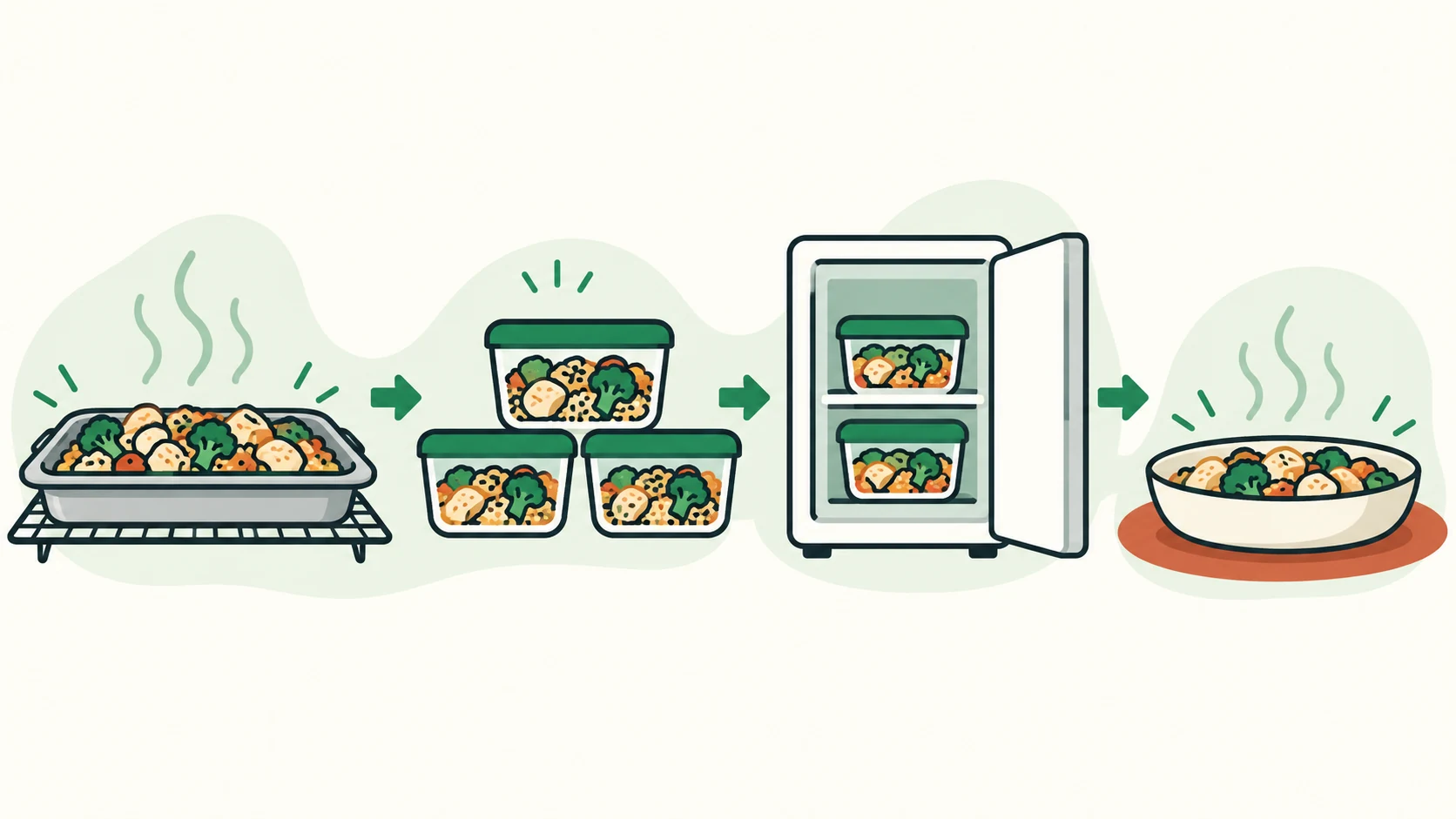
Freezing pauses microbial growth; it does not sterilize food. When food thaws, surviving microorganisms can become active again. Safe freezer prep therefore starts before the container reaches the freezer: cook the food correctly, cool it promptly, prevent cross-contamination, and keep a reliable date label.1
“Keto” does not create a separate storage rule. The food in the dish determines its handling. A chicken casserole follows cooked poultry and casserole guidance. An egg salad remains a salad that does not freeze well. A low-carbohydrate label does not extend either item's refrigerator life.
Recipe and storage checks
- Check ingredients
- Cook safely
- Cool and store
- Reheat or discard
What freezes well, and what loses texture
Food can remain safe while continuously frozen at 0°F (-18°C), but texture, moisture, flavor, and color can deteriorate. USDA freezer time ranges describe best quality rather than a point when continuously frozen food suddenly becomes unsafe.1
| Usually freezes well | Likely quality change | Better approach |
|---|---|---|
| Soups, stews, braises, and cooked meat in sauce | Some vegetables soften further during reheating | Stop cooking while the vegetables still have structure, then finish after reheating if the recipe permits |
| Meatballs, cooked patties, shredded poultry, and many casseroles | Lean meat can dry out when exposed to air | Use airtight freezer packaging and include sauce separately when useful |
| Sliced low-carbohydrate bread and other firm baked goods | Whole loaves take longer to thaw and invite repeated handling | Freeze separated slices so only the needed amount is removed |
| Blanched or cooked sturdy vegetables | Ice crystals damage cell walls, so thawed vegetables will be softer | Use thawed vegetables in soups, casseroles, frittatas, or sautés rather than expecting raw texture |
| Undressed cooked components | Garnishes and fresh herbs can wilt | Freeze the base and add fresh finishes at serving |
Some foods are safe to freeze but disappointing after thawing. USDA notes that emulsions such as mayonnaise and cream can separate. The FoodSafety.gov chart says egg, chicken, ham, tuna, and macaroni salads do not freeze well; it also advises against freezing hard-cooked eggs.12 Raw cucumber, salad leaves, and other high-water produce lose crispness as ice crystals damage their cells. Fried or crisp coatings also soften when enclosed with moisture.
Freeze a small test portion when texture matters. A separated cream sauce may sometimes be stirred back together over gentle heat, but that is a quality repair, not a safety test.
Cool food in shallow containers
Perishable food should be refrigerated or frozen within two hours of cooking or removal from hot holding. When the surrounding temperature is above 90°F (32°C), the limit is one hour. Divide soup, casserole, cooked meat, and other large batches into shallow containers so heat can leave quickly. USDA FSIS says hot food can be placed directly in the refrigerator or rapidly chilled in an ice or cold-water bath before refrigeration.3
Do not leave a stockpot or deep casserole on the counter until it feels cool. The outside may cool while the center remains in the 40°F to 140°F (4°C to 60°C) range where bacteria multiply quickly.
Keep the refrigerator at 40°F (4°C) or below and the freezer at 0°F (-18°C) or below. Use an appliance thermometer rather than relying only on the setting printed beside a dial.4
Package, label, and freeze promptly
Use containers or wrapping made for freezer storage. Airtight packaging limits moisture loss and freezer burn. A sensible label includes:
- the dish or component name;
- the date it was cooked;
- the date it entered the freezer, if different;
- an allergen or household note when relevant;
- a reheating note, such as “stir halfway and check several places.”
Freeze food while it is still in good condition. Freezing a portion near the end of its refrigerator window does not restore the days already used. If a meal is planned for a later week, package and freeze it during the original cooling and storage process.
Spread new packages in a single layer until frozen solid instead of stacking a warm mass of containers. USDA explains that faster freezing forms smaller ice crystals and generally protects texture better. Stack the packages after they are solid.1
The meal-prep workflow shows where labeling and freezer decisions fit into a batch-cooking session. For food ideas, use the keto recipe collection and follow each recipe's handling instructions.
Use category-specific storage ranges
There is no single freezer lifetime for every keto meal. Use the row that matches the actual dish, and check the current FoodSafety.gov chart or FoodKeeper for foods not covered here.
| Food category | Refrigerator at 40°F (4°C) or below | Freezer at 0°F (-18°C) or below | Meaning of the freezer range |
|---|---|---|---|
| General cooked leftovers | 3 to 4 days | USDA's general leftovers guide gives 3 to 4 months | Best-quality guidance |
| Soup or stew with vegetables or meat | 3 to 4 days | 2 to 3 months | Best-quality guidance |
| Cooked meat or poultry leftovers | 3 to 4 days | 2 to 6 months | Best-quality guidance |
| Baked egg casserole | 3 to 4 days | 2 to 3 months | Best-quality guidance |
| Egg, chicken, ham, tuna, or macaroni salad | 3 to 4 days | Does not freeze well | Texture guidance |
These are federal home-storage ranges, not dates inferred from ingredients or a generic meal-prep calendar.23 Commercial frozen meals and foods with package instructions should be handled according to the package. If the storage temperature or elapsed time is uncertain, discard the food rather than tasting it to decide.
Thaw by one of three safe methods
USDA recognizes three safe thawing methods: the refrigerator, cold water, and the microwave. Countertop thawing, hot water, a porch, a garage, or a car can leave part of the food at an unsafe temperature while the center is still frozen.5
Refrigerator
Place the wrapped food on a tray or in a container that can catch leaks. Refrigerator thawing takes planning, but the food remains cold throughout. Previously cooked leftovers thawed in the refrigerator can generally be used within three to four days or refrozen, although another freeze-thaw cycle may reduce quality.3
Cold water
Seal the food in a leakproof bag, submerge it in cold water, and change the water every 30 minutes. Reheat or cook it promptly after thawing. A leaking bag can introduce contamination and waterlog the food.1
Microwave
Use the defrost function when appropriate, then continue directly to reheating. USDA advises bringing microwave-thawed leftovers to 165°F (74°C), measured with a food thermometer. Partial warming creates areas where bacteria can multiply if the food is held for later.5
Frozen soup, stew, casserole, and other cooked leftovers can also be reheated from frozen in a saucepan, oven, or microwave. This takes longer, but it avoids a separate thawing period.3
Reheat to a measured 165°F
Reheat leftovers to 165°F (74°C) throughout. Test several places with a food thermometer rather than judging by steam, bubbling edges, or the temperature of the container.6
For even microwave reheating:
- move the food to a microwave-safe dish;
- cover it while leaving a vent for steam;
- stir or rotate during heating;
- follow any stated standing time;
- measure the temperature in several places.
USDA advises bringing sauces, soups, and gravies to a rolling boil during reheating. A slow cooker is useful for holding food hot after it has been reheated correctly, but it is not recommended as the reheating method because the food may remain too long in the unsafe temperature range.3
Reheat the amount you plan to eat when practical. Return untouched refrigerated food promptly. Keep the oldest safe package visible and use it first so dates remain easy to follow.
Refreeze only when the handling history supports it
Food thawed safely in the refrigerator can be refrozen without cooking, with an expected loss of quality. Food thawed in cold water or the microwave should be cooked or reheated before refreezing. Previously cooked leftovers can also be refrozen after reheating to a measured 165°F.13
Do not refreeze perishable food left at room temperature for more than two hours, or more than one hour above 90°F (32°C). Discard food that has been warmer than 40°F (4°C) for too long or whose temperature history cannot be established.
Freezing and storage questions
How long can a keto meal stay in the freezer?
Can I thaw a frozen meal on the counter?
Can I put hot leftovers directly in the refrigerator?
Do cream sauces and salads freeze well?
What temperature should a reheated frozen meal reach?
Sources
Article history
- Replaced inaccessible USDA FAQ links with stable federal thawing and reheating guidance
- First published
Your learning guide