Why Meal Planning Matters on Keto
Planning is a control for logistics and foreseeable risk. It can reveal repeated foods, missing vegetables, unsafe medication assumptions, expensive ingredients, and leftovers with no destination.
Planning is not a treatment. It cannot make keto appropriate for everyone, guarantee ketosis or weight loss, prevent induction symptoms, or correct a diet that is too restrictive to meet a person's needs.
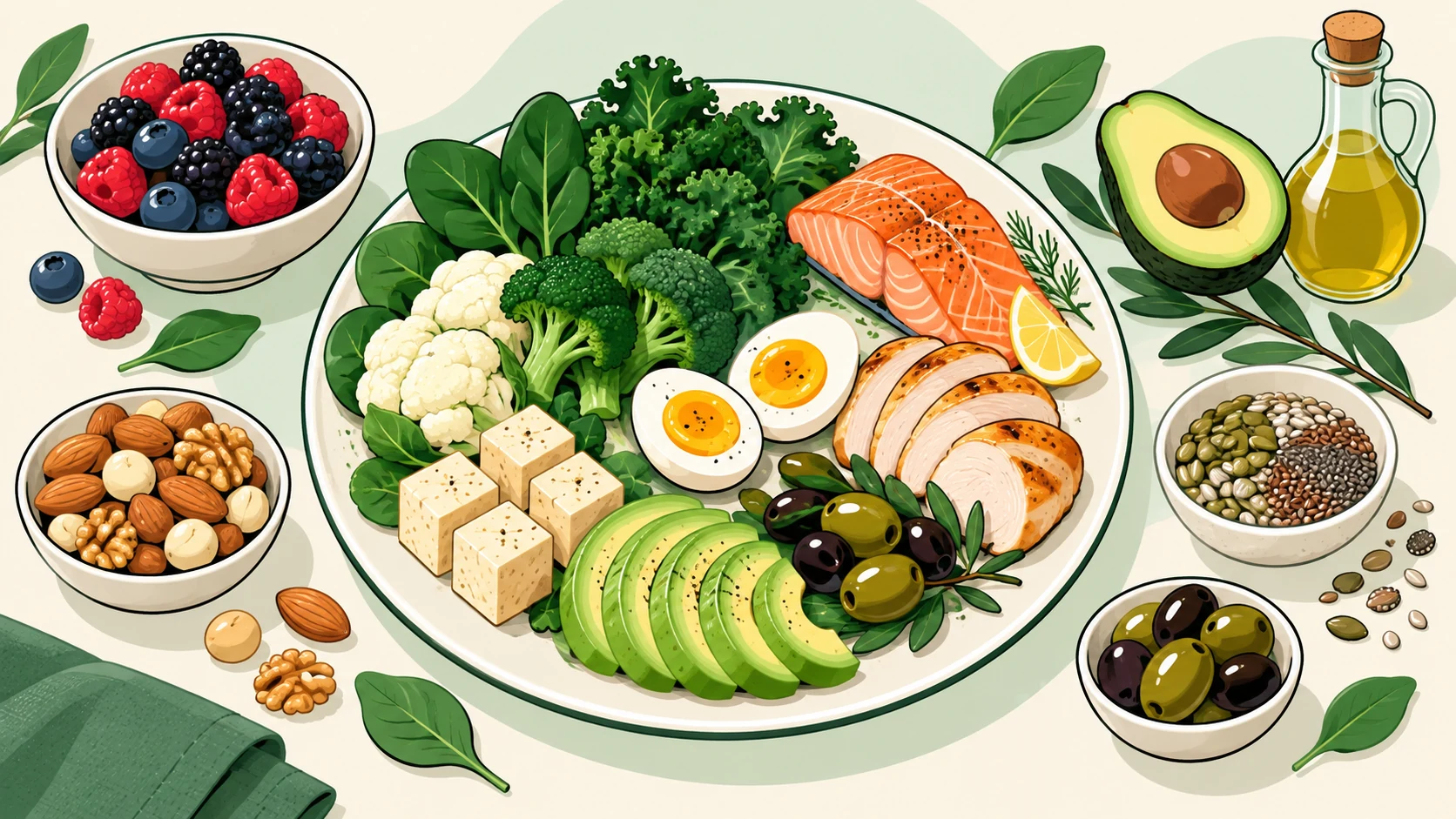
Meal planning is useful when it turns a vague intention into decisions that can be checked. Its value is especially practical on a ketogenic diet because removing or sharply limiting grains, legumes, fruit, and many prepared foods can narrow nutrient sources and complicate shared meals. The restriction also has medical consequences for some people taking glucose-lowering medicines.
The evidence does not support presenting planning itself as the reason a diet works. A plan can improve the conditions under which someone makes food decisions. The food pattern, health context, medication, access, and ability to continue still determine much of the result.
What research can tell us about planning
In a 2017 cross-sectional analysis of 40,554 French adults in the NutriNet-Santé cohort, researcher Pauline Ducrot and colleagues found that people who reported planning meals were more likely to score in the highest quartiles for adherence to French nutrition guidance and food variety. Meal planning was also associated with lower odds of obesity.1
That study did not test keto, and it cannot show that planning caused the differences. Participants volunteered for a web-based nutrition study, planning was self-reported, and body weight and height were self-reported. People who already had more time, nutrition interest, or resources may have been more likely to plan. The finding supports meal planning as a plausible tool, not as a proven weight-loss intervention.
Keto-specific evidence shows another boundary. Christopher Gardner and colleagues randomized 40 adults with prediabetes or type 2 diabetes to a well-formulated ketogenic diet and a Mediterranean-plus diet for 12 weeks each; 33 participants had complete primary-outcome data. HbA1c did not differ between the diets. During the ketogenic phase, fiber and three nutrients were lower, LDL cholesterol was higher, and follow-up eating patterns were closer to the Mediterranean-plus pattern.2 Even a structured diet supplied within a trial can have nutritional and sustainability trade-offs.
A flexible planning loop
- Plan
- Shop
- Prepare
- Review and adapt
Planning can expose nutrition gaps
A day of eggs, cheese, processed meat, butter, and a packaged “keto” snack may fit someone's carbohydrate arithmetic while providing little plant variety and a large amount of saturated fat. Writing several days together makes that repetition visible.
A useful review looks for:
- several types and colors of non-starchy vegetables;
- sources of fiber that fit the person's carbohydrate method;
- rotation among fish, poultry, eggs, tofu, tempeh, meat, dairy, seeds, nuts, or other suitable proteins;
- frequent use of predominantly unsaturated fats, such as olive or canola oil, avocado, seeds, nuts, and fish;
- nutrients made harder to obtain by the foods removed;
- enough total food for the person's needs.
The ADA's 2026 nutrition guidance for people with diabetes emphasizes individualized meal plans, nutrient-dense foods, high-fiber carbohydrate sources, plant proteins, and limiting saturated fat. It discourages ketogenic eating for people using SGLT2 inhibitors.3 These principles matter because a low carbohydrate total is not a measure of diet quality.
Planning can identify a likely gap, but a menu or tracking app cannot diagnose a deficiency. Symptoms, medical history, laboratory testing, and a clinician or registered dietitian may be needed. The detailed meal-plan builder shows how to audit food roles without forcing a fixed macro ratio.
Planning can make medication instructions usable
A sharp carbohydrate reduction may change glucose quickly enough that an old medication routine becomes unsafe. The relevant planning happens with the prescriber before the menu starts.
For a person using insulin or a sulfonylurea, a plan can record:
- the carbohydrate-counting method approved by the diabetes team;
- when and how glucose will be checked;
- clinician-provided dose and sick-day instructions;
- how hypoglycemia will be treated;
- who to contact when readings or symptoms fall outside the agreed range.
People taking an SGLT2 inhibitor need a different decision: the ADA discourages a ketogenic eating pattern because of ketoacidosis risk, which may occur at glucose levels lower than people expect.3 A meal calendar cannot offset that drug-diet interaction.
Pregnancy also changes the decision. The ADA's 2026 pregnancy standard advises avoiding eating patterns that severely restrict a macronutrient class, specifically including ketogenic patterns.4 Kidney disease can require individualized protein, sodium, potassium, phosphorus, and fluid choices that change with disease stage and treatment.5 Current or previous eating-disorder symptoms warrant an eating-disorder-informed assessment before adding food rules or tracking.
Use the suitability screen and the side-effects guide before treating fatigue, nausea, dizziness, or persistent constipation as a problem that more meal prep will solve.
Planning can put a ceiling on cost
A plan can control purchases even when it cannot lower local food prices. Inventory-first planning, unit-price comparisons, shared ingredients, frozen vegetables, store brands, and a maximum spend are more useful than a list built around specialty breads, bars, powders, or supplements.
The US Department of Agriculture's food-plan models use current food prices, nutrient targets, consumption data, and assumptions about food waste to estimate market baskets at several cost levels.6 Those models are not ketogenic meal plans and do not prove that keto costs less. They do show why cost belongs in the plan itself rather than in an afterthought at checkout.
The best-priced package can still be a poor buy if half will spoil. Plan the edible quantity, not the sticker price alone. The keto grocery guide explains how to compare current labels and packages without requiring organic, grass-fed, or branded “keto” products.
Planning can reduce avoidable waste, if storage is part of the plan
Giving a perishable ingredient two scheduled uses may prevent it from being forgotten. Assigning a date to leftovers can also make the next lunch easier. Neither step proves a population-level reduction in waste, but both give each purchased quantity a destination.
Batch cooking adds a safety obligation. The US Department of Agriculture advises refrigerating perishable leftovers within two hours, or one hour above 90°F/32°C; large batches should be divided into shallow containers. Refrigerated leftovers are generally kept for three to four days before being used or discarded, with longer storage moved to the freezer.7
Labeling a container “Thursday lunch” does not make it safe after improper cooling. Clean hands and surfaces, separate raw foods, cook to safe temperatures, and chill promptly. Check the guidance for the exact food and for anyone at higher risk of foodborne illness.
Planning can reduce repeated decisions, not remove friction
Choosing meals once can reduce the number of decisions made during a busy week. A backup meal can prevent a missed grocery trip from turning into an urgent search for food. Shared ingredients can shorten preparation.
The plan still has to fit actual working conditions. It may fail because a recipe takes too long, a child will not eat it, the only shop is out of an ingredient, a cultural staple was removed, or the planned food is unsatisfying. Those are design findings, not evidence of weak commitment.
For allergies, the ingredient list and preparation environment matter more than the plan's title. In the United States, packaged foods must identify the nine major allergens used as ingredients. Precautionary statements such as “may contain” are voluntary and do not provide a uniform measure of cross-contact risk.8 A diagnosed allergy requires the person's clinical avoidance plan and a fresh label check for every purchase.
Vegetarian and vegan keto patterns need particular scrutiny because they combine restrictions. If the remaining set of foods cannot provide adequate variety or the plan depends heavily on supplements and specialty products, a less carbohydrate-restricted vegetarian or vegan pattern is a practical alternative. Religious practice, cultural foods, household needs, and access should be treated as design requirements rather than obstacles to compliance.
What meal planning cannot fix
| Problem | Why planning is insufficient |
|---|---|
| Keto is medically unsuitable | A neat menu does not resolve medication, pregnancy, kidney, eating-disorder, or other clinical risk. |
| The diet lacks nutrient variety | Repeating the same narrow set of foods more efficiently still leaves a narrow diet. |
| The carbohydrate target is inappropriate | There is no universal ratio or gram target. Clinical protocols and individual needs differ. |
| A promised outcome does not occur | Ketosis does not guarantee fat loss, better glucose control, improved cognition, or symptom relief. |
| Induction symptoms are persistent or severe | Planning does not prove a cause and does not justify generic salt, potassium, magnesium, or fluid dosing. |
| The plan requires unavailable money, time, equipment, or food | A document cannot create access. The diet or the plan must change. |
| Restriction increases anxiety, compulsive tracking, or loss-of-control eating | More detailed rules can intensify the problem. Stop and seek appropriate support. |
Our macro guide explains the limits of calorie and macro estimates. The food list can help widen ingredient choices, but it should remain subordinate to safety, nutrition quality, and feasibility.
A minimum viable planning method
A useful first plan can fit on one page. It does not need seven unique days, precise graphics, or an app.
- Write the non-negotiables: medical instructions, allergens, cultural requirements, budget, cooking limits, and the carbohydrate-counting convention.
- Inventory perishable food: schedule what needs to be used first.
- Choose three dinners: give each a protein source, at least one non-starchy vegetable, and an unsaturated-fat source. Identify which dinners will make a safe leftover lunch.
- Choose repeatable breakfasts or lunches: repetition is reasonable when the rest of the plan supplies variety.
- Name one backup: use an allergen-safe shelf-stable or frozen meal for disruptions.
- Set storage dates and a review point: note what was wasted, expensive, difficult, unsatisfying, or associated with symptoms.
For a complete workflow, substitutions, label conventions, and a printable planning structure, use how to create a keto meal plan. If examples help, adapt the seven-day keto meal plan rather than treating it as a prescription.
A person who finds that a Mediterranean-style, moderately lower-carbohydrate, or other balanced pattern is safer and easier to sustain can keep the same planning method. The plan has done its job when it clarifies that decision.
Sources
Article history
- Legacy update; details were not recorded
- First published
Your learning guide