High-Protein Low-Carb: Evidence, Targets & Meals
Start with what's actually in front of you: a food and a meal moment, not an abstract number. Are you looking at a carton of eggs before work, a tub of yogurt for a snack, or a rotisserie chicken for dinner? Before comparing them, decide which benchmark below actually applies to your situation — benchmarks meant for a healthy adult, an athlete in training, or someone managing a diagnosed condition are not interchangeable, and using the wrong one can lead you to over- or under-shoot in ways that matter.
That's especially true if you're living with kidney disease or cirrhosis, are pregnant, take medication for diabetes, are frail or recovering from illness, or have a history of disordered eating. A generic target pulled from a guide like this one may not fit; ask a clinician or registered dietitian who knows your labs, medications, and history. This page won't supply a personal number for you; it's meant to help you compare foods and benchmarks clearly enough to bring a useful question to that conversation.
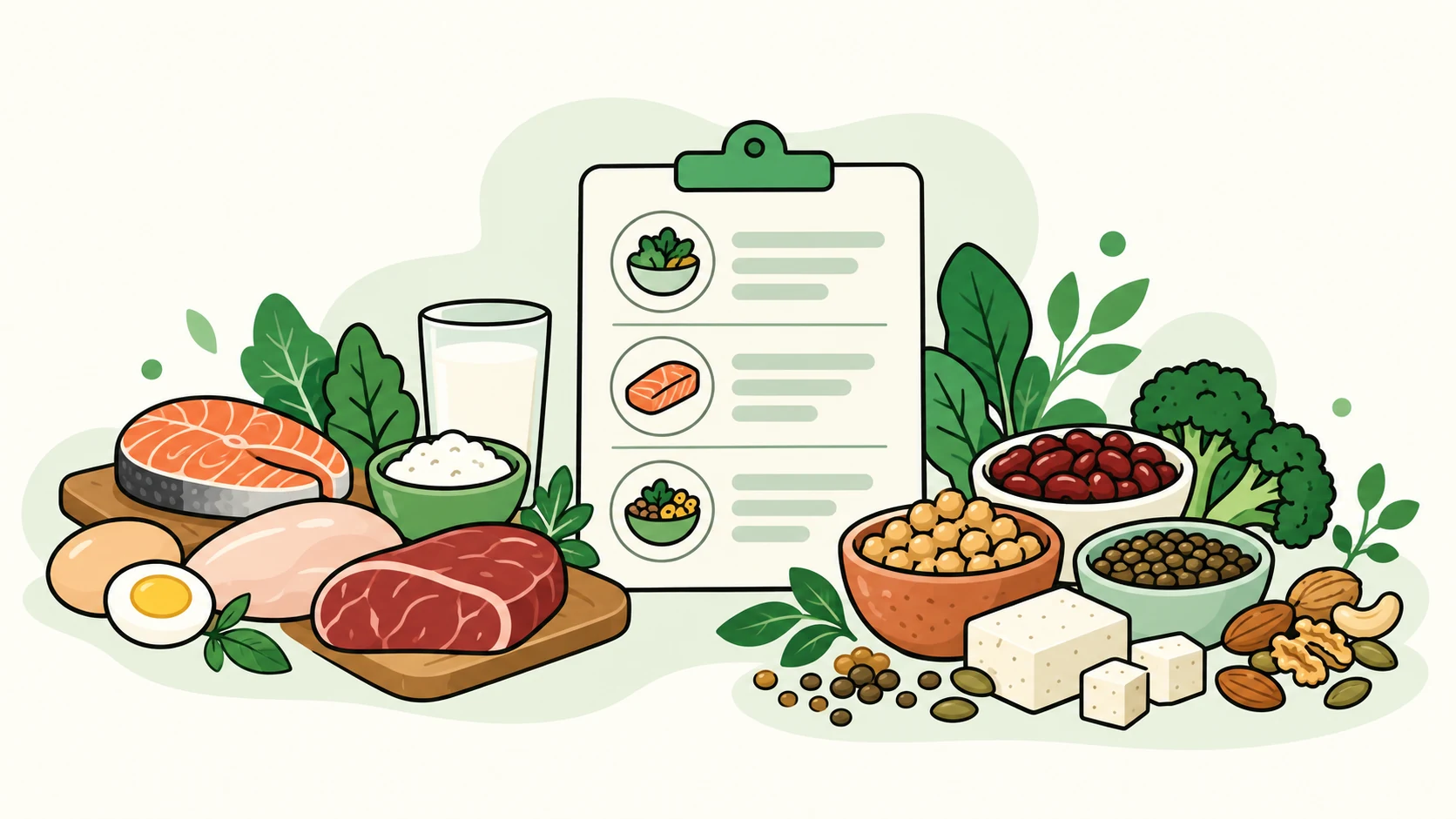
Comparing foods side by side
Once you know which benchmark applies to you, it helps to see what a handful of common protein foods actually contribute — not as a meal plan, but as a reference point. The table below uses this site's frozen USDA food-record data for four single foods in specific edible forms and gram amounts. A bowl or plate built around any of these will add its own protein and carbohydrate from everything else on it — rice, bread, vegetables, dressing, sauce — so these numbers describe the food alone, not a finished meal, and they aren't a claim that a 50 g egg "equals" a 120 g chicken breast in any meaningful sense beyond what's in this table.
| Food (exact form) | Amount | Protein | Total carbohydrate |
|---|---|---|---|
| Whole egg, boiled or poached | 50 g | 6.2 g | 0.5 g |
| Greek yogurt, nonfat milk, plain | 150 g | 15.5 g | 5.5 g |
| Chicken breast, baked/broiled/roasted, skin not eaten, from raw | 120 g | 36.2 g | 0 g |
| Almonds, unroasted | 28.35 g | 6.1 g | 5.7 g |
A quick example of how to use this: say you're choosing between a small handful of almonds (28.35 g) and a boiled egg (50 g) as a mid-afternoon protein bump. They land close on protein — 6.1 g versus 6.2 g — but the almond portion carries noticeably more carbohydrate, 5.7 g against 0.5 g. That's a comparison between two actual portions, not a running meal total; if you're also having yogurt or chicken at the same sitting, add each food's own numbers rather than assuming any one row already accounts for the rest of your plate.
Almonds and Greek yogurt are typically bought packaged, and packaged nutrition facts can shift between brands, flavors, and reformulations. Treat the values above as a reference for the specific food and form described, and check the current label on whatever's actually in your kitchen before treating a packaged product as equivalent to it.
What counts as high-protein and low-carb?
There is no accepted clinical cutoff that makes a diet “high-protein low-carb.” Research papers define protein as grams per kilogram of body weight, a percentage of energy, or an absolute daily amount. Low-carbohydrate studies also use different thresholds. Those definitions are not interchangeable: 25% of calories can represent very different protein amounts at 1,200 and 3,000 calories.
Use two separate questions:
- What protein benchmark fits this person and purpose?
- What carbohydrate intake is safe, nutritionally adequate, and sustainable for that person?
A diet can be low in carbohydrate without producing measurable nutritional ketosis. Conversely, a person can produce ketones with more protein than a traditional therapeutic ketogenic diet permits. The high-protein keto guide explains that narrower overlap.
Which protein number should you use?
Current U.S. guidance contains two prominent adult benchmarks. They answer different policy questions and should be labeled accurately.
| Context | Benchmark | What it means |
|---|---|---|
| National Academies Dietary Reference Intake | 0.8 g/kg/day RDA for healthy adults | An intake designed to meet the requirement of nearly all healthy adults; it is not a muscle-building prescription |
| 2025–2030 Dietary Guidelines for Americans | 1.2–1.6 g/kg/day general goal | The current federal food-based guidance; it does not replace condition-specific clinical care |
| Exercise and strength training | Often 1.4–2.0 g/kg/day in sports guidance | A population-specific range, not a target for every adult |
| Chronic kidney disease stages G3–G5 | Around 0.8 g/kg/day; avoid more than 1.3 g/kg/day when at risk of progression | KDIGO guidance that requires clinical context and nutrition supervision |
| Stable cirrhosis | 1.2–1.5 g/kg ideal body weight/day | AASLD advises against routine protein restriction because malnutrition and sarcopenia are important risks |
The 0.8 g/kg RDA remains a valid Dietary Reference Intake. Calling it merely a “deficiency minimum” is inaccurate: the National Academies set an RDA to cover the needs of about 97–98% of healthy people in a life-stage group.1 The 2025–2030 Dietary Guidelines introduced a broader 1.2–1.6 g/kg goal for protein, accompanied by advice to prioritize nutrient-dense foods.2
Neither number is automatically a personal prescription. Actual body weight can produce an implausibly large result for some people with obesity, while ideal, adjusted, or fat-free mass methods require professional judgment. The 2025 joint GLP-1 nutrition advisory explicitly says there is no consensus on the best weight basis during obesity treatment.3
Does more protein stop ketosis?
Protein can provide amino acids for gluconeogenesis, and protein meals can affect insulin and glucagon. That does not support a rule that every extra gram of protein becomes glucose or that protein can never affect ketone levels.
Claire Fromentin and colleagues used stable isotopes after a 23 g egg-protein meal in eight healthy adults. Only a small share of the glucose produced over eight hours came directly from the ingested amino acids.4 This carefully controlled experiment is useful evidence against the “protein instantly turns to sugar” claim, but it does not test every protein dose, health condition, or ketogenic diet.
If ketosis is medically required, use the protocol and monitoring prescribed by the clinical team. If ketosis is a personal dietary goal, track the outcome that matters rather than relying on a fixed protein percentage. Our gluconeogenesis explainer covers the pathway and its limits.
Who may benefit from a protein-forward low-carb pattern?
A higher protein density can be useful when total energy intake is low, when resistance training raises recovery needs, or when preserving function during weight loss is a priority. Protein alone does not preserve skeletal muscle. Resistance exercise supplies the training stimulus, while adequate energy, sleep, and a workable program also matter.
Ralf Jäger and colleagues' sports-nutrition position stand places most exercising adults around 1.4–2.0 g/kg/day and allows higher context-specific intakes during intense training or energy restriction.5 Robert Morton and colleagues' meta-analysis found that protein supplementation enhanced gains from resistance training, with the average fat-free-mass response leveling near 1.62 g/kg/day in energy-sufficient participants.6 Fat-free mass is not identical to skeletal muscle, and this result is not a universal ceiling.
People using semaglutide, tirzepatide, or another incretin therapy may struggle to eat enough because appetite and meal size fall. Their priority is a nutritionally adequate plan plus structured resistance training, not a self-assigned maximum protein number. See protein and muscle during GLP-1 treatment.
When can generic high-protein advice be wrong?
- Chronic kidney disease: KDIGO recommends about 0.8 g/kg/day for adults with CKD G3–G5 and advises avoiding intake above 1.3 g/kg/day in people at risk of progression.7
- Cirrhosis: routine protein restriction can worsen malnutrition. AASLD guidance commonly targets 1.2–1.5 g/kg ideal body weight/day in stable cirrhosis.8
- Diabetes medication: lowering carbohydrate can change glucose patterns and insulin or sulfonylurea needs. SGLT2 inhibitors add a specific ketoacidosis risk with very-low-carbohydrate eating.
- Pregnancy and lactation: needs differ by life stage. A restrictive ketogenic plan requires obstetric and nutrition guidance.
- Low appetite, frailty, or eating-disorder history: adding another dietary rule can reduce total energy, fiber, and micronutrient intake.
These examples show why “ask your doctor if you have kidney or liver disease” is incomplete. Kidney and cirrhosis guidance can point in opposite directions.
How do you build the diet around food rather than ratios?
Start with a protein food that fits your dietary and medical context: fish, eggs, poultry, lean meat, tofu, tempeh, unsweetened dairy, or a suitable plant combination. Add non-starchy vegetables and an unsaturated fat such as olive oil, avocado, nuts, or seeds. Include enough fiber and total energy for the plan to remain nutritionally adequate.
Protein quantity does not cancel out food quality. Processed meat, butter, and cheese can keep carbohydrate low while pushing saturated fat and sodium high. A plate built from fish, tofu, vegetables, nuts, seeds, and olive oil has a different nutrient profile even if its protein total is similar.
For practical options without invented precision, use:
- meal templates for breakfast, lunch, and dinner;
- a food-by-food shopping guide;
- breakfast ideas;
- snacks selected by storage and appetite needs;
- the meal template builder to filter ideas by preferences and exclusions.
The meal and food guides intentionally avoid exact nutrition totals for underspecified combinations. Brand, cut, raw or cooked state, edible yield, and serving weight can change the result. For packaged foods, use the product label; for a calculated recipe, record every ingredient weight and the finished yield.
If you want a fixed ingredient list and method, the chicken Cobb salad and beanless beef chili are editorial formulas. Both are not kitchen-tested, and neither has a measured serving yield or approved protein calculation.
The keto calculator is an input-only macro arithmetic worksheet. It calculates results from values you enter; it does not choose a personalized protein or macro target.
Where to go from here
This page is meant to help you compare foods and benchmarks in general. If you're looking for something more specific to a moment in your day, these related guides go deeper:
- Building a morning routine around protein: High-protein, low-carb breakfast
- Structuring lunch or dinner: High-protein, low-carb meals
- Snacking between meals: High-protein keto snacks
- A broader list of protein-forward foods to choose from: Low-carb, high-protein foods
- Thinking past the short term: Reviewing keto long-term
Frequently Asked Questions
Is high-protein low-carb the same as keto?
Is 0.8 g/kg or 1.2–1.6 g/kg the official protein recommendation?
Does protein turn into sugar on keto?
Should someone with kidney disease eat high protein?
Should protein be restricted in cirrhosis?
Works cited
Your learning guide