Dirty vs Clean Keto: Terms, Not Standards
“Dirty keto” and “clean keto” are informal community labels, not standardized diets or clinical protocols. They usually contrast a low-carbohydrate pattern built around convenience and packaged foods with one built around less-processed foods. There is no agreed ingredient rule, macro split, certification, or clinical test that assigns either label.
Research on ketogenic diets or ultra-processed foods does not directly compare two stable protocols named “dirty keto” and “clean keto.” It cannot establish that both labels trigger ketosis at the same speed, predict weight-loss outcomes, or show that one label is the better long-term choice.
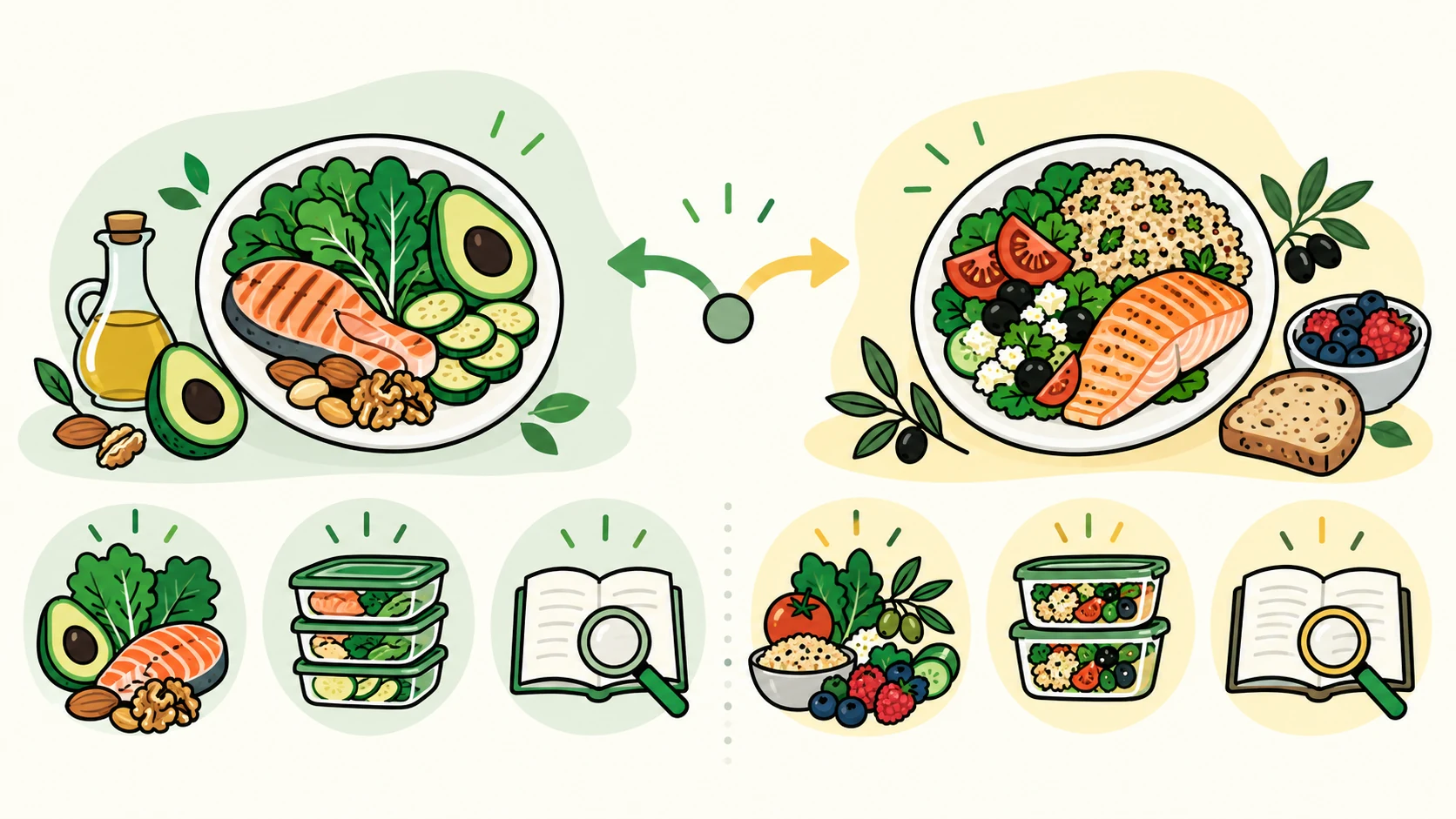
What do people usually mean by the terms?
“Dirty keto” usually means prioritizing a carbohydrate target while accepting more packaged, restaurant, or highly processed foods. “Clean keto” usually means choosing more whole or minimally processed foods while also restricting carbohydrate. These are descriptions of tendencies, not objective categories.
A bunless restaurant burger, deli meat, packaged low-carb bar, salad, home-cooked egg dish, or plain yogurt cannot be classified from packaging or ingredient count alone. Processing exists on a continuum, and a single food does not define the quality of an entire dietary pattern.
The words can also moralize food and people. A clearer description is usually available: “higher in sodium,” “contains processed meat,” “provides 5 g fiber,” “fits the budget,” or “convenient when traveling.”
Reading evidence in context
- Observed outcome
- Certainty
- Duration
- What remains unknown
What can and cannot be inferred?
| Question | What can be checked | What should not be promised |
|---|---|---|
| Carbohydrate | Current label, portion, full recipe, and documented calculation | That a category guarantees ketosis |
| Food processing | Ingredients and how the food was made | That one ingredient count defines health |
| Nutrient profile | Protein, fiber, sodium, saturated fat, vitamins, minerals, and calories | That “clean” automatically means complete |
| Weight change | Individual trend within a complete plan | Faster loss from either informal label |
| Long-term health | Evidence about specific foods and overall dietary patterns | A direct outcome from an undefined social-media category |
| Sustainability | Cost, access, preparation time, culture, enjoyment, and symptoms | That everyone should follow the same version |
Ketosis is a measurable metabolic state, but a label such as “clean” or “dirty” cannot predict it. The amount and pattern of carbohydrate, individual physiology, medicines, health conditions, and measurement method all matter.
What does evidence about food quality show?
Diet quality still matters within any carbohydrate level. The 2025–2030 Dietary Guidelines for Americans recommend nutrient-dense foods, vegetables and fruits, healthy fats, and significantly limiting highly processed foods. They also say saturated fat should generally remain below 10% of daily calories and sodium below 2,300 mg per day for the general population aged 14 and older.1
An umbrella review found associations between greater ultra-processed-food exposure and multiple adverse health outcomes, but much of that literature is observational and does not test “dirty keto” as a defined intervention.2 The evidence supports examining the whole pattern, not assigning a diagnosis to one convenience food.
WHO's cancer agency classifies processed meat as carcinogenic to humans based on evidence for colorectal cancer and reports that risk rises with the amount consumed.3 That supports limiting processed meat; it does not show that every packaged low-carb food has the same risk.
How can you assess a low-carbohydrate eating pattern?
Replace the clean/dirty verdict with specific questions.
- Is the carbohydrate information traceable? Use the current label or a documented recipe calculation, not a front-of-package keto claim.
- Does the pattern include varied nutrient-dense foods? Consider vegetables, protein sources, fats, fiber-containing foods, and micronutrient sources across the week.
- What are the sodium and saturated-fat totals? Restaurant food, processed meat, cheese, sauces, and packaged snacks can contribute large amounts.
- How much processed meat and highly processed food is routine? Frequency and the rest of the diet matter more than a one-off meal.
- Is the plan adequate and sustainable? Cost, access, culture, cooking time, enjoyment, gastrointestinal symptoms, and eating-disorder risk matter.
- Does medical context change the plan? Diabetes medicine, kidney or liver disease, pregnancy, childhood, epilepsy treatment, and other conditions require individualized guidance.
The keto food list can provide examples, while the net-carb calculator can document selected deductions from one label. Neither tool grades dietary quality or predicts a health outcome.
Are packaged foods automatically a poor choice?
No. Processing level is one dimension. Frozen vegetables, canned fish, plain yogurt, tofu, and other packaged foods can be nutrient-dense and practical. A long ingredient list is not a clinical risk score, and an unfamiliar ingredient name is not evidence that it is harmful.
Use the Nutrition Facts panel and ingredient list for concrete information. Compare products on the nutrients relevant to your needs. Convenience can improve adherence and food access, while frequent reliance on foods high in sodium, saturated fat, added sugar, or processed meat deserves a specific review.
Are expensive ingredients required?
No. “Clean keto” does not require grass-fed meat, pasture-raised eggs, wild-caught fish, specialty oils, or premium supplements. Those choices may reflect preference, availability, environmental goals, or animal-welfare priorities, but they are not a prerequisite for a less-processed eating pattern.
Budget options can include eggs, canned fish, frozen vegetables, cabbage, tofu, plain unsweetened dairy where tolerated, nuts or seeds in measured portions, and home-cooked meat or poultry. The appropriate mix depends on nutritional needs, culture, access, and medical context.
Which approach works better?
There is no direct evidence that answers this question for two undefined categories. A person can construct a nutrient-poor “clean” menu or a balanced pattern that includes some packaged foods. Weight change and ketone readings do not capture dietary adequacy, cardiovascular risk, gastrointestinal tolerance, or sustainability.
For long-term planning, use measurable features rather than a slogan: food variety, fiber, protein adequacy, sodium, saturated fat, processed-meat frequency, energy intake, symptoms, laboratory values when clinically indicated, and quality of life.
Frequently Asked Questions
What is dirty keto?
What is clean keto?
Does dirty keto cause faster or slower weight loss?
Do both versions produce ketosis?
Are all packaged foods dirty keto?
Which version should I choose?
Works cited
Article history
- Reframed dirty and clean keto as informal labels; removed fixed macro definitions and outcome predictions; added measurable food-quality criteria
- First published
Your learning guide