Keto vs Low Carb vs Carnivore: What Actually Sets Them Apart?

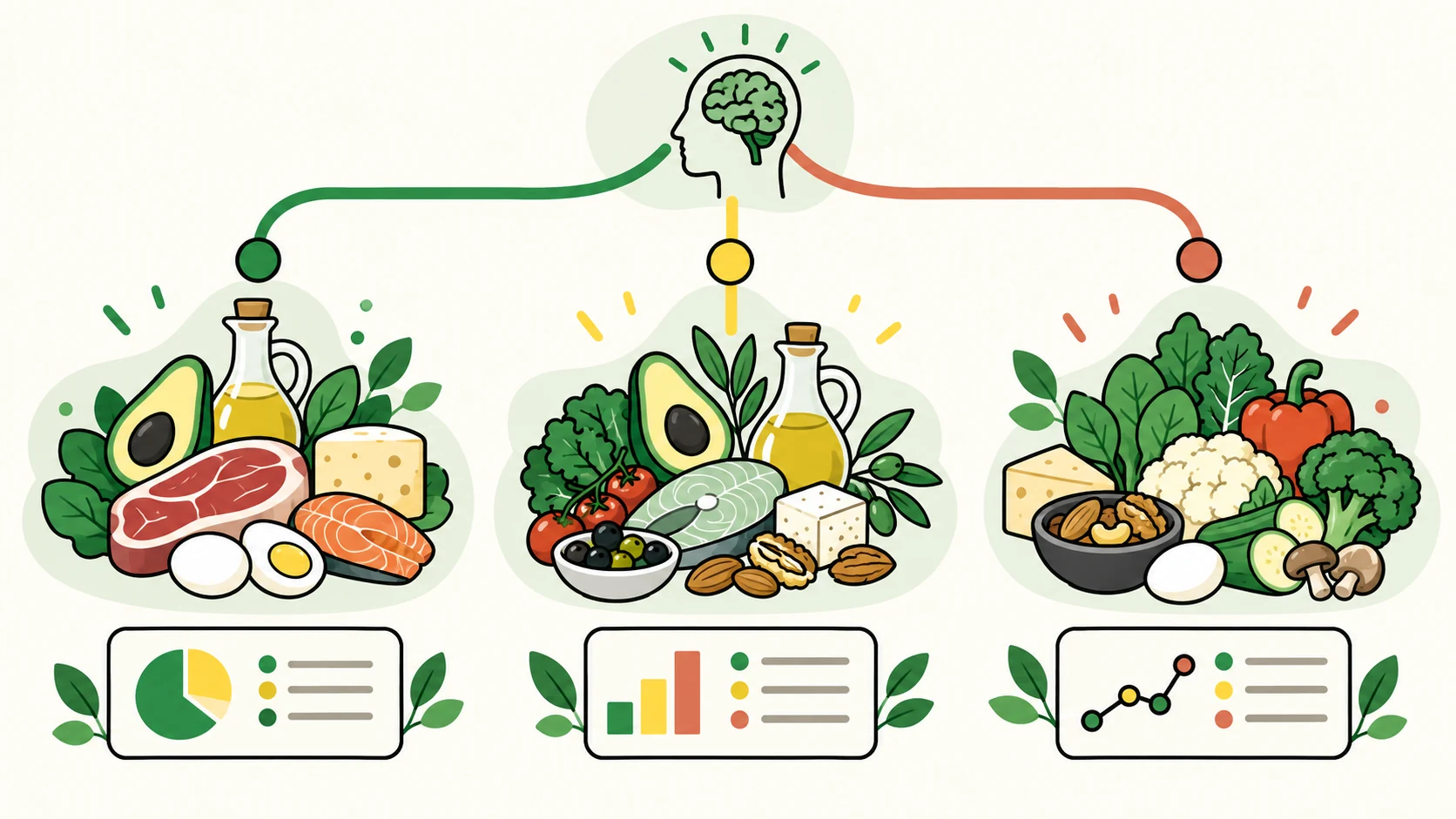
Keto, low carb, and carnivore all restrict carbohydrates, but they differ in how far they go and why. Low carb is the broadest category, at roughly 50 to 130 g of carbs a day. Keto tightens that to 20 to 50 g specifically to trigger ketosis. Carnivore is the strictest of all — near-zero carbs, because only animal foods are allowed.

If you've searched "keto vs low carb" or "carnivore vs keto" and come away more confused, you're not alone — the terms get used interchangeably online even though they describe genuinely different eating patterns. This guide lines them up side by side: carb thresholds, macros, food lists, evidence, and risk, so you can see exactly where each diet sits and which one actually fits your goal.

Keto vs Low Carb vs Carnivore: What's the Difference at a Glance?

The single biggest difference between the three is the carbohydrate ceiling, which drives everything else — whether you reach ketosis, how much food variety you keep, and how restrictive daily eating feels. Low carb is the most flexible, keto is built specifically to trigger ketosis, and carnivore is the most restrictive because it also eliminates every plant food.

Low CarbStandard KetoCarnivore
Net carbs/day~50–130 g~20–50 g~0 g (near zero)
FatModerate60–75% of caloriesHigh
ProteinModerate–high15–30% of caloriesHigh
Foods allowedMeat, fish, eggs, dairy, non-starchy veg, some fruit, some legumesMeat, fish, eggs, dairy, non-starchy veg, nuts, healthy oilsMeat, fish, eggs, some dairy only
Foods excludedSugar, refined grains, most dessertsGrains, sugar, most fruit, starchy veg, legumesAll plant foods: veg, fruit, grains, nuts, legumes
Ketosis likely?Rarely — carbs usually stay too high1Yes, when carbs stay in range2Often, but not guaranteed — depends on protein intake
Best forEasing off high-carb eating; sustainable, flexible weight/blood-sugar managementFat-adapted weight loss, metabolic and blood-sugar goalsShort-term elimination troubleshooting; not a default long-term plan

Think of it as one spectrum rather than three unrelated diets: low carb sits at the loose end, keto tightens the carb ceiling to force ketosis, and carnivore pushes the same logic to its extreme by removing an entire food kingdom. If you want to see how keto itself branches further — targeted, cyclical, and other variations — that's covered in our guide to the types of keto diet.

What Counts as a Low-Carb Diet?

A low-carb diet generally means eating under about 130 g of carbohydrate a day, compared with the roughly 225 to 325 g a typical diet includes — with "very low carb" describing anything under 50 to 60 g.1 Definitions vary by source, but the range is wide enough to include everything from a modest carb cutback to the edge of ketogenic eating.

Because the ceiling is loose, a low-carb diet still leaves room for some fruit, dairy, legumes, and starchy vegetables in moderation — it simply reduces the overall load rather than eliminating whole categories. That flexibility is the appeal: it's easier to sustain socially and doesn't require tracking net carbs to the gram.

Is a low-carb diet the same as keto? No — most low-carb eating stays above the roughly 50 g threshold where ketosis reliably begins, so it doesn't consistently shift your body into fat-and-ketone burning the way keto does.1 A general low-carb approach suits people who want better blood sugar and weight control without the stricter bookkeeping keto requires.

What Is the Standard Ketogenic Diet, Exactly?

The ketogenic diet is a high-fat, moderate-protein, very-low-carb plan — roughly 60 to 75% fat, 15 to 30% protein, and 5 to 10% carbs (about 20 to 50 g net carbs a day) — designed specifically to trigger nutritional ketosis.2 That's the defining mechanism: when carbs drop low enough, your body shifts from burning glucose to burning fat and producing ketones for fuel.3

Keto emphasizes meat, fish, eggs, full-fat dairy, non-starchy vegetables, nuts, seeds, and oils, while restricting grains, sugar, most fruit, starchy vegetables, and legumes. You can see the complete breakdown in our keto food list, and the underlying mechanics of ketone production in the science of ketosis.

Standard keto isn't the only version — targeted keto (carbs timed around workouts), cyclical keto (periodic higher-carb days), and high-protein keto all shift the ratios for specific goals, as covered in the types-of-keto-diet guide linked above.

What Is the Carnivore Diet — and Is It Just Strict Keto?

The carnivore diet allows only animal foods — meat, fish, eggs, and sometimes dairy — while excluding every plant food, which makes daily carb intake effectively zero. It isn't a formally standardized diet the way keto is; there's no official macro split, but protein and fat intake are both naturally high because there's nothing else to eat.

Carnivore is best understood as a stricter, elimination-style subset of keto rather than a wholly separate diet: both restrict carbs enough to often produce ketosis, but carnivore adds a second layer of restriction by removing all plant foods, including the non-starchy vegetables and nuts that keto keeps. Whether it produces ketosis depends heavily on protein intake, since very high protein can blunt ketone production in some people.

Carnivore is also the least-studied of the three. A 2026 scoping review of the available evidence found the research base is small, low-certainty, and mostly short-term self-reported surveys rather than controlled trials — enough to flag reported benefits and risks, not enough to confirm long-term safety.4

How Do Keto, Low Carb, and Carnivore Compare Head-to-Head?

Once you line them up directly, four things separate the diets in practice: how far carbs are restricted, how much food variety and fiber you keep, how protein and fat are emphasized, and how sustainable each one is day to day. Carb restriction drives the rest — the tighter it gets, the narrower your food list and the harder the diet is to keep up long term.

Which has the lowest carb threshold and the best odds of ketosis?

Carnivore has the lowest carb intake by far (effectively zero), followed by keto (20 to 50 g), then low carb (50 to 130 g). Keto is the only one of the three explicitly designed and measured around reaching ketosis; low carb often stays too high to trigger it, and carnivore usually does but isn't guaranteed to.

Which diet keeps the most food variety and fiber?

Low carb keeps the most variety and the most fiber, since fruit, legumes, and starchy vegetables in moderation are still allowed. Keto narrows variety to non-starchy plants plus animal foods. Carnivore removes fiber and plant foods entirely, which is the diet's single biggest nutritional trade-off.5

How do protein and fat targets differ?

Keto specifically caps protein at roughly 15 to 30% of calories because excess protein can be converted to glucose and blunt ketosis.2 Low carb doesn't cap protein the same way, and carnivore is naturally high in both protein and fat with no formal ceiling on either.

Which is easiest to sustain long term?

Low carb is generally the easiest to sustain because it's the least restrictive and the most compatible with normal social eating. Keto requires more label-reading and meal planning but is manageable for many people long term. Carnivore is the hardest to sustain socially and nutritionally, which is part of why it's more often used short term than as a permanent approach.

Which Diet Has the Strongest Research Behind It?

Keto and low-carb diets have the deepest evidence base, including randomized controlled trials on weight loss and blood sugar; carnivore has the thinnest, resting mostly on small surveys and short case studies. All three can support weight loss short term by increasing satiety and reducing overall intake, but the certainty of the evidence drops sharply as the diets get more restrictive.

A meta-analysis of randomized controlled trials found that people following a very-low-carbohydrate ketogenic diet lost more weight long term than those on a low-fat diet, along with improvements in triglycerides and HDL cholesterol — though the differences were often modest and came with a rise in LDL cholesterol for some.6 Low-carb diets generally have a longer track record for improving blood sugar control, which is one reason they're widely discussed for type 2 diabetes management.1

Carnivore's evidence is far more limited. The available scoping review found some reported improvements in weight and certain metabolic markers, but the underlying studies were small, uncontrolled, and short — not enough to establish carnivore as a proven long-term approach.4 Most of the stronger, better-documented benefit data applies to keto specifically rather than carnivore.

What Are the Risks, and Who Should Be Cautious?

All three diets can cause an adjustment period, but the risks grow as carb and food-group restriction increases — from mild "keto flu" symptoms on keto and carnivore to real nutrient-deficiency and cholesterol concerns as restriction gets more extreme. Cutting carbs lowers insulin, which increases sodium, potassium, and magnesium loss through urine — the main driver of early fatigue, headaches, and muscle cramps on both keto and carnivore.7 Symptoms typically peak around day three or four and ease within one to two weeks as your body adapts.7

As restriction increases, so does the risk of nutrient gaps. A nutrient-composition analysis of carnivore-style meal plans found intakes below recommended levels for fiber, and inconsistently for magnesium, calcium, vitamin C, and other nutrients, depending on exactly what was eaten.5 Carnivore has also been associated with elevated LDL and total cholesterol in some of the available data, which is worth discussing with a clinician if you have existing cardiovascular risk factors.4

People who should talk to a healthcare professional before starting any of these diets — and especially before trying keto or carnivore — include those who are pregnant or breastfeeding, anyone with kidney or liver conditions, anyone on medication for diabetes or blood pressure (doses may need adjusting), and anyone with a history of disordered eating.3 If you're not sure keto itself is the right starting point, our guide to whether keto is right for you walks through who tends to benefit and who should be more cautious, and our potential side effects guide covers what to expect and when symptoms warrant medical attention.

How Do You Choose the Right Low-Carb Diet for Your Goals?

Choose among low-carbohydrate, ketogenic and carnivore patterns by considering the intended outcome, nutritional adequacy, evidence and ability to maintain the diet. Keto specifically aims to produce nutritional ketosis; a broader low-carbohydrate diet may be less restrictive, while carnivore removes entire food groups and has limited long-term evidence. The guide to calculating keto macros explains common planning assumptions, and how many carbs on keto explains why no calculator can supply a guaranteed individual threshold.

If you're moving between approaches — say, easing from low carb into full keto, or trying carnivore short term to troubleshoot symptoms — go gradually rather than switching overnight, and lean on calculating your keto macros to set a personal carb target instead of relying on a generic range. Whichever direction you're headed, talk to a healthcare provider first if you have an existing health condition, take medication, or are considering carnivore for more than a short trial — the more restrictive the diet, the more that guidance matters.

Frequently Asked Questions

Is the carnivore diet just strict keto?
Largely, yes. Carnivore restricts carbs even further than keto (to near zero) and adds a second layer of restriction by removing all plant foods, but it isn't a formally standardized diet with its own macro targets the way keto is.
Is keto considered a low-carb diet?
Yes. Keto is a stricter subset of low carb — low carb generally means under about 130 g of carbs a day, while keto narrows that to roughly 20 to 50 g specifically to trigger ketosis.
Which is best for fast weight loss: keto, low carb, or carnivore?
Keto and very-low-carb diets tend to produce faster initial weight loss than a general low-carb diet, largely due to water loss and appetite suppression. Carnivore may also produce short-term loss, but the evidence for it is far thinner and less studied.
Can you be in ketosis on a low-carb diet that isn't keto?
It's possible but uncommon. Most low-carb diets keep carbs above the roughly 50 g threshold where ketosis reliably starts, so you'd need to cut carbs closer to keto-level amounts to consistently produce ketones.
Is the carnivore diet safe long term?
It isn't well established either way. Current research is limited to small, short, mostly uncontrolled studies, so long-term safety hasn't been confirmed. Most clinicians treat it as a short-term elimination approach rather than a permanent diet.
How many carbs per day for each diet?
Roughly 50 to 130 g a day for general low carb, 20 to 50 g a day for standard keto, and near 0 g for carnivore, since only animal foods are allowed.

Works cited

  1. Low-Carbohydrate Diets — Harvard T.H. Chan School of Public Health, Nutrition SourceAugust 19, 2026 https://nutritionsource.hsph.harvard.edu/carbohydrates/low-carbohydrate-diets/
  2. Ketogenic Diet — StatPearls, NCBI BookshelfAugust 19, 2026 https://www.ncbi.nlm.nih.gov/books/NBK499830/
  3. Ketosis: Definition, Benefits and Side Effects — Cleveland ClinicAugust 19, 2026 https://my.clevelandclinic.org/health/articles/24003-ketosis
  4. Carnivore Diet: A Scoping Review of the Current Evidence, Potential Benefits and Risks — PMC, NCBIAugust 19, 2026 https://www.ncbi.nlm.nih.gov/pmc/articles/PMC12845189/
  5. Assessing the Nutrient Composition of a Carnivore Diet: A Case Study Model — PMC, NCBIAugust 19, 2026 https://www.ncbi.nlm.nih.gov/pmc/articles/PMC11722875/

Article history

  1. Updated
  2. First published

Your learning guide

Loading reading status…