Keto vs Mediterranean Diet: Evidence and Tradeoffs
Keto and Mediterranean diets are different food patterns, not rival brand names. A ketogenic diet restricts carbohydrate enough to pursue nutritional ketosis. A Mediterranean pattern centers vegetables, olive oil, legumes, nuts, fruit, whole grains, and fish while limiting highly processed foods and allowing more carbohydrate. One particularly informative direct comparison lasted 12 weeks per diet in 40 adults with prediabetes or type 2 diabetes. It found no difference in glycated hemoglobin between phases, lower triglycerides on keto, lower LDL cholesterol and higher fiber intake on the Mediterranean phase, and a follow-up signal favoring Mediterranean adherence. That is useful evidence, but it cannot identify one best diet for every person.
This comparison was written from current primary research, systematic evidence, and official clinical guidance rather than biased interpretations of studies. It separates measured outcomes from preference and does not prescribe either pattern or replace care for diabetes, high cholesterol, pregnancy, or another medical condition.
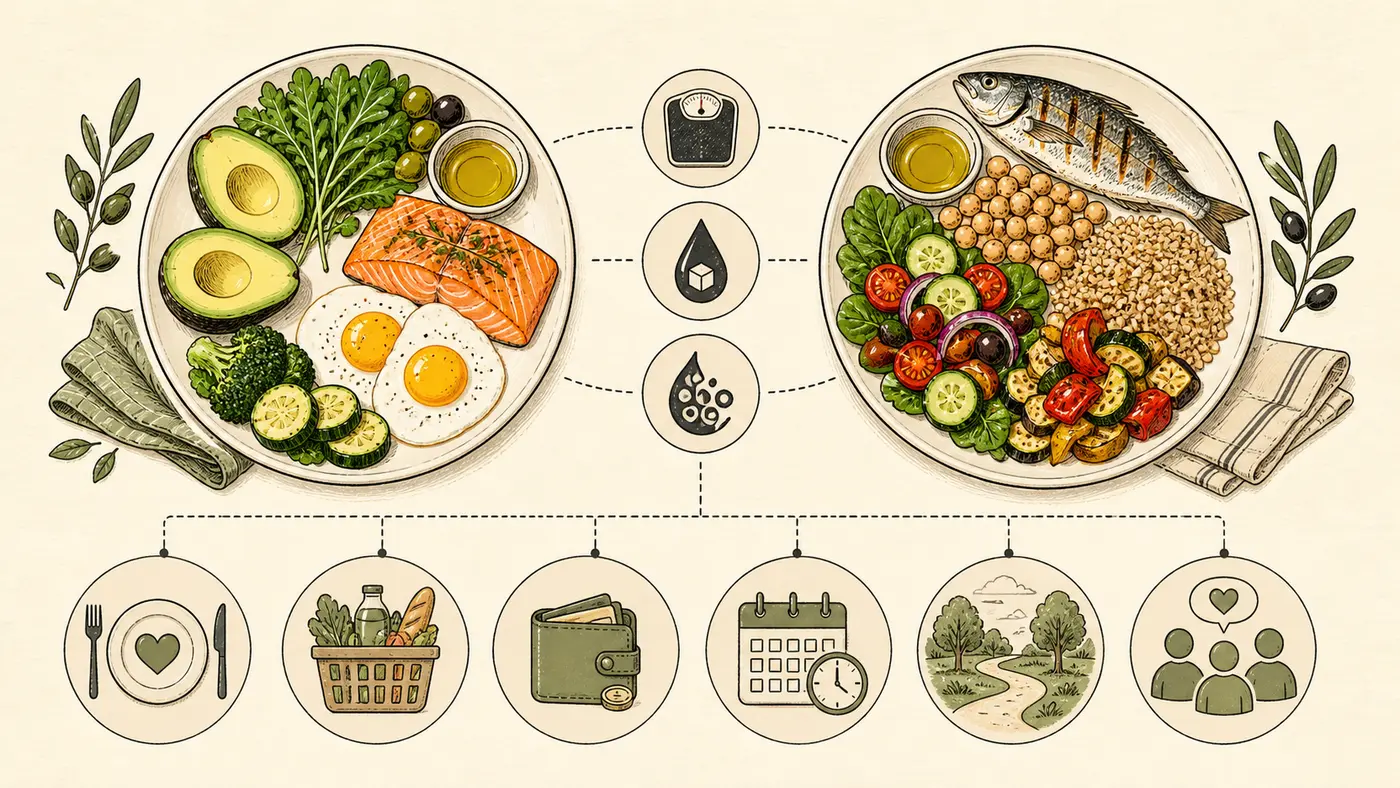
The two labels hide substantial variation
“Keto” may mean a medically prescribed ketogenic dietary therapy, a tightly tracked lifestyle diet, or a loose low-carbohydrate pattern. “Mediterranean” may mean a research protocol or simply meals that use olive oil and contain vegetables. A fair comparison starts with what people actually ate.
| Feature | Ketogenic pattern | Mediterranean pattern |
|---|---|---|
| Defining constraint | Carbohydrate is kept low enough to pursue nutritional ketosis | No ketosis requirement or fixed carbohydrate ceiling |
| Common plant foods | Non-starchy vegetables, nuts, seeds, avocado, olives | Vegetables, legumes, fruit, nuts, seeds, and whole grains |
| Common fats | Can range from olive oil and fish to large amounts of butter, cream, coconut oil, and processed meat | Olive oil is the characteristic added fat; fish and nuts are common |
| Protein | Meat, fish, eggs, dairy, tofu, and other low-carbohydrate sources may fit | Fish, legumes, poultry, eggs, dairy, and smaller amounts of red or processed meat may fit |
| Fiber access | Must be planned inside the carbohydrate restriction | Broader access to legumes, fruit, and intact whole grains |
| Main tracking burden | Carbohydrate amount, food quality, symptoms, and sometimes ketones | Pattern quality, portions when relevant, and consistency |
The types of keto diet guide explains variation within keto. This page focuses on the evidence comparing a ketogenic and Mediterranean pattern. It does not repeat the keto food list, write either diet as a meal plan, or turn a short trial into a universal verdict.
What the Keto-Med trial actually compared
Christopher Gardner, Matthew Landry, Dalia Perelman, and colleagues conducted a randomized crossover trial in 40 adults with prediabetes or type 2 diabetes. Each participant was assigned a well-formulated ketogenic diet and a Mediterranean-plus diet for 12 weeks apiece, in random order. Food was supplied for the first four weeks of each phase, followed by eight weeks of self-provision. The primary analysis included 33 participants with complete data.1
The diets deliberately shared three features: non-starchy vegetables, no added sugar, and no refined grains. The Mediterranean-plus phase included legumes, fruit, and whole, intact grains. The ketogenic phase excluded those categories to maintain carbohydrate restriction. The trial therefore tested two comparatively high-quality patterns. It did not compare a butter-and-bacon keto menu with an unrestricted Western diet.
After 12 weeks on each diet, glycated hemoglobin did not differ between phases. Triglycerides fell 16% during the ketogenic phase and 5% during the Mediterranean-plus phase. LDL cholesterol rose 10% during the ketogenic phase and fell 5% during the Mediterranean-plus phase. Both between-diet differences were statistically significant. Reported weight loss was 8% and 7%, respectively, but diet order interacted with the weight and HDL results, so those figures should not be read as a clean advantage for keto.1
Participants reported lower fiber intake and lower intake of three nutrients during the ketogenic phase. At the 12-week post-trial follow-up, reported eating patterns and participant feedback suggested that Mediterranean-plus was more sustainable. The trial authors described this as a suggestion, not proof of lifetime adherence.
Newer direct trials answer different questions
In 2025, José Ignacio Martínez-Montoro and colleagues randomized 160 adults with obesity to five calorie-restricted groups, including a ketogenic diet and a Mediterranean diet. At three months, 140 participants had completed the trial. The ketogenic group lost an average 3.78 kg more than the Mediterranean group, the study's control arm.6 Weight change was the primary outcome. The result does not establish long-term feasibility, compare cardiovascular events, or isolate carbohydrate restriction from the energy intake achieved under each prescription.
In 2026, Ann Farrell and colleagues randomized 25 adults with overweight or obesity and metabolic dysfunction-associated steatotic liver disease to a 12-week ketogenic very-low-energy diet or a prescribed Mediterranean diet; 24 completed that phase. Liver fat and weight fell more in the ketogenic group, but the interventions did not differ only in carbohydrate. The ketogenic arm deliberately imposed severe energy restriction while the Mediterranean arm remained approximately eucaloric.7 This small, unblinded pilot informs a specific liver-disease treatment question. It is not a general ranking of the two food patterns, and its later maintenance phase added semaglutide only to the former ketogenic arm.
Outcome-by-outcome, the tradeoffs differ
Glucose control
Keto-Med's primary outcome was the percentage change in glycated hemoglobin. The diets did not differ after 12 weeks, although both improved from baseline. Because they shared vegetables and removed added sugar and refined grains, the study cannot attribute all improvement to carbohydrate quantity. Its participants also had prediabetes or type 2 diabetes, so the result is not a general glucose claim for people without either condition.
The American Diabetes Association's 2026 Standards of Care recognize more than one evidence-based eating pattern and emphasize individual needs, preferences, culture, access, and metabolic goals. The Standards cite the Keto-Med result when noting that the ketogenic phase did not improve glycated hemoglobin more than the low-carbohydrate Mediterranean phase and produced a less favorable LDL result.3 Anyone using insulin, a sulfonylurea, or an SGLT2 inhibitor needs medication-specific clinical planning before sharply reducing carbohydrate.
Triglycerides, LDL cholesterol, and the full lipid picture
The trial produced a split lipid result: triglycerides favored keto while LDL cholesterol favored Mediterranean-plus. One marker should not be used to erase the other. The keto and cholesterol guide explains why LDL, non-HDL cholesterol, triglycerides, HDL, and sometimes apoB answer different questions and why interpretation belongs in a person's wider cardiovascular context.
Food choices within either label can change the comparison. A keto pattern based on olive oil, nuts, seeds, avocado, and fish differs from one dominated by butter, coconut oil, cream, and processed meat. A Mediterranean-labeled menu dominated by refined bread, sweets, or restaurant food may not resemble a research pattern at all.
Fiber and food variety
Legumes, fruit, and intact whole grains gave the Mediterranean-plus phase more routes to fiber and micronutrients. Keto can include non-starchy vegetables, avocado, nuts, seeds, and carefully selected foods, but restriction makes displacement easier. The practical question is not whether a food is “allowed.” It is whether the actual day contains enough varied plant foods and whether gastrointestinal symptoms, food avoidance, or dependence on added fibers signal that the pattern needs review. The keto fiber guide separates intact foods, added fibers, label conventions, and supplement safety.
Adherence and satisfaction
Landry and colleagues analyzed adherence during the crossover trial. Adherence was stronger when food was provided and declined when participants bought and prepared their own food, with variation by diet and measurement method.2 That distinction matters. A tightly controlled 12-week diet can establish biological effects under study conditions; it cannot show whether a household can afford, prepare, enjoy, and sustain it for years.
Adherence is not a character trait. Cost, cooking skill, family meals, cultural foods, appetite, gastrointestinal tolerance, food access, and the burden of constant tracking all affect it. A less restrictive pattern that someone can maintain may be more useful than a theoretically precise diet that repeatedly collapses.
Reading evidence in context
- Observed outcome
- Certainty
- Duration
- What remains unknown
Evidence horizon: direct comparison versus longer outcome research
Keto-Med is unusually valuable because the same people completed both diets. Its crossover design reduces some between-person differences. It remains a small, single-site, short study, and the COVID-19 period affected parts of data collection. It did not measure heart attacks, strokes, kidney failure, dementia, or mortality.
Mediterranean patterns have been studied in larger and longer cardiovascular trials. The corrected and republished PREDIMED trial followed older Spanish adults at high cardiovascular risk and found fewer major cardiovascular events with Mediterranean interventions supplemented by extra-virgin olive oil or nuts than with advice to reduce dietary fat.5 PREDIMED was not a keto comparison and should not be pasted onto a different population. It does show that the evidence horizons are unequal: Mediterranean research includes clinical cardiovascular outcomes, while direct keto-versus-Mediterranean evidence is mainly short-term and marker-based.
The American Heart Association's scientific statement on popular dietary patterns reached a related but different conclusion. It assessed how intended patterns align with the AHA's dietary guidance, not which diet wins a randomized contest. Mediterranean-style patterns aligned well; very-low-carbohydrate ketogenic patterns aligned poorly because of restrictions on several plant-food groups and the potential for high saturated fat.4 That framework is useful for food-quality review, but it does not replace individual trial results.
A decision framework without declaring a winner
Use questions that match the decision:
- What outcome matters? Glucose, triglycerides, LDL cholesterol, bowel function, seizure control, weight, and food enjoyment are not interchangeable.
- What is the medical context? Diabetes medicines, kidney disease, familial hypercholesterolemia, pregnancy, eating-disorder history, and prescribed ketogenic therapy change the safety boundaries.
- What foods will replace the foods removed? Removing refined grains is different from removing legumes, fruit, and intact whole grains without replacing their fiber and nutrients.
- What can be sustained without escalating restriction? Test the real workload, cost, family fit, and symptoms rather than assuming enthusiasm predicts adherence.
- What needs measurement? A diet label cannot reveal glycated hemoglobin, LDL cholesterol, triglycerides, blood pressure, nutrient adequacy, or adverse effects.
There is no universal winner between keto and Mediterranean diets. Direct trials show different results in different populations and under different energy prescriptions, while longer cardiovascular-outcome evidence is stronger for Mediterranean patterns. A reasonable choice depends on the goal, the version of each diet, the person's safety context, and what happens when the plan moves from supplied meals to ordinary life.
Frequently Asked Questions
Did keto beat the Mediterranean diet in the Keto-Med trial?
Which diet caused more weight loss?
Can a Mediterranean diet be low in carbohydrate?
Can someone combine features of both patterns?
Works cited
Article history
- First published
Your learning guide