Vegetarian Keto: Protein, Nutrients, and Meal Structure
Vegetarian keto combines two choices: no meat, poultry, or fish, plus a carbohydrate restriction intended to produce nutritional ketosis. It can be constructed for some adults, especially when eggs or dairy are included, but “vegetarian” and “keto” do not establish nutrient adequacy. Protein, fiber, fat quality, micronutrients, allergies, and total restriction still need separate checks.
This guide was written from current research papers, systematic reviews, and official nutrition guidance rather than marketing claims or secondhand interpretations. It is a planning framework for nonpregnant adults. It does not prescribe a carbohydrate target, supplement dose, or treatment diet.
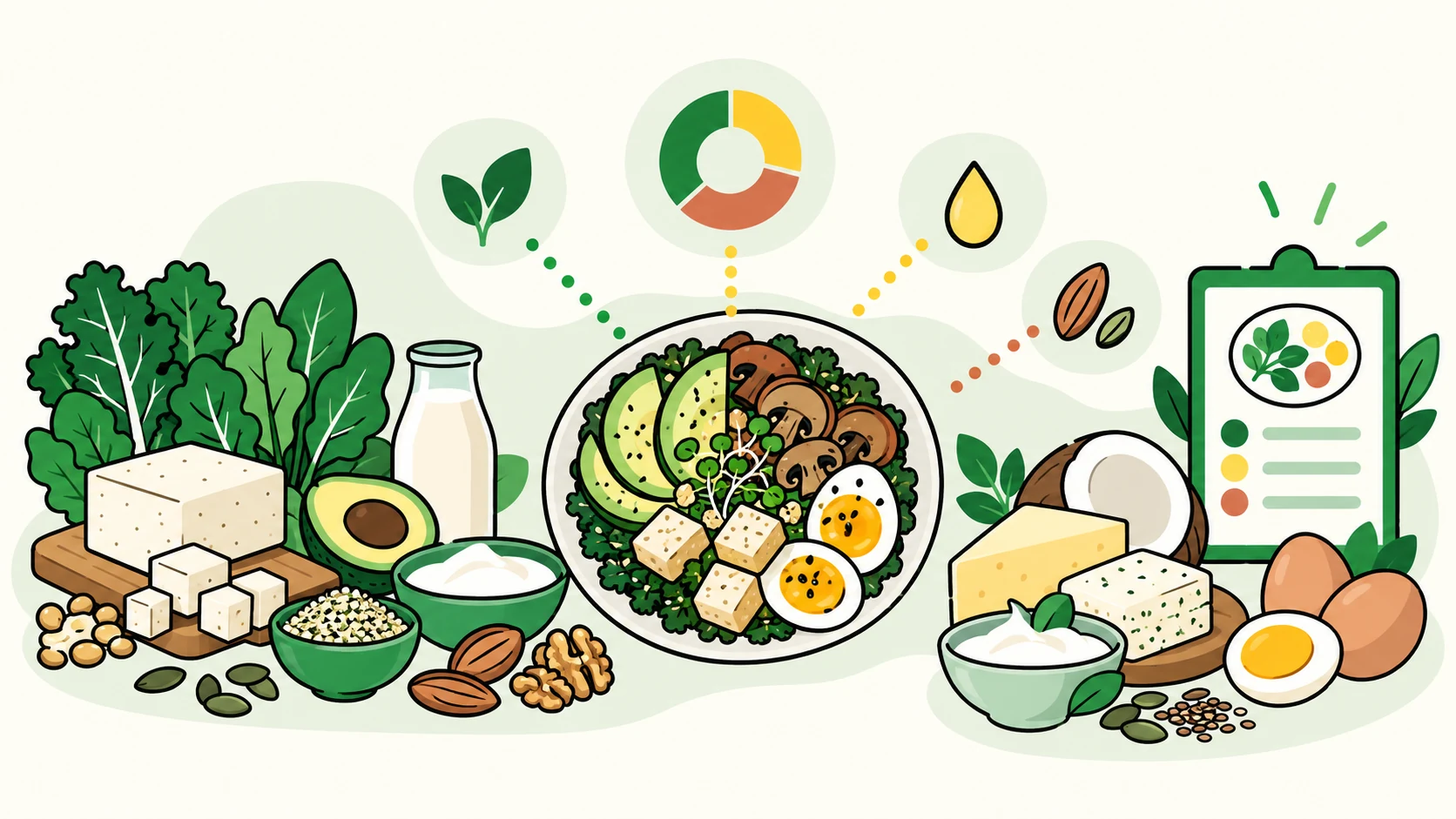
What counts as vegetarian keto?
The 2025 Academy of Nutrition and Dietetics position paper led by Sudha Raj defines vegetarian patterns as excluding meat, poultry, and seafood. Vegan patterns exclude all foods of animal origin.1 Within that boundary, “vegetarian keto” can describe several materially different diets:
| Pattern | Foods included | Planning consequence |
|---|---|---|
| Lacto-ovo vegetarian | Eggs and dairy | More protein and vitamin B12 options, with milk carbohydrate, saturated fat, and allergens still visible |
| Lacto-vegetarian | Dairy, no eggs | Protein can come from dairy, soy, seitan, nuts, and seeds; iron and meal variety still need attention |
| Ovo-vegetarian | Eggs, no dairy | Calcium, vitamin D, and fortified-alternative choices need a deliberate place |
| Vegan | No animal-derived foods | Vitamin B12 requires a reliable fortified-food or supplement plan, and the combined restriction needs closer review |
The vegan keto guide treats the fully plant-based version separately. The keto food list answers which food categories may fit a carbohydrate allowance; this page answers how to assemble a vegetarian pattern without losing sight of nutrition.
Reading evidence in context
- Observed outcome
- Certainty
- Duration
- What remains unknown
How strong is the evidence for vegetarian keto?
Direct evidence is limited. Giuseppe Mazzola, Mariangela Rondanelli, Cristina Cabrini, and Simone Perna reviewed seven randomized trials, covering 976 adults and lasting 4 to 52 weeks, of predominantly plant-based low-carbohydrate or ketogenic interventions. The trials varied in carbohydrate level, food provision, energy restriction, population, and protein source. Most participants had overweight, obesity, or a metabolic disorder. The review found short-term metabolic improvements, while adherence declined in less controlled settings and long-term evidence remained limited.2
That evidence does not establish one standard vegetarian-keto menu, prove nutritional adequacy in free-living adults, or show that tighter carbohydrate restriction is better. Some included interventions were low carbohydrate rather than ketogenic, and some very-low-calorie ketogenic protocols were clinically supervised.
David Jenkins and colleagues also randomized 164 adults with type 2 diabetes to advice for a low-carbohydrate vegan diet or a moderate-carbohydrate vegetarian diet for three months. Both were prescribed at 60% of estimated energy needs. Weight, glycated hemoglobin, and blood pressure changed in both groups, but the only statistically significant between-group result highlighted in the abstract was estimated greenhouse-gas emissions. The paper does not turn a self-directed vegetarian keto diet into diabetes treatment.3
Start each meal with a credible protein source
Choose the protein before adding oils, cheese, cream, avocado, or nuts for fat. A food can be low in carbohydrate and still contribute little protein. A handful of nuts, for example, has a different protein-to-energy ratio from tofu, tempeh, eggs, plain strained yogurt, cottage cheese, or seitan.
| Protein anchor | What to verify on the actual product | Common constraint |
|---|---|---|
| Tofu or tempeh | Serving protein, total carbohydrate, calcium setting when relevant, sodium, ingredients | Soy allergy; flavored products may add sugar or starch |
| Eggs | Planned serving and preparation fat | Egg allergy; no fiber |
| Plain strained yogurt or cottage cheese | Total carbohydrate, added sugar, protein, sodium, saturated fat | Milk allergy or lactose intolerance; flavored versions differ |
| Seitan | Protein, carbohydrate, sodium, ingredients | Wheat allergy or celiac disease |
| Edamame or measured legumes | Total carbohydrate, fiber, protein, serving size | A useful portion may spend more carbohydrate than tofu or seitan |
| Nuts and seeds | Protein, serving size, energy, sodium | Easy to treat as the entire protein source when they work better as one component |
Use USDA FoodData Central for plain foods and the current package for branded products.4 The plant-protein food reference compares the food form and listed portion behind a record. It is a lookup aid, not an assessment of nutrient adequacy or a prescription for what or how much to eat. When eggs or dairy are included, the dairy and alternatives reference is another form-and-label lookup, not an adequacy assessment or advice about how much to eat. The net-carb calculator can perform label arithmetic, but it cannot decide whether the meal supplies enough protein or whether the label matches the food entered.
Build around vegetables and mostly unsaturated fats
Once the protein is chosen, add varied non-starchy vegetables and a fat that serves the dish. Olive, canola, soybean, sunflower, safflower, peanut, and avocado oils; nuts; seeds; olives; and avocado contribute mostly unsaturated fat. Butter, coconut oil, cream, and cheese can fit a vegetarian pattern, but low carbohydrate content does not cancel their saturated fat.
This distinction matters because vegetarian keto can otherwise become a rotation of cheese, cream, eggs, substitute breads, and sweets. Raj and colleagues emphasize the quality of the full vegetarian pattern, including nutrient-dense plant foods and moderation of highly processed foods high in saturated fat and sodium.1 Carbohydrate restriction narrows access to fruit, legumes, and whole grains, so the vegetables, seeds, nuts, and measured plant proteins that remain should not be displaced by added fat.
Audit nutrients instead of assuming coverage
Nicole Neufingerl and Ans Eilander reviewed 141 studies comparing adult plant-based diets with meat-eating patterns. Average protein intake in vegetarian and vegan groups was generally within recommendations, but vitamin B12, vitamin D, iron, zinc, iodine, calcium, EPA, and DHA deserved attention. The review also found inadequacies in every dietary pattern, including omnivorous diets. It supports checking the actual menu, not declaring one label complete or deficient.5
For a vegetarian keto plan, review these points:
- Vitamin B12: eggs and dairy can contribute, but their presence does not guarantee adequate intake. NIH notes that vegetarians and vegans have higher deficiency risk because natural food sources are limited to animal foods.6
- Iron and zinc: tofu, tempeh, seeds, nuts, eggs, and some fortified foods contribute different amounts and forms. Do not take high-dose iron from a generic checklist; deficiency and excess both need appropriate assessment.
- Calcium and vitamin D: dairy may help, while a dairy-free pattern needs verified fortified alternatives or other sources. Shake a fortified beverage if its package instructs it; suspended minerals can settle.
- Iodine: dairy and eggs can contribute variable amounts. Plant beverages are not automatically iodine-fortified, and seaweed can supply highly variable amounts. Check the label rather than using kelp as an unmeasured supplement.
- Omega-3 fats: flax, chia, walnuts, and canola oil provide alpha-linolenic acid. They are not nutritionally identical to the longer-chain EPA and DHA found in seafood or algae-derived products.7
- Fiber and plant variety: preserve multiple vegetables, seeds, nuts, avocado, and any measured legumes that fit. Persistent constipation deserves a review of total food, fluid, medication, and restriction rather than an automatic supplement stack.
A registered dietitian can compare intake with needs and decide whether laboratory testing or supplementation is appropriate. A multivitamin does not replace protein, essential fats, fiber, or a varied food pattern.
Manual planning check
Vegetarian keto planning check
Mark an item only after you have checked it for the food and routine you are actually planning. Eggs and dairy can be part of this pattern, but their presence alone does not confirm nutrient adequacy.
This checklist does not diagnose a deficiency, establish nutrient adequacy, prescribe portions or doses, or save or transmit data. Selections stay only in this page's memory while it is open.
Nothing is saved when you leave or reload this page.
Read vegetarian substitutes as packaged foods
A plant-based burger, bread, snack, or protein powder is not automatically low in carbohydrate. Start with serving size, then read Total Carbohydrate, Dietary Fiber, protein, saturated fat, sodium, ingredients, and allergens. Use the label-literate grocery guide for US, EU, and UK carbohydrate conventions.
Soy, wheat, milk, egg, peanuts, tree nuts, and sesame are common in vegetarian keto products. FDA identifies all of them among the nine major US food allergens and explains that a voluntary “may contain” statement does not replace manufacturing controls.8 Someone with a diagnosed allergy needs the current package, the manufacturer's cross-contact information when necessary, and their own emergency plan.
Vegetarian does not change cold-storage rules. Refrigerate perishable dairy, eggs, opened tofu or tempeh, and cooked food according to the package and applicable food-safety guidance. USDA generally advises refrigerating perishable leftovers within two hours, or one hour above 90°F (32°C), and using refrigerated leftovers within three to four days.10
A practical construction sequence
Use this order for each meal rather than copying a rigid menu:
- Choose one protein anchor that fits the vegetarian pattern and allergies.
- Add at least one non-starchy vegetable, rotating plant families and colors across the week.
- Add a mostly unsaturated cooking fat, dressing, seeds, nuts, olives, or avocado as the meal requires.
- Count the measured carbohydrate sources and packaged-food label values using one consistent convention.
- Check whether the day has credible sources of vitamin B12, calcium, iron, zinc, iodine, vitamin D, omega-3 fats, and fiber.
- Review feasibility: cost, cooking time, storage, cultural fit, gastrointestinal symptoms, and food waste.
The meal template builder can filter its idea catalog for vegetarian meals and ingredient exclusions. It does not calculate nutrient adequacy or prescribe portions. For cost constraints, use keto on a budget; for an actual weekly planning workflow, use how to create a keto meal plan.
Who should not use this page as a self-directed plan?
Pregnancy is not a setting for a self-directed ketogenic diet. The American Diabetes Association's 2026 pregnancy standard cites a minimum pregnancy intake of 175 g carbohydrate per day and says eating patterns that severely restrict a macronutrient class, specifically ketogenic patterns, should be avoided.9
Children and adolescents need growth-specific assessment. A ketogenic diet used for epilepsy is a medical therapy with a trained multidisciplinary team, monitoring, and supplementation; it is not the consumer pattern described here. The clinical-program directory lists source-verified institutional services without rankings.
Seek individualized care before combining restrictions if you use insulin, a sulfonylurea, or an SGLT2 inhibitor; have kidney, liver, gallbladder, pancreatic, or metabolic disease; have a history of ketoacidosis; are underweight; or have an active or past eating disorder. Restriction that produces fear, compulsive tracking, bingeing, purging, or avoidance of shared meals is a reason to stop and seek appropriate support.
Frequently Asked Questions
Can a vegetarian diet be ketogenic?
Do vegetarian keto meals need eggs and dairy?
Is vegetarian keto the same as vegan keto?
Are plant-based meat substitutes keto?
Works cited
Article history
- Added a plant-protein food-reference link and a temporary source-and-label checklist. It records manual checks only and does not establish nutrient adequacy, prescribe portions or doses, or save data.
- First published
Your learning guide