Lazy Keto: What You Track and What You Miss
“Lazy keto” has no standard clinical definition. It usually means watching carbohydrate while skipping detailed logging of protein, fat, and calories. That may reduce the burden of tracking, but it cannot guarantee nutritional ketosis, weight loss, protein adequacy, food quality, or safety with medicines.
Therapeutic ketogenic diets for epilepsy and other medical uses are prescribed and monitored protocols. Lazy keto is not an equivalent substitute. Athletes and people using a ketogenic diet for a clinical outcome may also need more precise food, training, laboratory, and symptom data.
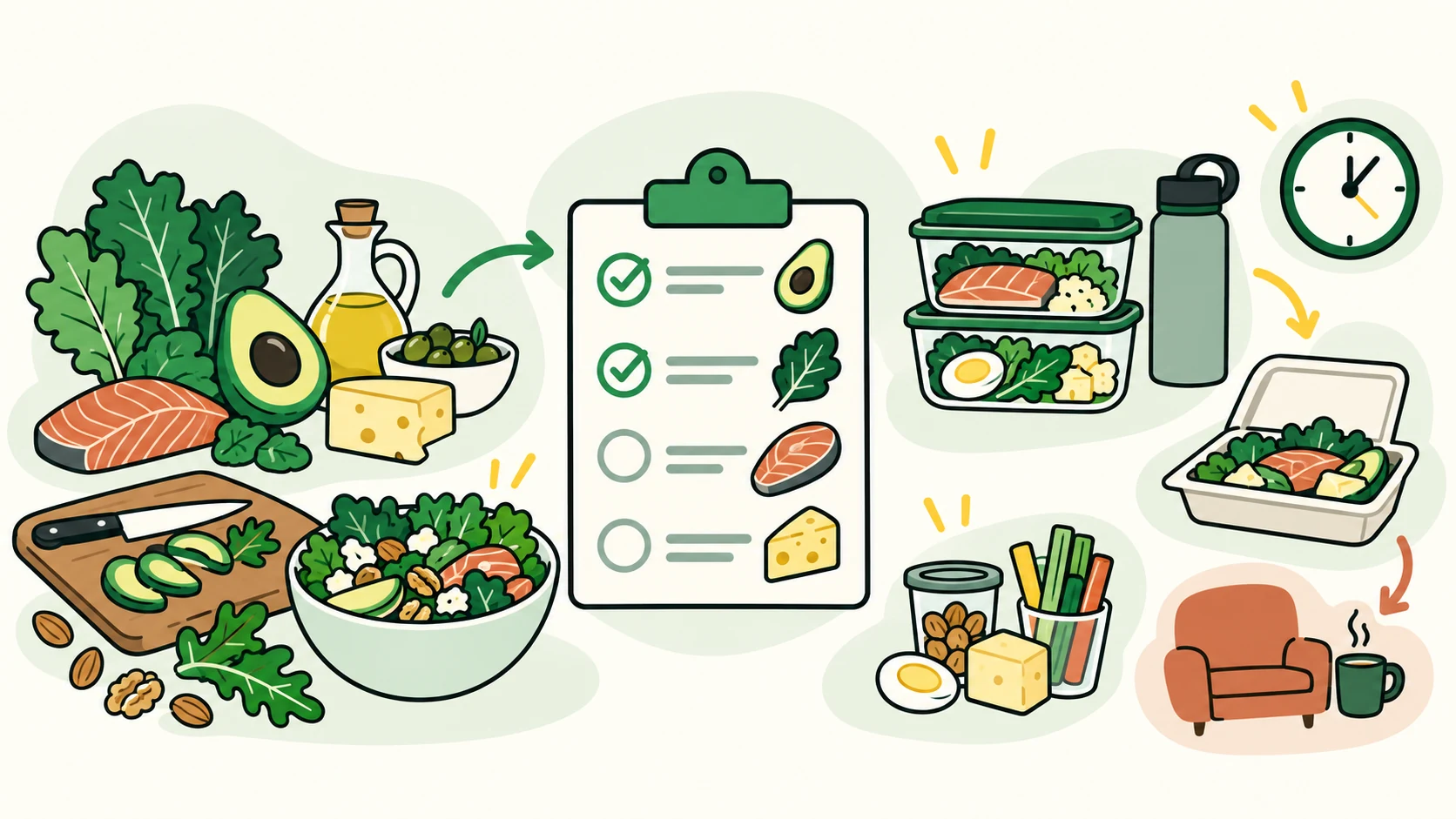
What does lazy keto track?
Most versions set a carbohydrate limit and rely on food selection rather than weighing every ingredient. The often-used range of 20-50 grams per day is a convention, not a threshold that guarantees the same ketone level in every person. Total carbohydrate, fiber, sugar alcohols, serving size, activity, energy intake, and individual physiology all matter.
| Question | Lazy-keto approach | What remains unknown |
|---|---|---|
| Carbohydrate | Usually checked from labels or a food database | Exact intake if portions are estimated |
| Protein | Usually not logged | Adequacy for the person and purpose |
| Fat | Usually not logged | Energy and fat-quality balance |
| Calories | Usually not logged | Whether intake supports loss, maintenance, or gain |
| Ketones | Sometimes measured, sometimes assumed | Whether the food pattern produces sustained ketosis |
The U.S. Nutrition Facts label reports total carbohydrate and dietary fiber under federal rules.1 “Net carbs” is a calculated marketing term rather than a separately defined FDA nutrient. Sugar alcohol treatment also varies by product and jurisdiction. Use the net-carb calculator to show the arithmetic, then read its label-system notes.
Can untracked protein stop ketosis?
Protein should not be reduced to a slogan that it either “turns into sugar” or never affects ketones. Gluconeogenesis uses lactate, glycerol, and amino acids to maintain glucose where it is needed. Its rate responds to physiology and substrate availability.
In a stable-isotope study by Hugo Fromentin and colleagues, eight healthy adults ate 23 grams of egg protein after an overnight fast. Over eight hours, about 3.9 grams of roughly 50 grams of glucose produced came directly from dietary amino acids.2 That small experiment refutes the idea that the entire protein serving rapidly became glucose. It does not prove that protein amount never changes ketone readings or that one ceiling fits everyone.
Use high-protein keto for the full evidence limits. The broad high-protein low-carb guide separates the adult RDA, current Dietary Guidelines, sports ranges, and clinical exceptions.
Reading evidence in context
- Observed outcome
- Certainty
- Duration
- What remains unknown
What can lazy keto miss?
Total energy
Carbohydrate restriction does not make energy intake irrelevant. Oils, cheese, cream, nuts, and processed snacks can add substantial energy in small portions. A plateau does not identify one cause; sleep, medicines, fluid shifts, adherence, activity, and measurement error can contribute.
Protein context
The adult DRI RDA is 0.8 g/kg/day and was set to meet the needs of about 97-98% of healthy adults.3 The 2025-2030 Dietary Guidelines now give 1.2-1.6 g/kg/day as a general daily goal.4 These answer different questions, and neither becomes a personalized lazy-keto target without an appropriate body-weight basis and health context.
Food quality and variety
A carb count alone says little about fiber, micronutrients, saturated fat, sodium, processing, or food safety. Build meals from varied protein foods, non-starchy vegetables, mostly unsaturated fats, and other foods compatible with the chosen carbohydrate level. Labels decide whether a packaged product fits.
Medication safety
Very-low-carbohydrate intake, fasting, and dehydration increase ketoacidosis risk with SGLT2 inhibitors. Insulin and insulin secretagogues can cause hypoglycemia when intake changes.5 Medication adjustment belongs with the prescriber.
A lower-burden method with guardrails
- Define whether the goal is food organization, weight change, glycemic management, or measured ketosis.
- Choose a carbohydrate accounting method and use it consistently.
- Include a protein food and produce at meals instead of counting carbs alone.
- Review product labels for serving size, fiber, added sugar, saturated fat, sodium, and allergens.
- Check trends in the outcome that matters rather than assuming ketones prove success.
- Escalate to a dietitian or prescriber when a medical condition or medicine is involved.
The meal template builder filters a fixed catalog by selected preferences and exclusions. It does not assign portions, calories, or macros.
The keto calculator is an input-only macro arithmetic worksheet. It calculates results from values you enter; it does not choose a personalized protein, carbohydrate, calorie, or macro target.
Who needs more structure?
Lazy keto is a poor fit for a prescribed therapeutic ketogenic diet, pregnancy, growth in children or adolescents, a history of disordered eating, clinically important kidney or liver disease, unexplained weight loss, or a situation requiring medication adjustment. Competitive training may also require more specific fueling and recovery data than a carb-only log provides.
A brief food record can be used as a diagnostic snapshot without becoming a permanent task. Record amounts, brands, cooking state, symptoms, activity, and relevant glucose or ketone measurements for several ordinary days, then review what the data can actually support.
Frequently Asked Questions
How many carbohydrates define lazy keto?
Can extra protein automatically knock you out of ketosis?
Are net carbs an FDA-defined nutrient?
Does lazy keto cause weight loss without counting calories?
Can a calculator create lazy-keto targets?
Works cited
Article history
- Rebuilt carbohydrate tracking, protein and gluconeogenesis claims, calculator limits, and medication cautions
- First published
Your learning guide