Keto Supplements: An Evidence and Safety Guide
No supplement is required simply because a person follows a ketogenic diet. A useful supplement decision begins with a specific purpose, such as correcting an assessed nutrient gap or testing an ingredient for a well-defined outcome. It then asks whether the evidence applies, whether food or clinical care addresses the problem more directly, what the full label contains, and whether medicines or health conditions change the risk.
This guide was written from current primary research, systematic reviews, and official FDA and NIH guidance rather than biased interpretations of research or supplement marketing. It is a non-affiliate selection framework. It does not rank products, prescribe a dose stack, or replace advice from a physician, pharmacist, or registered dietitian.
Reading evidence in context
- Observed outcome
- Certainty
- Duration
- What remains unknown
Education is not diagnosis
- General education
- Personal self-check
- Clinician discussion
- Urgent care if needed
What this guide covers
“Keto supplement” is a marketing category, not a single intervention. It can refer to a vitamin, mineral, electrolyte mix, fiber product, creatine, medium-chain triglyceride oil, exogenous ketone, herb, stimulant, gummy, or multi-ingredient powder. Those ingredients have different purposes, evidence, and risks, so a claim about one cannot validate the rest.
This guide covers the broad decision process. The focused guides below examine each question in more detail:
- The electrolyte guide covers sodium, potassium, magnesium, fluid balance, and why symptoms do not establish a deficiency.
- The keto fiber guide distinguishes intact food fiber from added fibers and covers label and supplement safety.
- The exogenous ketones and BHB review examines whether a higher ketone reading demonstrates a useful outcome.
- The creatine guide addresses training evidence and creatine-specific safety.
- The keto gummies review examines gummy claims and ingredients rather than treating “keto” on the package as evidence.
A ketogenic diet prescribed for epilepsy has a separate clinical purpose. Its supplements and monitoring belong with the specialist team, not a consumer checklist; see ketogenic diet therapy for epilepsy.
Regulation does not answer whether a product works
FDA regulates dietary supplements as food, not as drugs. Manufacturers and distributors are responsible for safety and truthful labeling, while FDA does not approve supplements for safety, effectiveness, or label accuracy before they reach the market.1 A bottle can therefore be legally sold without the premarket evidence expected for a prescription medicine.
The Supplement Facts panel identifies serving size, dietary ingredients, and declared amounts. “Other ingredients” can disclose flavors, binders, colors, sweeteners, or capsule materials. These fields help identify what the product says it contains; they do not show that the chosen outcome was tested in people eating a ketogenic diet.
Words such as “natural,” “clinically formulated,” “keto approved,” and “standardized” do not settle safety or effectiveness. NIH's Office of Dietary Supplements notes that “standardized” has no legal definition for dietary supplements. It also explains that independent seals from testing organizations may indicate checks for manufacturing quality, contaminants, and label contents, but such a seal does not prove that a product is safe or effective.2
Start with the decision, not the shelf
Write the intended outcome in a sentence that could be checked later. “Support keto” is too vague. “Correct low thiamine confirmed in an assessment” and “evaluate creatine for resistance-training performance” are different questions with different evidence.
| Proposed purpose | First question | Where the decision usually leads |
|---|---|---|
| Prevent a nutrient gap | What foods were removed, what does the current intake contain, and is there a measured or clinically credible risk? | Food review, dietitian assessment, or targeted testing before an automatic multivitamin |
| Treat headache, cramps, fatigue, or constipation | Has the cause been established, and are there warning signs? | Symptom-specific review; symptoms alone do not identify a mineral or fiber need |
| Raise a ketone-meter reading | Is a temporary BHB rise itself the outcome that matters? | Ingredient-specific evidence, not an assumption of greater body-fat loss |
| Improve strength or endurance | Was the ingredient studied for that performance outcome in a comparable population? | A single-ingredient assessment alongside training, food, sleep, and recovery |
| Lose weight quickly | Was the complete product tested for durable weight or safety outcomes? | Strong skepticism toward stimulant blends, “fat burners,” gummies, and testimonials |
If the outcome cannot be defined, postponing the purchase is a reasonable decision.
Carbohydrate restriction can change intake, but it does not create one supplement stack
Chaitong Churuangsuk, Daniel Griffiths, Michael E. J. Lean, and Emilie Combet systematically reviewed ten studies of carbohydrate-restricted diets lasting 2 to 104 weeks. The prescribed diets ranged from 4% to 34% of energy from carbohydrate and differed substantially. Reported intakes of thiamine, folate, magnesium, calcium, iron, and iodine declined in some interventions, but the studies reported no diagnosed deficiencies. The review supports assessing the foods and nutrients displaced by a particular diet; it cannot establish a universal keto multivitamin or mineral dose.3
A later cross-sectional study by Churuangsuk and colleagues compared 49 adults following low-carbohydrate diets with 49 controls. Low-carbohydrate participants had lower thiamine intake and red-blood-cell thiamine diphosphate, even though two-thirds reported some supplement use. Three low-carbohydrate participants and one control met the study's laboratory definition of deficiency. The design cannot show that the diet caused the difference, and reported supplement use did not guarantee adequate status.4
The practical implication is to audit the actual pattern. Removing fortified grains, legumes, fruit, dairy, or other food groups changes different nutrients. Food choice, total energy intake, absorption, illness, alcohol use, medicines, and life stage also matter. One “keto” capsule cannot be assumed to cover those differences.
Read the complete label before comparing products
Use the current package, not a marketplace title or an old product image. Record:
- Ingredient identity and form. “Magnesium” is incomplete without the compound and amount. “Ketones” can hide a salt, ester, or unrelated ingredient.
- Amount per serving and serving definition. Several capsules may make one serving. A scoop can supply multiple minerals, stimulants, sweeteners, or fibers at once.
- All ingredients. Check the Supplement Facts panel and other ingredients for allergens, sugar alcohols, caffeine sources, botanicals, and added sodium or potassium.
- Proprietary blends. A blend total does not disclose the amount of each component. That prevents a sound comparison with research and can hide duplicated ingredients.
- Lot and quality information. A traceable lot, expiration or best-by information, manufacturer contact, and credible independent certification are useful quality signals. They are not efficacy findings.
- Claims and warnings. Claims to replace medicines, treat disease, produce rapid fat loss, or work for everyone are reasons to stop the evaluation.
For powders and gummies, count carbohydrate using the correct label convention. The net-carbohydrate guide explains why US and EU/UK labels cannot be read with the same subtraction rule.
Weight-loss products need extra skepticism
NIH concludes that there is little scientific evidence that weight-loss supplements work. Multi-ingredient products are particularly hard to evaluate because combinations and amounts differ, trials are commonly small and short, and a finding for one ingredient does not validate the marketed formula.5
FDA also maintains current notifications for weight-loss pills, “fat burners,” teas, candies, and products sold as natural supplements that contained hidden drug ingredients. FDA cautions that its list covers only a fraction of contaminated products, so absence from the database is not proof of safety.6 Social-media popularity, reviews, before-and-after photos, and an “all natural” claim do not substitute for an ingredient-specific human trial or product testing.
Screen for interaction and medical risk
Bring the exact label, including a clear photo or the container, to a pharmacist or prescriber when any of these apply:
- prescription or nonprescription medicines, especially glucose-lowering, blood-pressure, anticoagulant, diuretic, thyroid, seizure, or psychiatric medicines;
- kidney, liver, heart, gallbladder, pancreatic, gastrointestinal, or metabolic disease;
- pregnancy, pregnancy planning, breastfeeding, childhood, or adolescence;
- a diagnosed allergy, difficulty swallowing, fluid restriction, upcoming surgery, or abnormal laboratory result;
- more than one supplement, fortified product, electrolyte drink, or meal replacement supplying the same ingredient.
Do not stop or change a medicine to make a supplement fit. Insulin, sulfonylureas, and SGLT2 inhibitors require specific clinical planning when carbohydrate intake changes. A ketone product is not treatment for diabetic ketoacidosis, and nausea, vomiting, abdominal pain, rapid breathing, confusion, or high glucose with ketones warrants urgent medical guidance.
A six-step supplement screen
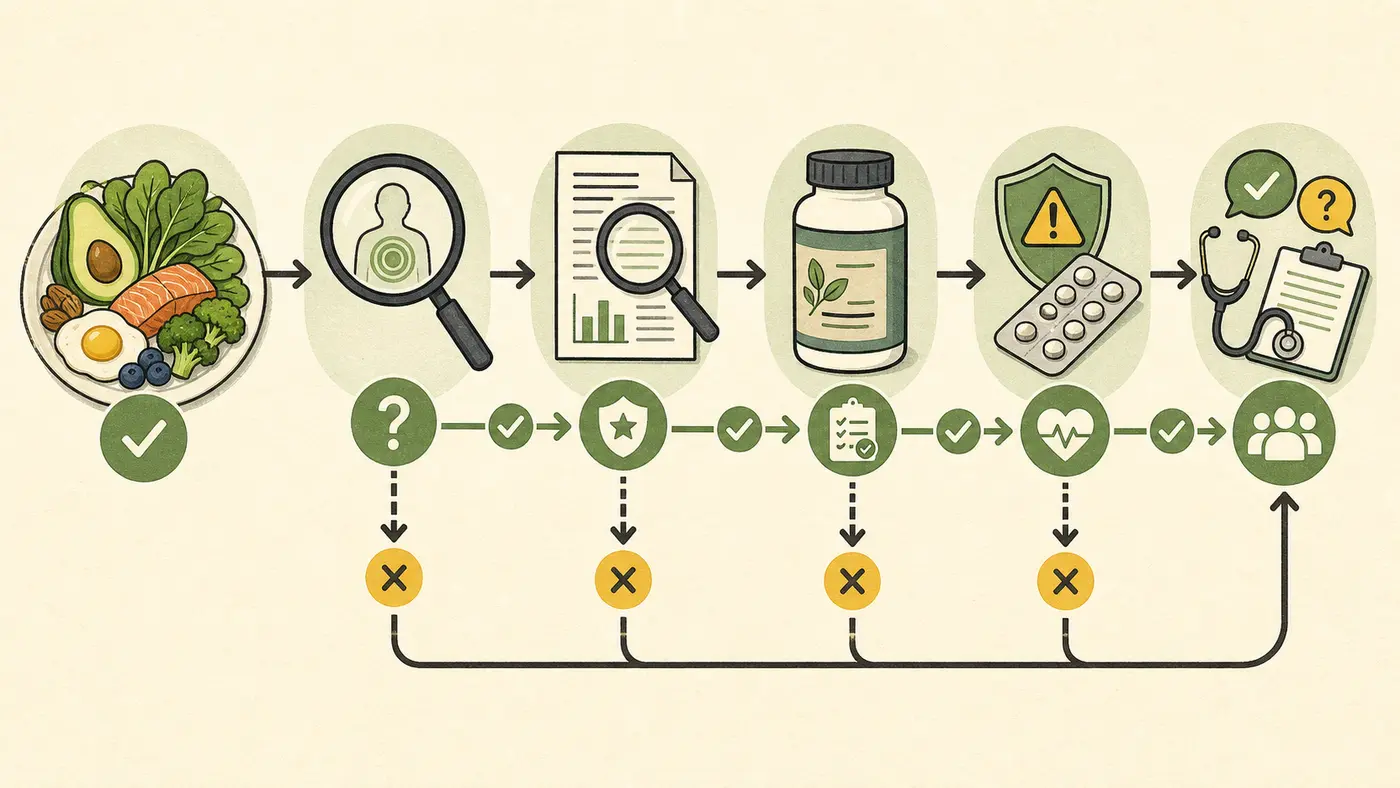
- Define one outcome and the time horizon that matters.
- Check food intake, symptoms, laboratory information, and the clinical context before assuming a deficiency.
- Find evidence for the exact ingredient, form, outcome, population, and duration. Do not transfer a study of one compound to a blend.
- Compare the research with the complete current label, including serving size, added minerals, stimulants, allergens, and other ingredients.
- Review medicines, diagnoses, pregnancy, age, swallowing safety, and duplicated sources with the appropriate clinician or pharmacist.
- If use remains reasonable, follow the package or individualized clinical direction, introduce one change at a time, and keep a record of the product, lot, timing, intended outcome, and adverse effects.
Stop a product and seek care for swelling of the lips, tongue, or throat; wheezing; fainting; chest pain; severe or persistent vomiting, diarrhea, or abdominal pain; dark urine; yellow skin or eyes; abnormal bleeding; marked mood or cognitive changes; or another serious reaction. FDA asks consumers and clinicians to stop the suspected product and submit a safety report when a dietary supplement may have caused a serious illness or reaction.7
Frequently Asked Questions
Do I need supplements to follow keto?
What is the best keto supplement?
Does third-party testing prove a supplement works?
Are proprietary blends safe to buy?
Can a supplement replace a medicine or medical ketogenic therapy?
Works cited
Article history
- First published
Your learning guide