What Are Ketones? BHB, AcAc, and Acetone
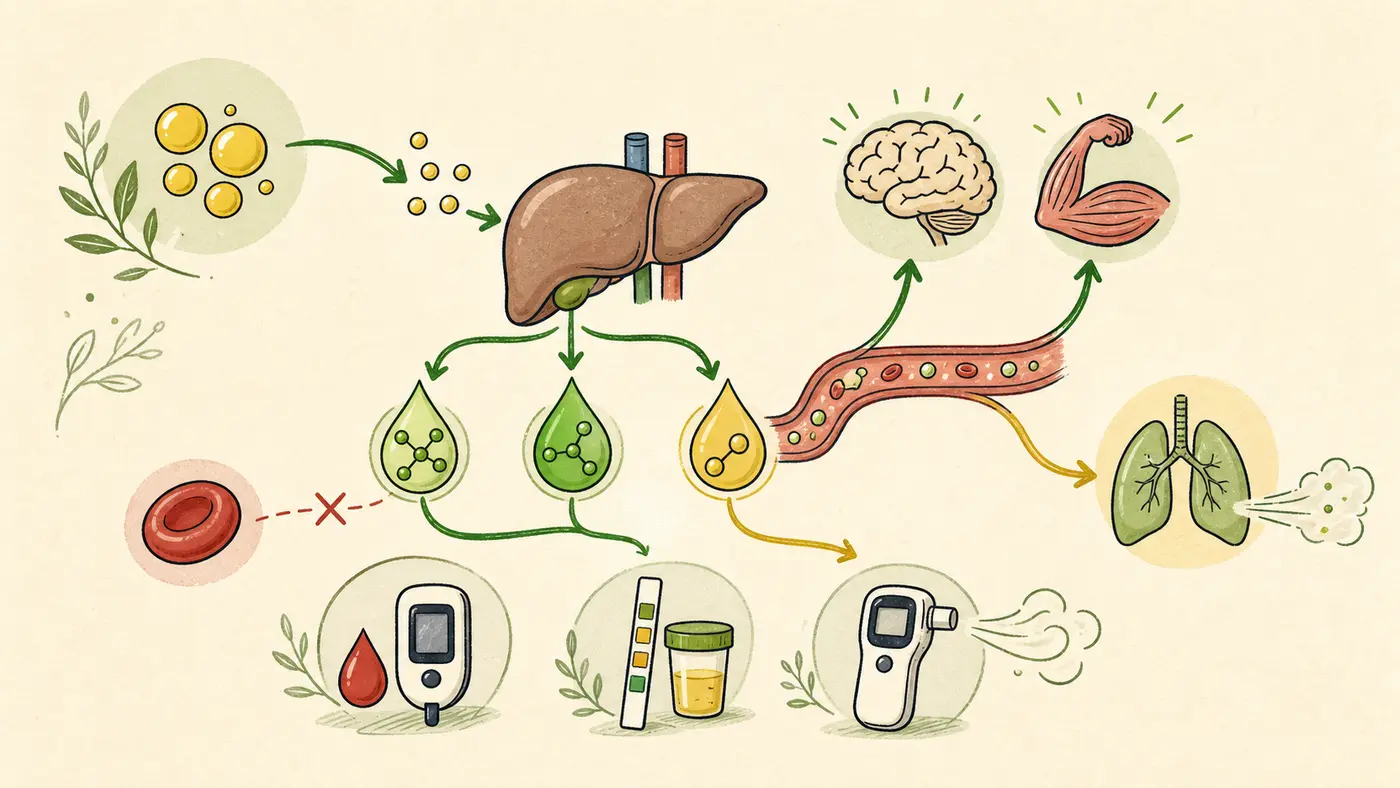
Ketone bodies are acetoacetate, D-beta-hydroxybutyrate (BHB), and acetone. Liver mitochondria produce acetoacetate mainly from fatty-acid-derived acetyl-CoA; acetoacetate can be reduced to D-BHB or break down to acetone. BHB is grouped with ketone bodies by metabolic convention even though it is not chemically a ketone.1
Blood, urine, and breath tests report different members of this group. A home blood meter usually reports BHB, not "total ketones," and no single ketone value proves health benefit, fat loss, or safety.
Seek emergency care now for persistent vomiting, severe abdominal pain, deep or difficult breathing, confusion, fainting, or marked drowsiness. These signs are especially concerning with known or possible diabetes, pregnancy, or use of an SGLT2 inhibitor. Do not wait for a very high glucose reading because euglycemic diabetic ketoacidosis can occur.5 7
Reading evidence in context
- Observed outcome
- Certainty
- Duration
- What remains unknown
Education is not diagnosis
- General education
- Personal self-check
- Clinician discussion
- Urgent care if needed
How does the liver make ketone bodies?
Ketogenesis takes place mainly in liver mitochondria when fatty-acid oxidation supplies more acetyl-CoA than the liver is oxidizing through the citric acid cycle. This response occurs during fasting, sustained carbohydrate restriction, and some periods of prolonged exercise. It is influenced by insulin, counter-regulatory hormones, fatty-acid delivery, and the liver's energy state.1
The central sequence is:
- Two acetyl-CoA molecules form acetoacetyl-CoA.
- Mitochondrial HMG-CoA synthase adds another acetyl-CoA to make HMG-CoA.
- HMG-CoA lyase cleaves HMG-CoA to produce acetoacetate.
- Acetoacetate is either reduced to D-BHB or decarboxylates to acetone.
The balance between acetoacetate and D-BHB reflects the mitochondrial NADH-to-NAD+ redox state. This means BHB is not always a fixed share of the ketone-body pool. Acetone is volatile and is largely exhaled, while BHB and acetoacetate circulate to tissues.1
The liver exports BHB and acetoacetate but cannot oxidize them because it lacks the enzyme SCOT, also called OXCT1. Extrahepatic tissues with mitochondria can convert them back to acetyl-CoA for energy. Red blood cells cannot use ketones because they have no mitochondria.
What are the three ketone bodies?
| Ketone body | Formation and role | Common measurement |
|---|---|---|
| Acetoacetate (AcAc) | The first ketone body made from HMG-CoA; it can be oxidized by tissues, reduced to D-BHB, or converted to acetone | Urine nitroprusside strips mainly detect AcAc |
| D-beta-hydroxybutyrate (BHB) | Formed by reduction of AcAc and oxidized after conversion back to AcAc; chemically a hydroxy acid | Most blood ketone meters and laboratory BHB assays |
| Acetone | A volatile product of AcAc decarboxylation; most is exhaled rather than used as a major fuel | Breath devices estimate acetone |
The IUPAC definition includes acetoacetic acid, acetone, and beta-hydroxybutyric acid in the ketone-body group. The chemistry caveat about BHB does not make it an error to call BHB a ketone body; the term describes their shared metabolism.2
How are ketones used?
BHB and acetoacetate cross cell membranes through monocarboxylate transporters. In tissues that express the required enzymes, they are converted to acetyl-CoA and oxidized to make ATP. Heart, skeletal muscle, kidney, and brain can use ketone bodies, although their uptake changes with concentration, tissue demand, and adaptation.1
The brain does not switch completely from glucose to ketones. In a human dual-tracer study after four days of a ketogenic diet, Courchesne-Loyer and colleagues estimated that acetoacetate supplied about 17% of whole-brain energy. Ketone use rises further with longer fasting, but some glucose metabolism remains necessary.3
BHB also participates in signaling pathways studied in cells, animals, and humans. Proposed mechanisms include histone deacetylase inhibition and receptor signaling. These observations do not establish that raising a home BHB number improves a specific health outcome. Clinical effects depend on the disease, intervention, dose, and study design.1
Does a blood meter measure total ketones?
A home blood meter usually reports BHB, not total ketone bodies. In many laboratory studies, "total ketone bodies" means BHB plus acetoacetate. Acetone may be measured separately because it is volatile. The analytes and method must be checked before comparing results.4
Blood, urine, and breath numbers are not interchangeable:
| Test | What it measures | What the result can and cannot show |
|---|---|---|
| Blood | Usually capillary or venous D-BHB | Reflects BHB in the sample at that time. Direct blood BHB is preferred when DKA is suspected, but a home result cannot assess blood pH or bicarbonate. |
| Urine | Mainly AcAc; some nitroprusside methods also react with acetone | Reflects ketones accumulated in urine since the last void and varies with hydration and kidney handling. It does not measure BHB. |
| Breath | Acetone | Reports breath acetone, not BHB. Device calibration, sampling protocol, and physiology affect the reading, so it cannot be converted directly into a blood BHB value. |
Nitroprusside urine tests can underestimate early DKA because BHB predominates, then appear to worsen during treatment as BHB is converted back to AcAc. ADA and laboratory-medicine guidance therefore recommends direct BHB measurement for diagnosing and monitoring DKA when available.4 5
For more detail, see the guides to blood ketone meters and urine ketone strips.
Is there an ideal ketone level?
No universally beneficial BHB range exists for weight loss or general wellness. A cutoff such as 0.5 mmol/L is often used as an operational definition of nutritional ketosis in research, but it is not a treatment target, safety guarantee, or measure of body-fat loss. A concentration reflects the balance among ketone production, distribution, tissue use, and clearance.8
Higher is not automatically better. Food intake, fasting duration, exercise, illness, pregnancy, alcohol, medication, time of day, and measurement method can all change a reading. For non-medical dietary use, decide in advance what action a result would change; a ketone value does not assess nutritional adequacy, safety, or whether the diet is producing the outcome you care about. Therapeutic diets and diabetes sick-day plans use condition-specific targets set by the clinical team.
Exogenous ketones can raise measured BHB without reproducing the fatty-acid metabolism that produced endogenous ketosis. The exogenous ketones and BHB review explains why a higher reading after a supplement does not demonstrate more body-fat use.
How is DKA different from nutritional ketosis?
Nutritional ketosis does not ordinarily include metabolic acidosis. Diabetic ketoacidosis (DKA) is an emergency defined by a combination of diabetes or qualifying hyperglycemia, elevated ketones, and metabolic acidosis. Under current consensus criteria, BHB of at least 3.0 mmol/L satisfies only the ketone component. The acid-base component is venous pH below 7.3 and/or bicarbonate below 18 mmol/L.5 6
DKA does not always produce very high glucose. Euglycemic DKA has the ketone and acidosis components with glucose below 200 mg/dL (11.1 mmol/L) and is reported in approximately 10% of patients with DKA in the international consensus report. Pregnancy, reduced food intake, recent insulin, alcohol-related impaired gluconeogenesis, and SGLT2-inhibitor use are among the recognized settings.5
The 2026 ADA Standards advise education and ketone-monitoring tools for people at risk of DKA who use an SGLT inhibitor and discourage a ketogenic eating pattern in that setting. The current FDA ertugliflozin label also lists a ketogenic diet, reduced caloric intake, surgery, insulin-dose reduction, volume depletion, and alcohol misuse among precipitating conditions. It directs clinicians to assess compatible symptoms regardless of glucose level.6 7
Fruity or solvent-like breath is not specific enough to distinguish dietary ketosis from DKA. With vomiting, abdominal pain, difficult breathing, confusion, unusual drowsiness, diabetes, pregnancy, or SGLT2-inhibitor exposure, seek urgent assessment rather than assuming the odor is a benign diet effect. The ketosis versus ketoacidosis guide covers diagnosis and emergency signs in detail.
Frequently Asked Questions
Is BHB technically a ketone?
Does a blood ketone meter report total ketones?
Does a higher BHB reading mean more fat loss?
Can DKA occur without very high glucose?
Is fruity breath always a harmless sign of ketosis?
Works cited
Article history
- Consolidated duplicate ketone explainers; updated BHB measurement and DKA guidance
- First published
Your learning guide