Keto Flour Substitutes: Almond, Coconut & Beyond
Compare label systems carefully
- US label
- Declared total carbohydrate
- EU / UK label
- Use the package in hand
Choose by cooking function
- Original role
- Texture
- Binding or thickening
- Verify in recipe
Which keto flour substitute should you compare first?
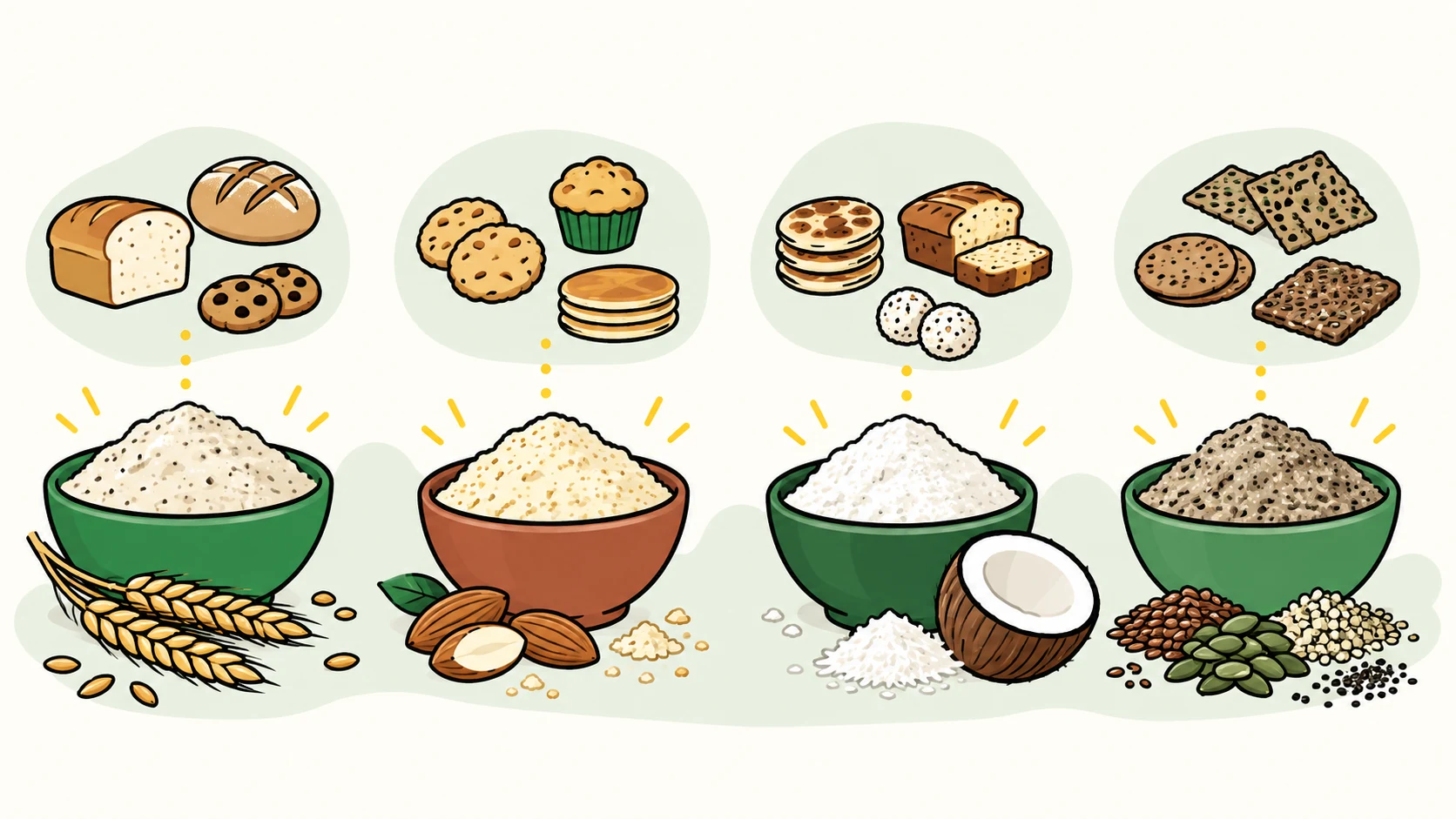
Almond flour is a common starting option, with about 3 g calculated net carbs per cited 1/4 cup (28 g) versus roughly 22 g in the cited amount of all-purpose wheat flour.1 Some formulas start with equal volume, but almond flour does not contain wheat gluten and is not a universal 1:1 replacement. Coconut, lupin, and other alternatives have different absorption, binding, and allergen profiles.
The useful choice depends on the tested recipe and the people eating it. Compare the exact product label, allergens, and role in the formula before choosing. In particular, sesame is a major food allergen in the United States, so sesame flour must not be described as allergy-safe.6
Which eight keto flour alternatives are compared?
The cited whole-food values below use a stated 1/4 cup serving where the source supports it. Packaged flours and fibers can differ by processing and brand, so use their current labels. Every ratio is a recipe-specific starting trial.
1. Almond flour
The cited blanched-almond-flour serving calculates to about 3 g net carbs per 1/4 cup (28 g: 5.6 g total carbohydrate minus 3 g fiber).1 An equal-volume amount can be an initial trial in a compatible formula, but cookies, muffins, and breads may need different binders or liquid. It has no wheat gluten, so expect a different structure.
2. Coconut flour
The cited coconut-flour serving calculates to about 8 g net carbs per 1/4 cup (28 g: 18 g total carbohydrate minus 10 g fiber).2 Coconut flour absorbs more liquid than wheat or almond flour. Many formulas use much less of it, but the flour, eggs, and liquid should come from a tested recipe rather than one universal conversion.
3. Lupin flour
Lupin flour is milled from lupini beans. Carbohydrate and protein values vary by product, so check the current label rather than relying on a universal serving estimate. Some tested bread and pizza formulas blend it with another flour; that does not establish a general replacement percentage. Lupin is a legume, so allergen considerations also matter.
4. Flaxseed meal
The cited ground-flaxseed serving calculates to about 3 g net carbs per 1/4 cup (28 g: roughly 9.6 g total carbohydrate minus 6.5 g fiber).3 It is often used as one part of a flour blend or binder. Replacement percentages and flax-and-water binder ratios remain formula-specific starting points.
5. Sesame flour
Defatted sesame flour and whole sesame seeds are different products, so the cited seed entry does not establish a universal flour value or 1:1 ratio.4 Check the current flour label and a tested formula. Sesame is a major U.S. food allergen; “nut-free” must never be read as “allergen-free” or “school-safe.”6
6. Sunflower seed flour
The cited raw sunflower-seed serving calculates to about 4 g net carbs per ounce, but a seed entry does not establish every sunflower flour's serving value or conversion.5 Check the product label and recipe. Sunflower flour can change color in some formulas with baking soda; that observation does not settle allergen or cross-contact requirements.
7. Oat fiber
Oat fiber products are milled from oat hulls, but their serving sizes and carbohydrate declarations are label-specific. It can add bulk to some flour blends, yet it is not a stand-alone flour and does not guarantee wheat-like structure or a particular glucose response. Follow a tested formula and check any gluten or cross-contact statement relevant to the eater.
8. Psyllium husk powder
Psyllium husk powder is used as a fiber-rich binder in some breads and wraps. Its label value, serving, hydration, and amount vary by product and formula. It is not a stand-alone flour, and a small amount can materially change a dough, so use the amount in a tested recipe.
Keto flour substitute comparison table
| Substitute | Carbohydrate reference | Conversion guidance | Common role |
|---|---|---|---|
| Almond flour | ~3 g per cited 1/4 cup | Recipe-specific; equal volume is only a trial | Cookies, muffins, breading |
| Coconut flour | ~8 g per cited 1/4 cup | Recipe-specific; commonly much less than wheat flour | Pancakes, dense quick breads |
| Lupin flour | Check current label | Use a tested blend | Bread and pizza formulas |
| Flaxseed meal | ~3 g per cited 1/4 cup | Use a tested blend or binder ratio | Binding and fiber |
| Sesame flour | Check current label | Use a tested formula | Crackers and flatbreads |
| Sunflower seed flour | Seed reference is ~4 g per ounce; check flour label | Use a tested formula | Seed-based baking |
| Oat fiber | Check current label | Use a tested blend | Bulk in some breads |
| Psyllium husk powder | Check current label | Use the recipe's small measured amount | Binding and structure |
| Wheat flour (baseline) | ~22 g | — | — |
How do you substitute almond flour in a recipe?
Start with a recipe written for almond flour or run a small, controlled conversion test. Equal volume, extra egg, reduced liquid, and a lower oven temperature are not universal rules. Flour grind, other ingredients, pan size, and desired texture change what the formula needs.
- Choose a compatible formula. Start with a recipe written for almond flour, or treat an equal-volume amount as a small test rather than a guaranteed conversion.
- Follow the tested binder. Use the egg, psyllium, or other binder specified by the formula; almond flour does not supply wheat gluten.
- Adjust one variable at a time. If the batter needs adjustment, change one measured variable such as liquid or binder and record it.
- Watch the recipe's doneness cues. Follow its temperature and doneness checks instead of assuming surface color proves the center is done.
- Cool as directed. Use the tested formula's cooling instructions before judging structure or slicing.
For a packaged flour, the net-carb calculator can document the deductions selected from its current label. It cannot approve a flour, set a daily target, or predict ketosis. Use the keto food list as a general comparison rather than a personalized plan.
How do keto flours compare to other keto swaps?
If a recipe also calls for breadcrumbs or a thickener, check the low-carb breadcrumb substitute guide or the low-carb cornstarch substitute guide. For other ingredient comparisons, see the full low-carb substitutes hub.
The keto macros guide explains why one flour serving cannot establish a personal carbohydrate allowance or ketone outcome.
Frequently Asked Questions
Is any flour a universal 1:1 substitute for all-purpose flour?
Can you substitute coconut flour for almond flour?
Which keto flour is best for bread?
What is the lowest-carb keto flour?
Are seed-based flours allergy-safe?
Works cited
Your learning guide