Low-Carb Rice Alternatives: 7 Options Compared
Pick the alternative that fits the dish, then check its exact food form and portion in the reference table below. The raw vegetable rows state a source cup and gram weight; that fixed mass is not a measured finished rice-style cup or a complete dish. Packaged shirataki, hearts-of-palm, and hemp products need their current label. A lower stated value does not establish a personal carb budget or predict ketosis.
For preparation, use the task matrix and manufacturer examples further down, then follow the pack or recipe you actually chose.
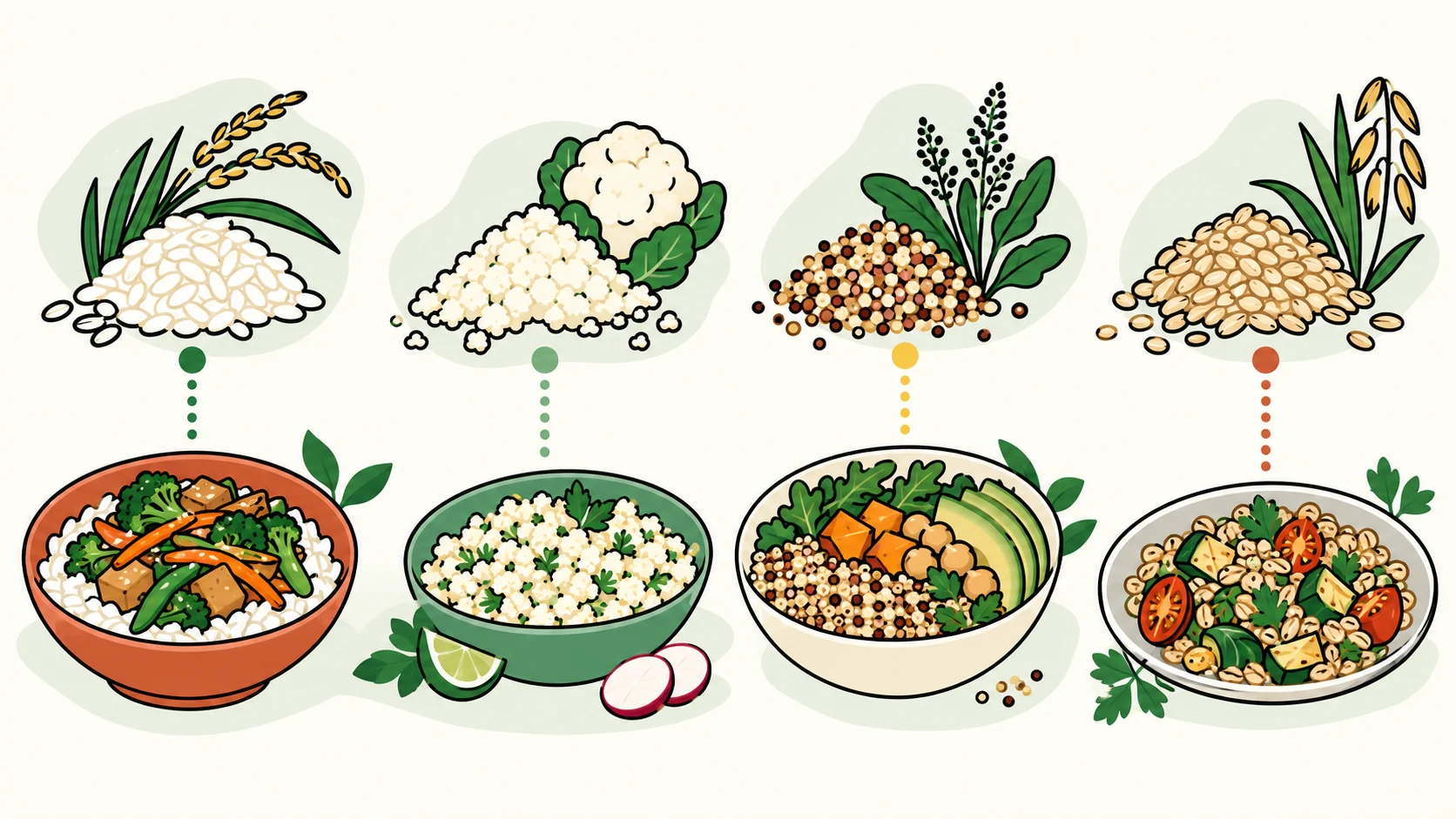
Compare label systems carefully
- US label
- Declared total carbohydrate
- EU / UK label
- Use the package in hand
Choose by cooking function
- Original role
- Texture
- Binding or thickening
- Verify in recipe
Exact ingredient references
Net carbs below are total carbohydrate minus fiber (not below zero), calculated from USDA FoodData Central records (FNDDS 2021-2023) for the stated source cup gram weight and rounded to 0.1 g.1 Each row is one fixed food form with a stated source portion. The source cup's fixed gram weight is not a measured finished rice-style cup, so when you scale, use the actual mass of the matching plain raw form, and check any cooking, added ingredients, or product form separately.
| Food form | FDC record | Source portion | Calculated net carbs |
|---|---|---|---|
| Cauliflower, raw | 2709777 | 1 cup, 110 g | 3.3 g |
| Broccoli, raw | 2709643 | 1 cup, 90 g | 3.5 g |
| Cabbage, green, raw | 2709773 | 1 cup, 90 g | 3.5 g |
| Jicama, raw | 2709787 | 1 cup, 130 g | 5.1 g |
| Rice, white, cooked, no added fat (baseline) | 2708408 | 1 cup cooked, 158 g | 43.6 g |
| Shirataki (konjac) rice | Product-specific | Current label serving | See the current label |
| Hearts-of-palm rice | Product-specific | Current label serving | See the current label |
| Hemp hearts | Product-specific | Current label serving | See the current label |
The net-carb calculator subtracts the carbohydrate and fiber figures you enter. Weighing your food does not supply those nutrient inputs, and the calculator does not look up nutrients, infer a prepared plate, or fill in missing quantities, so document the exact food, form, and amount first. The keto food list is general comparison material, not a personalized plan.
Seven rice alternatives compared
Cauliflower rice
Reference: cauliflower, raw (table above). The table gives a 110 g source cup, not a measured finished rice-style cup. Scale by the actual mass of plain raw cauliflower, and check any cooking, added ingredients, or product form separately. Cauliflower can be tested in bowls, sides, and stir-fries.
Shirataki (konjac) rice
Use the current product label and its stated serving. The label, not this page, sets the nutrients, ingredients, and directions. One manufacturer's directions are paraphrased under "What manufacturer directions say" below.
Broccoli rice
Reference: broccoli, raw (table above). The table gives a 90 g source cup. Scale by the actual mass of plain raw broccoli, and check any cooking or added ingredients separately. It can be tested in bowls, casseroles, or a measured blend with another base.
Palmini rice
Check the current hearts-of-palm product label and its serving. Formulations and serving sizes can change, so this page lists no nutrient value for it. A manufacturer recipe example appears below.
Riced cabbage
Reference: cabbage, green, raw (table above). The table gives a 90 g source cup. Scale by the actual mass of plain raw cabbage, and use the recipe's own amount and method for anything cooked or combined with other ingredients.
Jicama rice
Reference: jicama, raw (table above). Raw jicama is the cold-preparation option in the task matrix below.
Hemp heart rice blend
Use the current hemp-heart label and your measured amount. Hulled hemp hearts are seeds, not rice, and products can list different servings. A small measured amount can be tested alongside a vegetable base; the complete dish determines the nutrition.
Choose by cooking task
Start with the job the rice does in your dish, then check the package or recipe before you swap anything. The matrix below offers conditional starting points, not conversions.
| Task | Possible choice | Check first |
|---|---|---|
| Stir-fry | A riced vegetable, or a packaged rice-style product whose directions include a pan step | What the pack or recipe says to do before the base meets the sauce |
| Curry side | A base served beside or under the curry | Whether the recipe serves the curry over rice or cooks rice in it |
| Soup | A riced vegetable or packaged product added to the pot | Whether the label directions allow adding it to liquid |
| Cold bowl | Raw jicama or finely chopped raw vegetables from the guide above | Whether any packaged product's label says it is ready to eat |
| Casserole | Whatever the specific recipe's method supports | Whether the recipe calls for uncooked rice cooked in liquid |
Stir-fry and curry side
A stir-fry gives you room to choose. Prepare the base the way its own directions say, then combine it with your vegetables, protein, and sauce.
Two different methods hide inside "curry and rice." If the rice is served with the curry sauce, a riced vegetable or a packaged product prepared separately is a reasonable candidate to test. If the recipe cooks rice in the sauce or in measured liquid so the grains absorb it, a swap turns it into a different recipe, and you should not assume the substitute will behave the same way. For ordering curry away from home, see low-carb Indian restaurant orders.
Soup, cold bowl, and casserole
For soup, follow the label of any packaged product before it goes into the pot. If the label does not cover adding it to liquid, that is a limit on what this page can tell you, not a green light.
For a cold bowl, raw jicama or finely chopped raw vegetables from the guide above are options to test. A packaged rice-style product belongs in a cold bowl only if its own label confirms it is ready to eat. Otherwise follow its cooking directions.
A casserole that calls for uncooked rice plus liquid cannot assume a substitute. Read the actual recipe instructions. If the method depends on rice cooking in the dish, look for a recipe written for the base you want to use instead of guessing at changes.
For frozen products, go by the pack instructions. The fresh, frozen, and canned vegetables comparison covers how the forms differ.
What manufacturer directions say
These examples show how directions can differ between products, not what your pack says.
The Miracle Noodle Organic Rice instructions say to rinse it under cold water and drain it, then add it to a hot dry pan to cook off water before adding vegetables, protein, or sauce.2 Those directions belong to that product. Other packs follow their own.
One recipe on the Palmini site calls for draining and rinsing Palmini Rice, then adding it to a pan with garlic, onion, and olive oil.3 That is a manufacturer recipe example, not a current package label.
Two hypothetical meals
These are illustrations, not plans or nutrition targets.
A stir-fry night. Cook chopped vegetables and a protein you like, and serve them over a riced base prepared as its own pack or recipe directs. Check the label for allergens and any ingredients you avoid.
A cold lunch bowl. Combine raw jicama and chopped vegetables, washed and handled as you would any fresh produce, with a cooked, ready-to-eat protein and a dressing. Keep the bowl cold until you eat it; the low-carb packed lunches guide covers the practical steps. The keto Cobb salad is a reviewed formula for a cold, composed meal, but 247-Keto has not kitchen-tested it and promises no particular result. Leave out any packaged rice-style product unless its label says it is ready to eat.
If you want a cauliflower side that is not a rice swap, see keto cauliflower mac and cheese.
Check the method before you cook
- Read the exact pack's cooking instructions, or the chosen recipe's method.
- Note the amount and form the recipe lists: raw, frozen, riced, cooked, or packaged.
- Weigh the portion you plan to eat and document its total carbohydrate and fiber for that food, form, and amount. Then enter those figures in the net-carb calculator, which subtracts the inputs you supply; weight alone does not provide them.
- Check the ingredients and allergens on any packaged product.
This page gives no universal time, ratio, or equal-volume conversion for any alternative.
The same approach applies to low-carb pasta substitutes and low-carb potato substitutes. For the full swap directory, start at the low-carb substitutes hub. The keto macros guide explains why one serving cannot establish a personal target or ketone outcome, and the food database lists the exact food forms used above.
Frequently Asked Questions
Which rice alternative should I compare first?
Can cauliflower rice replace white rice in any recipe?
Can you use shirataki rice instead of white rice?
How many net carbs are in a cup of white rice?
Is riced broccoli lower carb than cauliflower rice?
Works cited
Article history
- Added cooking-task guidance and replaced prior rice-alternative carb figures with exact raw and cooked USDA food-form, portion, and gram-weight references.
- First published
Your learning guide