Keto dairy & alternatives: milk, cheese, yogurt, and creamers
Direct answer: dairy and dairy alternatives cannot be classified as keto-friendly by category alone. Cheese, milk, yogurt, cream, creamers, and plant-based drinks differ by food form, flavoring, portion, and recipe. Use the individual record and the label on the product you have.
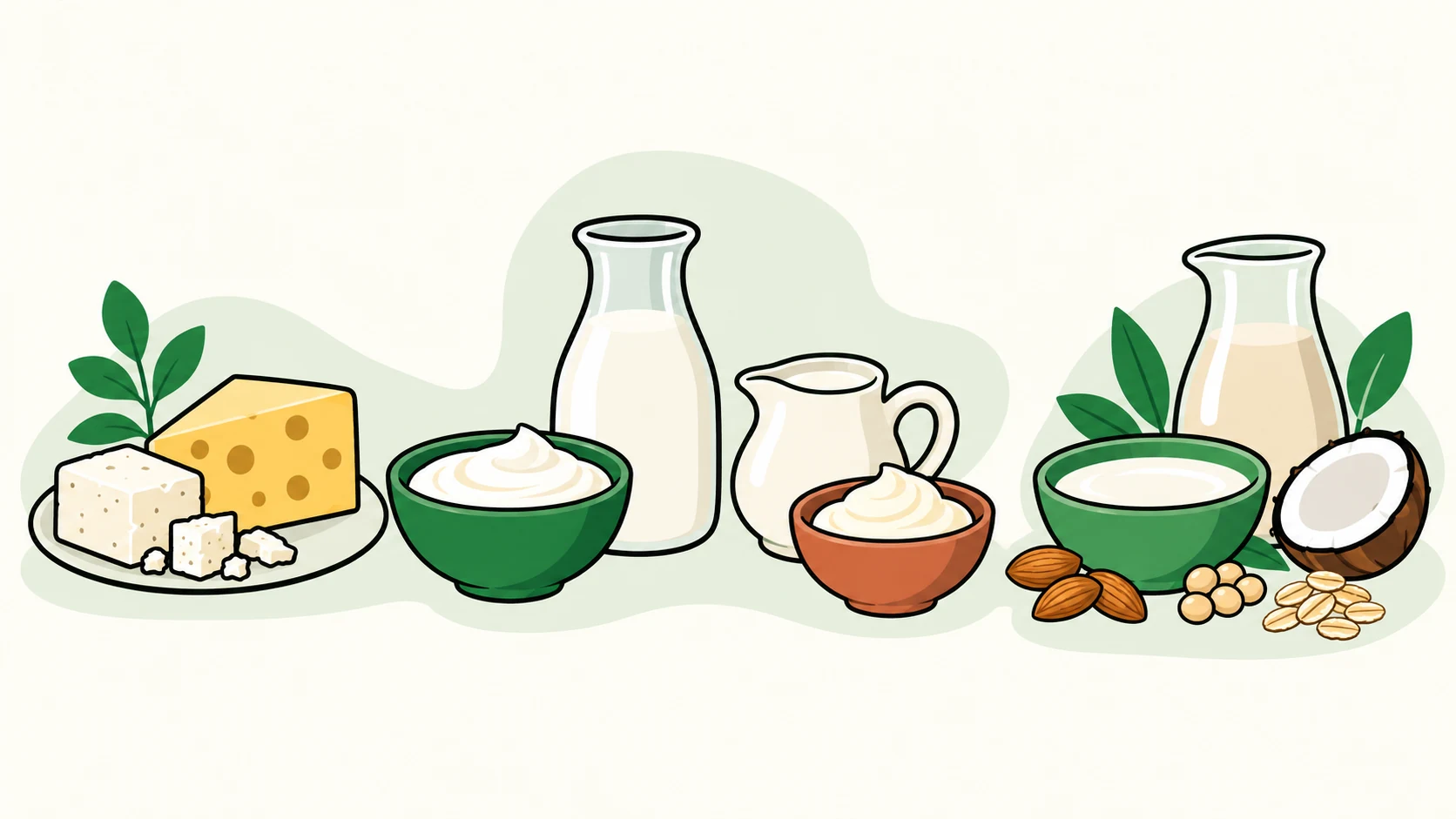
From food record to meal context
- Exact record
- Preparation
- Meal combination
- Personal context
Why “dairy” is too broad for a nutrition decision
The database separates foods that are often bundled together at the grocery store. A plain cheese, a milk beverage, a flavored yogurt, and a coffee creamer can have different source portions and carbohydrate values. An alternative milk is also not interchangeable with dairy milk simply because both are poured from a carton.
Start with the product form
Small-screen view: this comparison table scrolls sideways. Swipe or drag it horizontally to see every column.
| Product type | Records to compare | What to verify |
|---|---|---|
| Cheeses and cheese-like products | Cheese, Cheddar, cheese, Feta, cheese, Brie | The portion, added ingredients, and a product’s actual nutrition label. |
| Plain cultured dairy | Yogurt, Greek, whole milk, plain, yogurt, Greek, low-fat milk, plain, sour cream, regular | Plain versus flavored, serving size, and any mix-ins or sweeteners. |
| Milk and cream | Milk, whole, cream, heavy, cream, half and half | Pour size, lactose-containing ingredients, and whether the recipe uses more than the listed amount. |
| Dairy alternatives and coffee additions | Almond milk, unsweetened, soy milk, unsweetened, coffee creamer, liquid | Sweetening, fortification, thickeners, allergens, and the brand’s current label. |
| Flavored or dessert-style products | Chocolate milk, whole, strawberry milk, whole, yogurt, Greek, whole milk, fruit | Flavoring and added ingredients; do not substitute a plain record for a flavored one. |
Portion first, then personal context
USDA reports nutrients per 100 g. Each food page also uses the source’s household portion and gram weight to calculate a practical comparison. Those portions are not advice about how much dairy to eat, and they do not account for lactose intolerance, milk allergy, dietary preference, kidney disease, diabetes medicines, or a clinician-directed ketogenic therapy.
Calculated net carbs on this site equal total carbohydrate minus dietary fiber, capped at zero. It is a comparison convention rather than a promise about ketosis or a replacement for product labeling. See how net carbs are explained for the method and the net-carb calculator when you have a package label and an actual portion.
Continue with the right companion guide
For an editorial overview of dairy choices, read the keto dairy guide. For beverages with milk or creamer, use the keto coffee guide. To build a meal around the item rather than treat it in isolation, compare vegetables, meat, poultry & eggs, and nuts, seeds & legumes.
Complete dairy & alternative record directory
Browse all 55 selected USDA records in this dairy & alternative group
Entries are grouped by food concept, then by the exact USDA food form. Open the record that matches the preparation and product you are comparing.
Almond milk
- Almond milk, unsweetenedunsweetened
Blue or roquefort cheese
- Blue or Roquefort cheeseprepared food
Brick cheese
- Brick cheeseprepared food
Brie cheese
- Brie cheeseprepared food
Buttermilk
- Buttermilkprepared food
Camembert cheese
- Camembert cheeseprepared food
Cheddar cheese
- Cheddar cheeseprepared food
Chocolate milk
- Chocolate milk, reduced sugar, wholewhole · reduced-sugar
- Chocolate milk, wholewhole
Coconut milk
- Coconut milkprepared food
Coffee creamer
- Liquid coffee creamerliquid
- Powdered coffee creamerpowder
Colby cheese
- Colby cheeseprepared food
Cream cheese
- Cream cheese, regular, plainplain · regular
- Cream cheese, fat freefat-free
Cream half and half
- Half-and-halfwhole food
Cream heavy
- Heavy creamwhole food
Feta cheese
- Feta cheeseprepared food
Flavors other than fruit yogurt
Fontina cheese
- Fontina cheeseprepared food
Fruit yogurt
Goat cheese
- Goat cheeseprepared food
Goat milk
- Goat milkprepared food
Gouda or edam cheese
- Gouda or Edam cheeseprepared food
Greek flavors other than fruit yogurt
Greek fruit yogurt
Greek yogurt
- Greek yogurt, low fat milk, plainlow-fat · plain
- Greek yogurt, nonfat milk, plainnonfat · plain
- Greek yogurt, whole milk, plainwhole · plain
Gruyere cheese
- Gruyere cheeseprepared food
Imitation cheese
- Imitation cheeseimitation
Limburger cheese
- Limburger cheeseprepared food
Milk
- Milk, dry, reconstituted, wholewhole · dry · reconstituted
- Lactose-free milk, wholewhole · lactose-free
- Milk, evaporated, wholewhole · evaporated
- Skim milkfat-free
- Whole milkwhole
Monterey cheese
- Monterey cheeseprepared food
Muenster cheese
- Muenster cheeseprepared food
Provolone cheese
- Provolone cheeseprepared food
Queso asadero
- Queso Asaderoprepared food
Queso cotija
- Cotija cheeseprepared food
Queso fresco
- Queso Frescoprepared food
Rice milk
- Rice milkprepared food
Sour cream
- Sour cream, regularregular
- Sour cream, fat freefat-free
- Sour cream, imitationimitation
Soy milk
- Soy milk, unsweetenedunsweetened
Strawberry milk
Swiss cheese
- Swiss cheeseprepared food
Whipped topping
- Whipped toppingprepared food
- Whipped topping, fat freefat-free
Yogurt
- Yogurt, low fat milk, plainlow-fat · plain
- Yogurt, nonfat milk, plainnonfat · plain
- Yogurt, whole milk, plainwhole · plain
Source and method
This hub groups records selected from USDA FoodData Central’s Survey (FNDDS) release. Every linked page identifies the source food and portion, preserves the record’s preparation description, and provides the FoodData Central ID. Because branded and restaurant products can change, the database does not claim to represent every item marketed under a familiar dairy name.
Article history
- Updated food-category guidance after final factual and editorial review
- First published
Your learning guide